ABRASIVES GUIDE

Glass Bead Blasting for Stainless Steel: When to Use It

For food and pharmaceutical fabricators, achieving a clean, uniform finish on stainless steel without introducing the risk of corrosion is a critical production...

Published
03 Jan 2018
Category
Abrasives
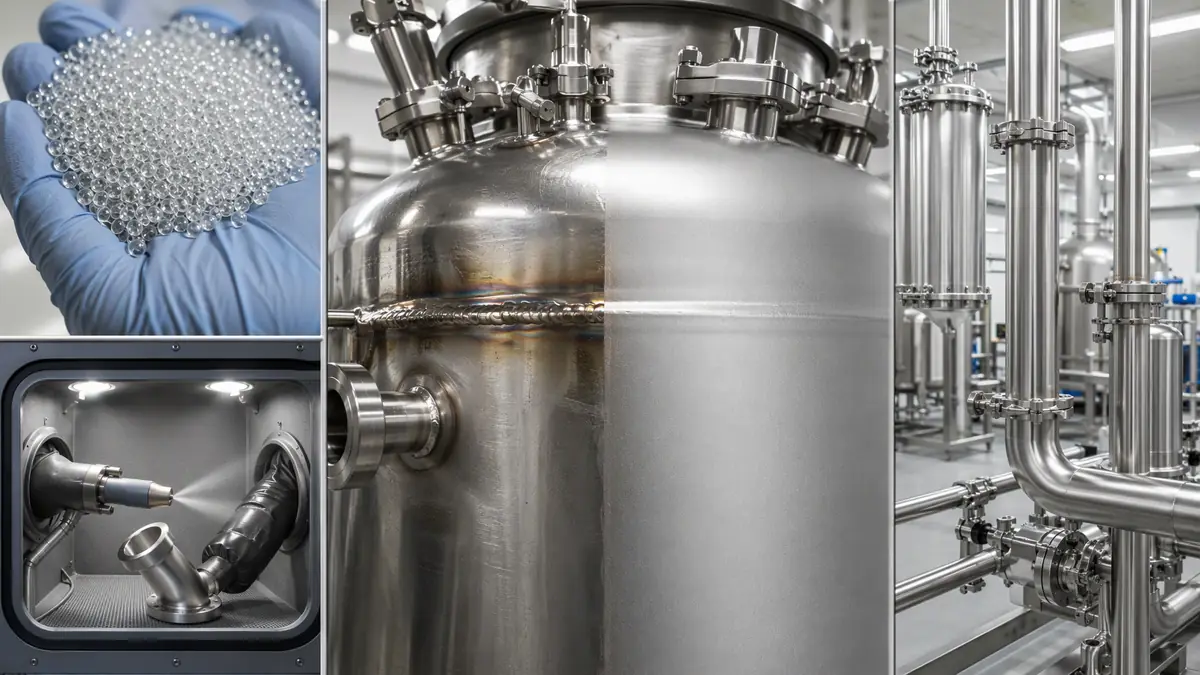
Multi-panel industrial collage showing glass bead blasting process on stainless steel, from media to finished satin surface i
FIG. 01A contamination-safe glass bead blasting w...

Featured editorial image for an article on glass bead blasting for stainless steel. A multi-section collage visually explains the non-ferrous finishing process, showing the raw glass bead media, the blasting operation inside a cabinet, the satin finish transition on a vessel, and the final applicati

Introduction

For food and pharmaceutical fabricators, achieving a clean, uniform finish on stainless steel without introducing the risk of corrosion is a critical production challenge. Glass bead blasting offers a contamination-safe method to create a consistent…

Introduction

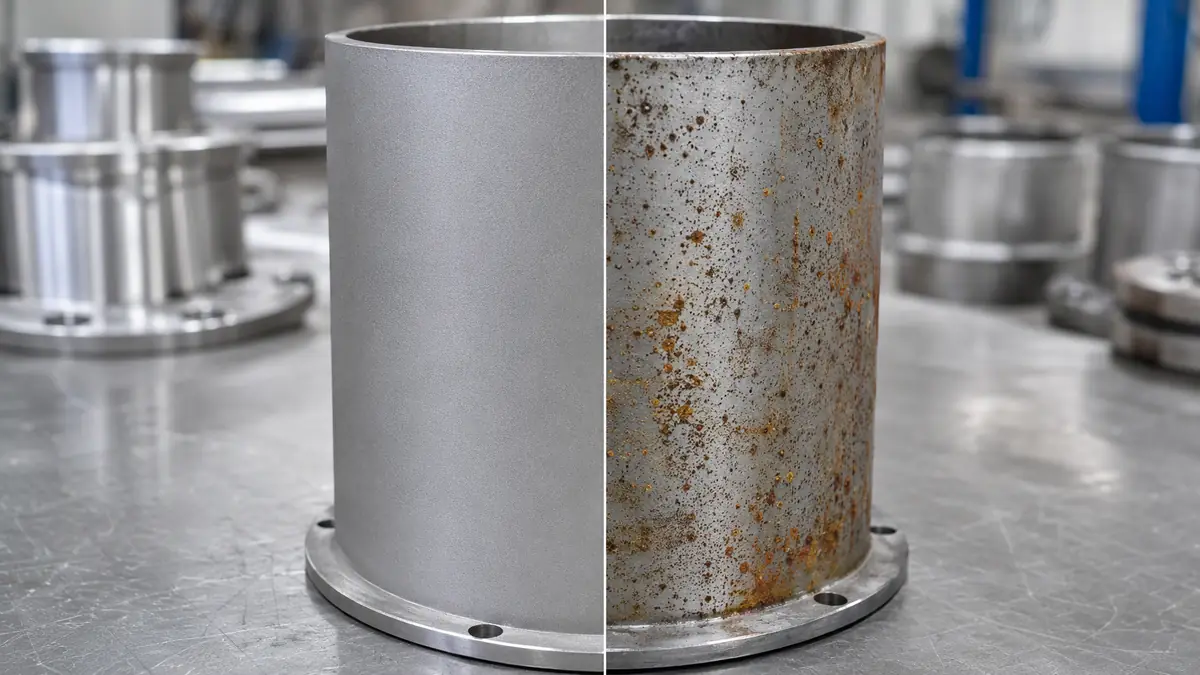
Split-view comparison of a clean glass bead blasted stainless steel satin finish versus a rusted, iron-contaminated stainless
The critical difference: a uniform, contamination-free satin finish from glass bead blasting (left) versus pitting and rust caused by iron contamination from fe

An image illustrating the introduction of the article. A side-by-side comparison emphasizes the risk of iron contamination on stainless steel, showing a clean satin finish achieved with non-ferrous glass beads next to a corroded, pitted surface damaged by ferrous media.

Split-view comparison of a clean glass bead blasted stainless steel satin finish versus a rusted, iron-contaminated stainless

Stainless steel derives its corrosion resistance from a passive chromium oxide layer on the surface. Any process that embeds free iron into this layer—a common risk with steel shot or grit blasting—can initiate pitting, rust staining, and ultimately component failure. For industries governed by strict hygiene and material integrity standards, such as food processing equipment, pharmaceutical vessels, and sanitary piping, this risk is unacceptable.

Glass bead blasting provides a practical solution. By using chemically inert, non-ferrous spherical media, fabricators can clean, deburr, and produce a uniform satin finish without contaminating the substrate. This article examines when glass bead blasting is the right choice for stainless steel, how to select appropriate media, what can go wrong, and how to evaluate the results—giving engineers and procurement managers the criteria needed to make an informed decision.

What Is Glass Bead Blasting?

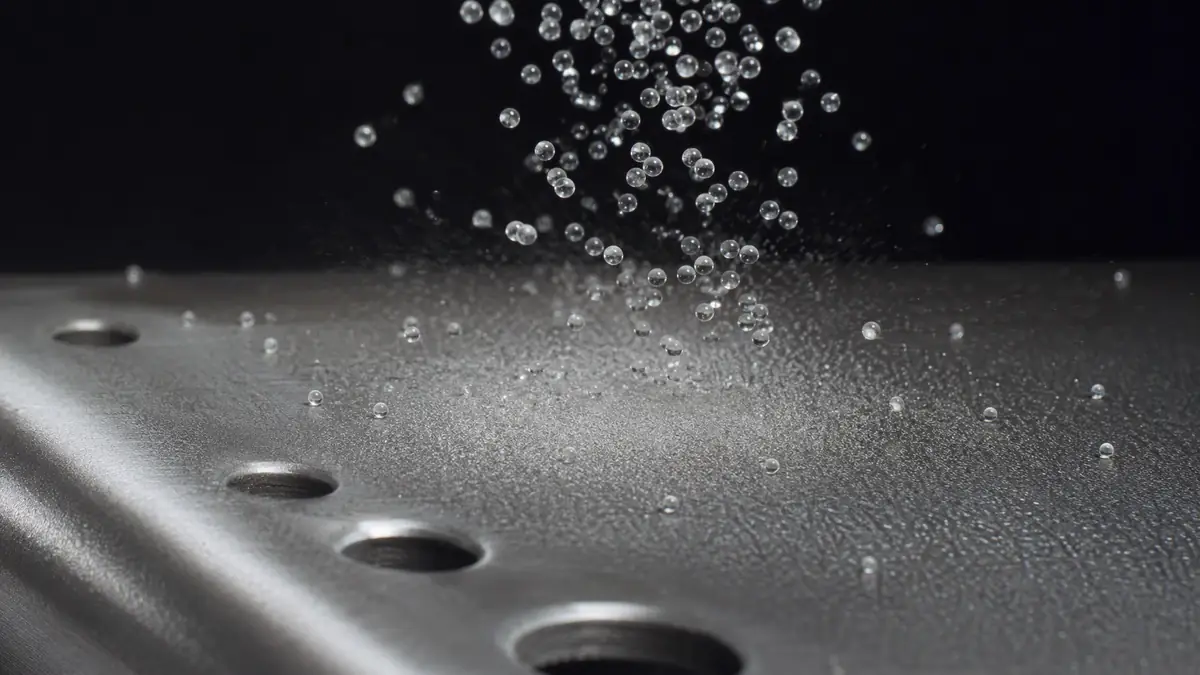
Macro shot of spherical glass beads impacting a stainless steel surface, creating a uniform satin peened finish.
Spherical soda-lime glass beads peening a stainless steel surface, creating a smooth, matte finish through controlled plastic deformation without cutting or fra

A detailed macro view illustrating the glass bead blasting process. Inert, spherical glass beads are shown impacting a stainless steel substrate, demonstrating the non-cutting peening action that produces a clean, uniform satin finish without embedding ferrous contaminants.

Macro shot of spherical glass beads impacting a stainless steel surface, creating a uniform satin peened finish.

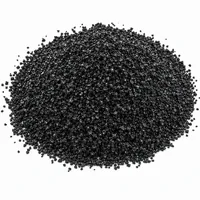
Glass bead blasting is a surface finishing process in which spherical particles of soda-lime glass are propelled against a workpiece using compressed air. Unlike angular abrasives that cut or fracture the surface, glass beads peen the surface—producing a smooth, matte, or satin appearance through controlled plastic deformation of the metal's outermost layer.

The media itself is chemically inert, lead-free, and contains no ferrous components. This makes it fundamentally different from steel grit, steel shot, or copper slag, all of which can leave metallic residues embedded in the stainless steel surface. For applications where contamination control is paramount, this distinction is decisive.

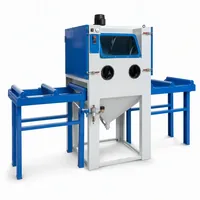
The process is typically performed in a dry blasting cabinet or a walk-in blast room at moderate pressures—generally between 40 and 80 PSI—depending on the desired finish and the condition of the substrate.

Why Contamination Control Matters for Stainless Steel

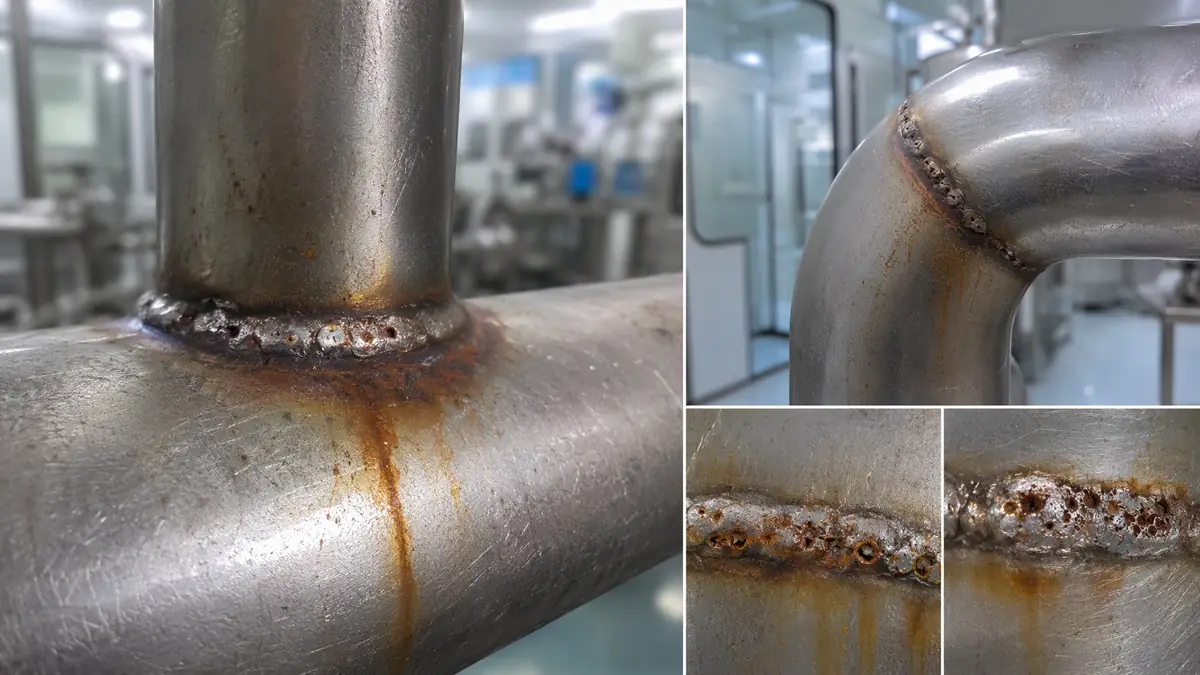
Close-up of a rusted and pitted sanitary stainless steel weld due to iron contamination.
A critical failure: rust staining and pitting corrosion on a sanitary stainless steel weld caused by embedded ferrous particles, a major risk in food and pharma

An image depicting the consequences of poor contamination control. A close-up of a stainless steel pipe weld in a cleanroom setting shows clear signs of rust and pitting, visually explaining the risk of bacterial growth and component rejection due to iron contamination from improper blasting media.

Close-up of a rusted and pitted sanitary stainless steel weld due to iron contamination.

The primary threat when blasting stainless steel is iron contamination. This occurs when ferrous particles from the blasting media, the equipment itself, or previously blasted carbon steel components become embedded in the stainless surface. Once embedded, these particles oxidize and form rust, which compromises the passive layer and can lead to:

  • Localized pitting corrosion
  • Rust staining on what should be a clean surface
  • Failure of sanitary welds and crevices to resist bacterial growth
  • Rejection of components during quality inspection or customer acceptance

In food and pharmaceutical environments, these failures carry additional consequences: product contamination, cleaning validation failures, and regulatory non-compliance. Glass bead blasting eliminates the source of iron contamination at the media level, provided that the blasting equipment itself is also free of cross-contamination from previous ferrous media use.

When to Use Glass Bead Blasting on Stainless Steel

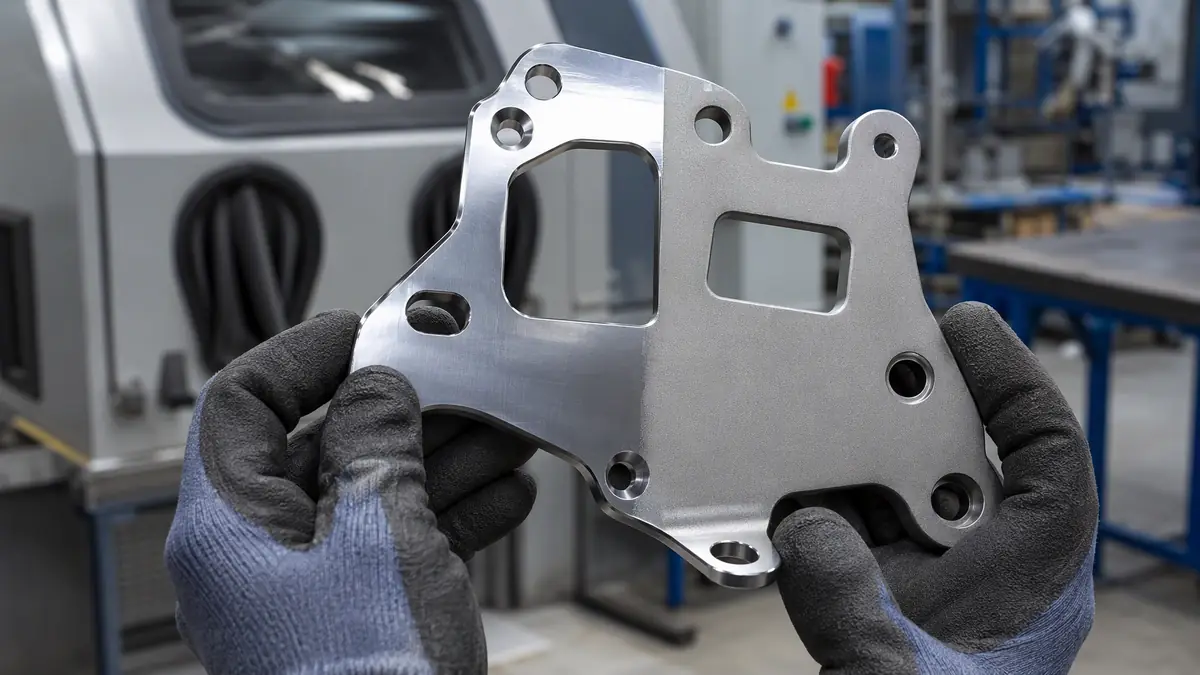
Stainless steel bracket half-finished, showing sharp machined edges versus a smooth, deburred satin finish from glass bead bl
An ideal application: glass bead blasting effectively removes light burrs and blends edges on a laser-cut stainless steel part, creating a uniform satin finish

An image showing a suitable application for glass bead blasting. A stainless steel component is half-finished to demonstrate the process's effectiveness in deburring and edge blending, transforming sharp machined edges into a smooth, uniform, and aesthetically pleasing satin finish.

Stainless steel bracket half-finished, showing sharp machined edges versus a smooth, deburred satin finish from glass bead bl

Glass bead blasting is not a universal solution. It excels in specific applications and is a poor fit for others. Understanding the distinction helps prevent costly misapplication.

Suitable Applications

Producing a uniform satin or matte finish. Glass beads create a consistent, low-reflectivity surface that is aesthetically pleasing and practical for equipment housings, control panels, and architectural stainless components.

Deburring and edge blending. The peening action of spherical beads is effective at removing light burrs from machined or laser-cut stainless parts without altering critical dimensions.

Cleaning without material removal. For removing light surface oxidation, shop dirt, or heat tint from welding, glass beads clean effectively while preserving the base metal. Unlike aluminum oxide or garnet, beads do not cut into the substrate.

Pre-coating preparation where a fine anchor profile is acceptable. While glass beads do not produce the sharp angular profile that some coatings require, they can provide a suitable surface for certain thin-film coatings and passivation treatments. Confirm against the specific coating specification.

Sanitary equipment finishing. Tanks, vessels, piping, and fittings destined for food contact or pharmaceutical use benefit from the contamination-free nature of the process.

When Glass Bead Blasting Is a Poor Fit

Heavy rust or mill scale removal. Glass beads lack the cutting aggression needed for thick oxide layers. Angular abrasives such as aluminum oxide or garnet are more appropriate—but carry their own contamination risks and require thorough post-blast cleaning and passivation.

Creating a deep anchor profile for thick coatings. If the coating specification requires a surface profile depth of 75 microns or more, glass beads will typically not achieve this. Angular media or specialized grit is necessary.

Decorative etching or frosting. While glass beads produce a satin finish, they are not designed for the deep, consistent etching required for architectural frosting or decorative patterns. This is a different application with different media requirements.

High-volume production with rapid material removal. Glass beads are a relatively gentle media. For aggressive stock removal, other processes are faster and more cost-effective.

Types of Glass Bead Media and Selection Factors

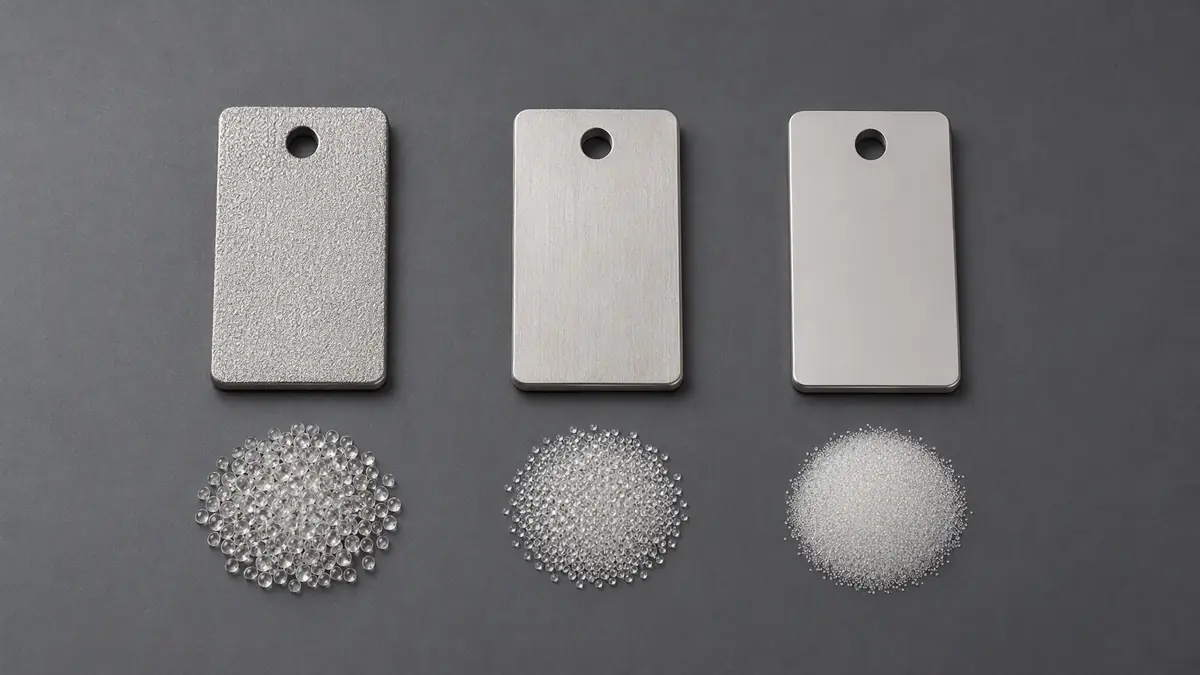
Three stainless steel coupons with coarse, medium, and fine satin finishes next to corresponding piles of glass bead media.
Media selection is key: coarse beads produce a heavier texture, medium beads a uniform satin finish, and fine beads a smooth, cosmetic surface on stainless stee

A comparative flat lay illustrating how glass bead media size affects the final surface finish on stainless steel. Three sample coupons display progressively finer satin textures, from coarse to fine, each paired with its respective mesh size of soda-lime glass beads.

Three stainless steel coupons with coarse, medium, and fine satin finishes next to corresponding piles of glass bead media.

Glass bead media is categorized primarily by particle size (mesh range) and, to a lesser extent, by grade or quality. Selecting the correct specification directly affects finish quality, cycle time, and media consumption.

Particle Size and Finish

Mesh Size RangeTypical Surface FinishCommon Applications
Coarse (e.g., 40–60 mesh)Heavier matte, more textureDeburring, heavy cleaning, pre-coating prep
Medium (e.g., 60–100 mesh)Uniform satin, moderate textureGeneral finishing, weld blending, sanitary equipment
Fine (e.g., 100–170 mesh)Smooth satin, low textureCosmetic finishing, precision components
Extra fine (170–325 mesh)Near-polished matteDelicate parts, minimal dimensional change

Finer beads produce a smoother, more reflective satin finish. Coarser beads work faster but leave a more pronounced texture. The choice depends on the balance between productivity and surface finish requirements.

Media Quality

Not all glass beads perform identically. Higher-quality media contains fewer irregular particles and less dust, leading to more consistent results and longer media life. Lower-grade beads may contain sharp fragments that produce an inconsistent finish and generate excessive dust, reducing visibility and increasing cleanup.

When specifying glass beads, consider:
- Roundness and sphericity of the particles
- Freedom from contaminants and foreign matter
- Sieve analysis confirming the particle size distribution
- Manufacturer's stated reusability cycles

Common Mistakes and How to Avoid Them

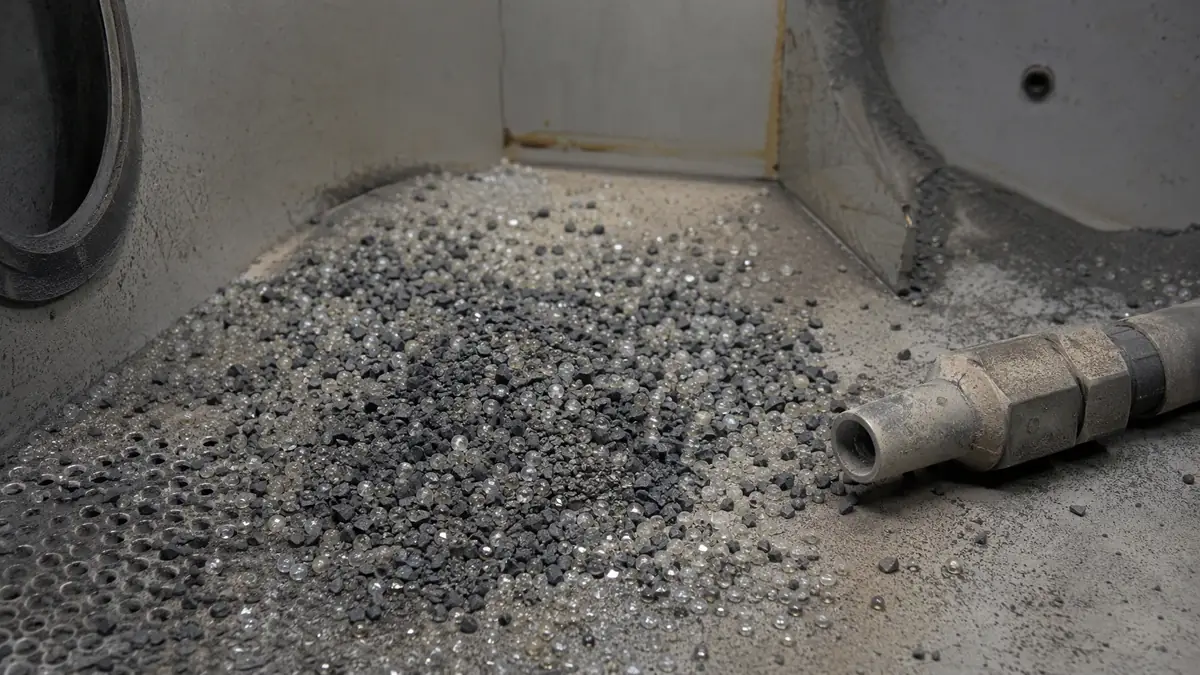
Contaminated blasting media mix of glass beads and angular steel grit on a dirty cabinet floor, showing cross-contamination r
A critical mistake: mixing ferrous steel grit with glass bead media in a blasting cabinet guarantees iron contamination on stainless steel workpieces.

An image highlighting a common and serious mistake in glass bead blasting. A view inside a poorly maintained blast cabinet reveals a contaminated mix of spherical glass beads and angular steel grit, visually explaining the primary cause of iron contamination and the need for dedicated equipment.

Contaminated blasting media mix of glass beads and angular steel grit on a dirty cabinet floor, showing cross-contamination r

1. Cross-Contamination from Equipment

The most serious mistake is using the same blasting cabinet or blast pot for both ferrous media and glass beads without thorough cleaning. Even residual steel grit in a hose or dust collector can contaminate stainless workpieces.

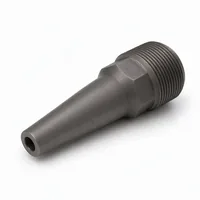
Prevention: Dedicate a blasting cabinet exclusively to non-ferrous media for stainless work. If this is not practical, implement a rigorous cleaning protocol between media changes, including purging hoses, cleaning the dust collector, and replacing worn nozzle components that may harbor embedded ferrous particles.

2. Excessive Blast Pressure

Operating at pressures above the recommended range—typically over 80 PSI for glass beads—accelerates media breakdown and can embed bead fragments into the stainless surface. This creates a rougher-than-intended finish and increases media consumption without proportional productivity gains.

Prevention: Start at lower pressure (40–50 PSI) and increase only if necessary. Monitor surface finish regularly and adjust pressure downward if the finish becomes inconsistent.

3. Using Worn or Contaminated Media

Glass beads fracture with repeated use. As the proportion of broken, angular particles increases, the finish shifts from a uniform satin to a more aggressive, inconsistent texture. Dust generation also rises, obscuring the workpiece and potentially clogging the dust collection system.

Prevention: Establish a media replacement schedule based on cycle count or visual inspection. Sieve media periodically if reclamation equipment is used. Replace media when finish consistency degrades or dust levels become problematic.

4. Neglecting Post-Blast Cleaning and Passivation

Even with contamination-free media, stainless steel benefits from post-blast passivation to restore the chromium oxide layer fully. Residues from the blasting process, including fine glass dust, should be removed before the component enters service.

Prevention: Follow blasting with a thorough cleaning—typically a detergent wash, rinse, and drying cycle. For critical sanitary applications, specify a nitric acid or citric acid passivation treatment per ASTM A967 or equivalent standard to ensure maximum corrosion resistance.

Evaluating the Finished Surface

A successful glass bead blast finish on stainless steel should exhibit:

  • Uniform appearance: No blotchy areas, streaks, or patches of different texture.
  • Consistent low-reflectivity satin sheen: The surface should not appear polished or glossy, nor should it show deep, irregular pitting.
  • Absence of rust staining: Any orange or brown discoloration after exposure to ambient air indicates iron contamination and requires investigation.
  • Smooth tactile feel: The surface should feel smooth and uniform to the touch, without sharp peaks or embedded particles.

For critical applications, surface roughness measurements using a profilometer can quantify the finish. Typical Ra values for glass bead blasted stainless range from approximately 0.5 to 2.0 microns, depending on bead size and process parameters. Confirm the acceptable range against the component specification or customer requirement.

Alternatives Worth Considering

Glass bead blasting is one of several non-ferrous finishing options for stainless steel. Depending on the application, alternatives may offer advantages:

  • Ceramic beads: Harder and more durable than glass, ceramic beads last longer and can produce a similar finish. They are more expensive initially but may reduce media consumption costs in high-volume operations.
  • Stainless steel shot: For peening applications where compressive stress is desired, stainless shot eliminates the iron contamination risk while providing a metallic peening action. This is a specialized process distinct from cosmetic finishing.
  • Aluminum oxide with passivation: Where a more aggressive profile is needed, aluminum oxide can be used followed by thorough cleaning and passivation. This adds process steps but may be necessary for certain coating specifications.
  • Electropolishing: For the highest level of surface smoothness and corrosion resistance, electropolishing is an alternative to mechanical finishing—though it is a chemical process with different equipment requirements and cost structure.

Conclusion

Glass bead blasting is a proven, contamination-safe method for finishing stainless steel when the application demands a uniform satin appearance without the risk of iron-induced corrosion. It is particularly well-suited to food and pharmaceutical equipment where surface integrity directly affects product safety and regulatory compliance.

The process succeeds when the right media is matched to the right application, when equipment is kept free of cross-contamination, and when post-blast cleaning and passivation are treated as essential steps rather than optional extras. Conversely, it is the wrong choice for heavy material removal, deep anchor profiles, or applications requiring a sharp angular surface.

For fabricators and procurement teams evaluating finishing options, the decision should be guided by the specific surface finish requirement, the contamination risk tolerance of the end-use environment, and the total process cost—including media consumption, equipment dedication, and post-blast treatment.

Frequently Asked Questions

How do I know if glass bead blasting is right for my stainless steel part?

It is the right choice when you need a uniform satin finish, light deburring, or contamination-free cleaning without removing base metal. It excels for food, pharma, and sanitary equipment where iron contamination is unacceptable. It is a poor fit for heavy rust removal, creating deep anchor profiles for thick coatings, or decorative etching.

What mesh size of glass bead should I select for a sanitary satin finish?

A medium mesh size, typically in the 60–100 range, is the standard choice for a uniform satin finish on sanitary equipment and general weld blending. Finer meshes (100–170) produce a smoother, lower-texture cosmetic finish, while coarser beads (40–60) work faster but leave a heavier matte texture.

How can I prevent iron contamination when blasting stainless steel?

The most critical step is to use a dedicated blasting cabinet exclusively for non-ferrous media on stainless work. If that's not possible, you must implement a rigorous cleaning protocol between media changes, including purging all hoses, cleaning the dust collector, and replacing nozzle components that may hold ferrous particles.

What blast pressure should I use for glass beads on stainless steel?

Start at a lower pressure between 40 and 50 PSI and only increase if necessary to achieve the desired finish. Operating above 80 PSI accelerates media breakdown, can embed fragments into the surface, and creates a rougher finish without proportional gains in speed.

Why is my glass bead finish inconsistent or blotchy?

This is often caused by using worn-out media where a high proportion of beads have fractured into angular particles. It can also result from excessive blast pressure or an inconsistent distance and angle of the nozzle. Replacing the media and verifying your pressure settings should resolve the issue.

Is passivation required after glass bead blasting stainless steel?

Yes, for critical applications, post-blast passivation is strongly recommended. Even with contamination-free media, passivation fully restores the protective chromium oxide layer. A nitric or citric acid treatment per ASTM A967 ensures maximum corrosion resistance after the surface has been thoroughly cleaned of all blasting residue.

Can I use the same blasting cabinet for steel grit and glass beads?

You should not, as this is the most common cause of iron contamination on stainless steel. Residual steel grit in the cabinet, hoses, or dust collector will embed in the stainless surface and cause rust. A dedicated cabinet is the only reliable way to prevent this cross-contamination.

What is the next step after deciding to use glass bead blasting?

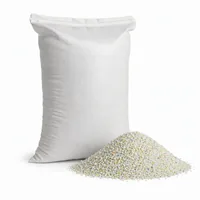
The next step is to specify the correct media size and quality for your finish requirements and then source a reliable supply. You can compare relevant abrasive products and their specifications on our platform and submit an enquiry to check availability and get a quote for your project.

Solution

Selecting the correct glass bead media and compatible blasting equipment is essential for repeatable, contamination-free results. Explore the range of abrasives available on SPA2Z, compare specifications, and enquire about compatibility with your existing blasting setup. For technical guidance on media selection or to request a quotation, contact the SPA2Z sales team with your application requirements.

Get a quote

Get a quote

Tell us what you need. We reply within one business day.

Sending…
Need a price? Ask us here.