Free Silica Content in Abrasive Products: What Buyers Must Check
For EHS officers and industrial buyers, the single most important document when evaluating blast media is not the technical data sheet—it is the Safety Data She...
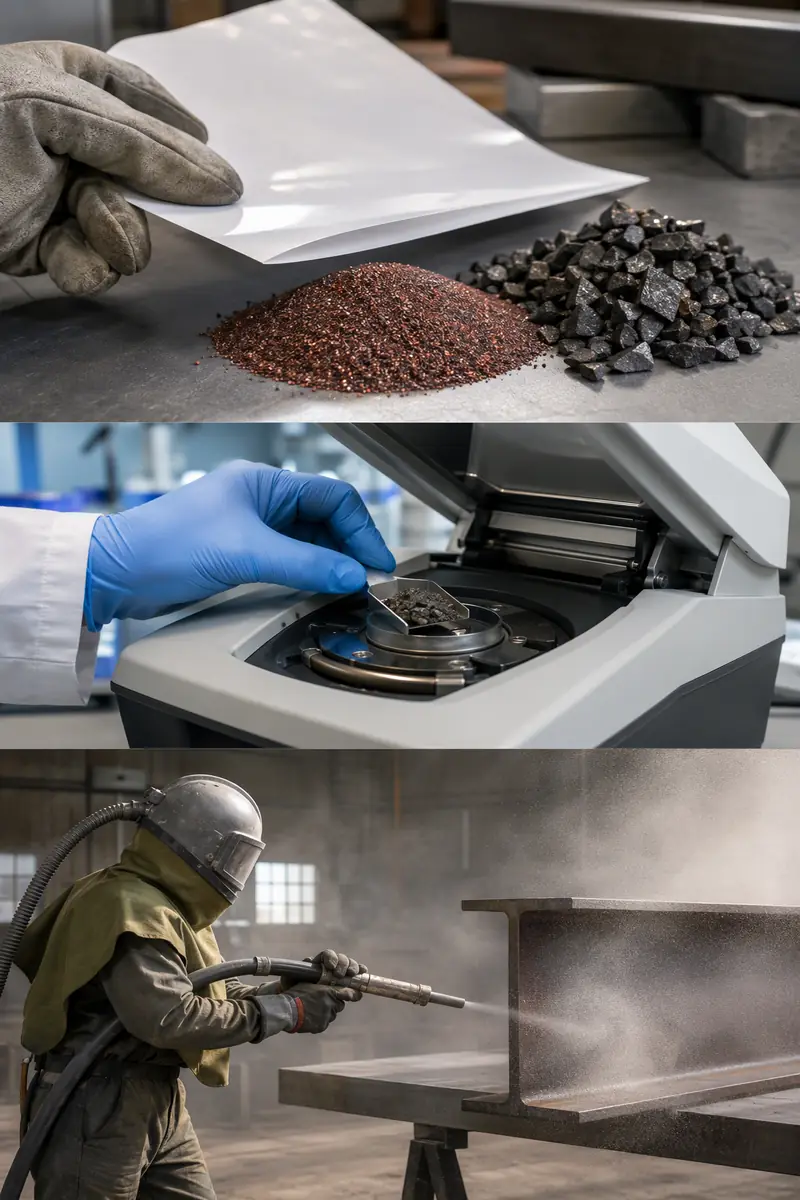
A multi-panel photorealistic industrial collage for an article on free silica in abrasives. The central panel features an SDS document next to garnet and slag samples. Supporting panels show a lab XRD analysis, a worker in full PPE blasting a steel beam, and a visual comparison of silica sand, slag,
01 Introduction
For EHS officers and industrial buyers, the single most important document when evaluating blast media is not the technical data sheet—it is the Safety Data Sheet (SDS). The SDS reveals the free silica content that directly determines your respirato…
02 Introduction
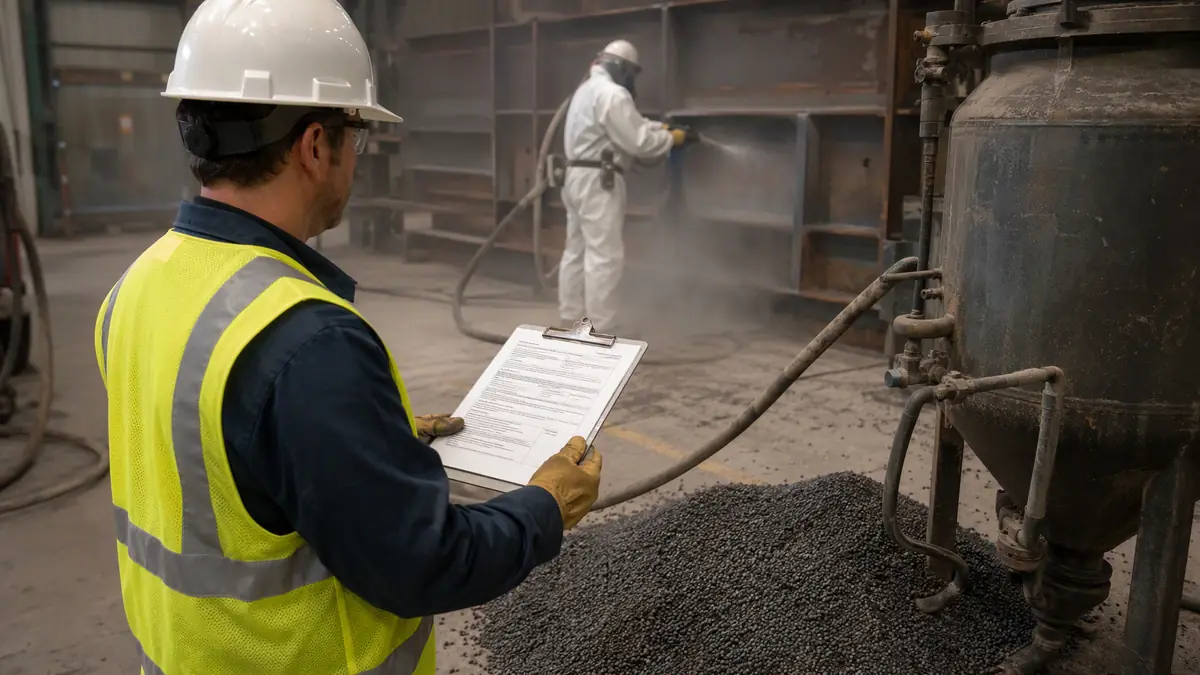
For EHS officers, the SDS is the foundational document for assessing worker exposure risk in abrasive blasting operations.
An EHS officer stands in a fabrication shop reviewing a Safety Data Sheet. In the background, an abrasive blaster in full PPE works on a steel structure, generating a controlled dust cloud. The image contrasts documentation with real-world hazardous conditions.
If your facility uses abrasive blasting for surface preparation, the media you select does more than determine your profile depth and production rate—it defines your worker exposure risk. Crystalline silica, when fractured into respirable dust during blasting, presents one of the most serious occupational health hazards in industrial operations. For EHS officers, procurement managers, and safety-conscious buyers, understanding free silica content in abrasives is not optional; it is the foundation of a defensible exposure control plan.
This article explains what free silica means in the context of blast media, why it matters for occupational health, how to read an SDS to identify silica content, and what practical steps you can take to select lower-risk abrasive products without compromising surface preparation quality.
03 What Is Free Silica in Abrasives?
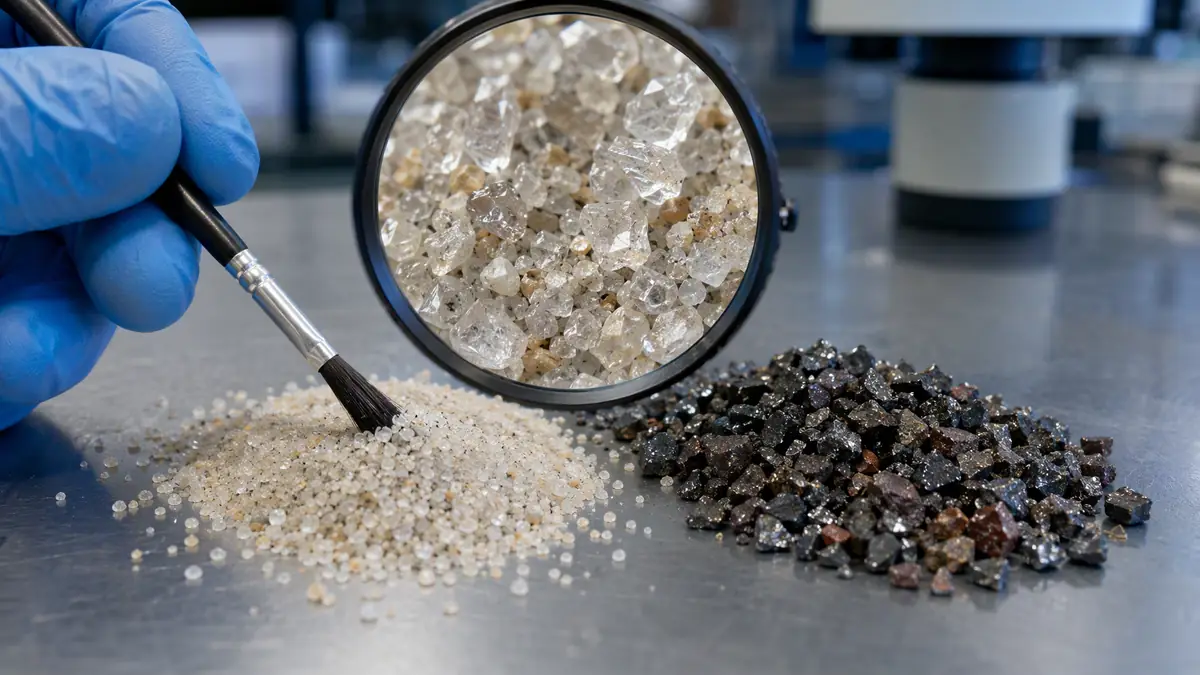
Free silica refers to respirable crystalline quartz, distinct from chemically bound silica in slag abrasives.
A macro photograph showing a lab technician using a brush and magnifying lens to examine a pile of light beige silica sand next to a pile of dark copper slag, illustrating the physical difference between free silica and bound silica abrasives.
Free silica refers to crystalline silicon dioxide (SiO₂) that exists in an uncombined, respirable form—most commonly as quartz, cristobalite, or tridymite. In abrasive blasting, the term matters because it distinguishes crystalline silica that can become airborne and inhaled from silica that is chemically bound within other minerals and not readily liberated as respirable dust.
When mineral abrasives are mined, crushed, and graded, their free silica content depends on the geological source. Some deposits naturally contain high percentages of free quartz; others are predominantly composed of other minerals where silica is locked in a non-hazardous silicate structure.
Key distinction: Not all silica is free silica. Many abrasive minerals contain silicon and oxygen as part of complex silicate compounds (such as garnet or olivine), but these do not generate respirable crystalline silica dust during blasting. The hazard is specific to crystalline silica that is free to become airborne.
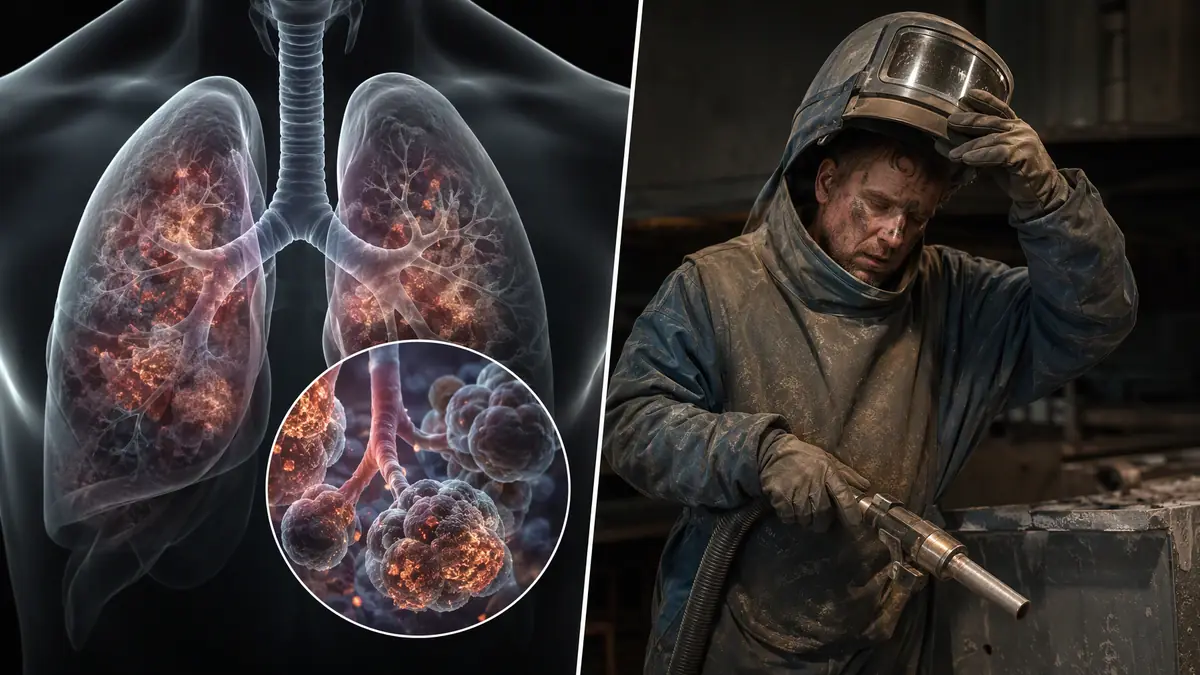
A split-scene image. The left shows a translucent lung diagram with respirable crystalline silica particles embedding in the tissue. The right shows a fatigued abrasive blaster in a dusty environment lifting their helmet visor, emphasizing the severe occupational health risks.
Respirable crystalline silica (RCS) particles are small enough to bypass the upper airway defenses and lodge deep in the lung tissue. Chronic inhalation causes silicosis—a progressive, irreversible, and potentially fatal fibrotic lung disease. The International Agency for Research on Cancer (IARC) classifies crystalline silica as a Group 1 carcinogen. Beyond silicosis, exposure increases the risk of lung cancer, chronic obstructive pulmonary disease (COPD), and kidney disease.
For the EHS officer or buyer, the practical implications are immediate:
Regulatory compliance: Many jurisdictions enforce strict occupational exposure limits for respirable crystalline silica. A commonly referenced benchmark is 0.05 mg/m³ as an 8-hour time-weighted average (TWA) , though the exact limit and its legal enforceability vary by country and regulation. Always verify against your local regulatory framework—this figure serves as a typical industrial hygiene reference point, not a universal standard.
Control costs: Higher free silica content demands more stringent (and expensive) engineering controls, containment, respiratory protection, and medical surveillance.
Waste disposal: Spent abrasive containing high crystalline silica may be classified differently for disposal, adding cost and administrative burden.
Worker confidence: Visible commitment to low-silica media supports your safety culture and simplifies workforce communication about exposure risks.
05 How Free Silica Enters Blast Media
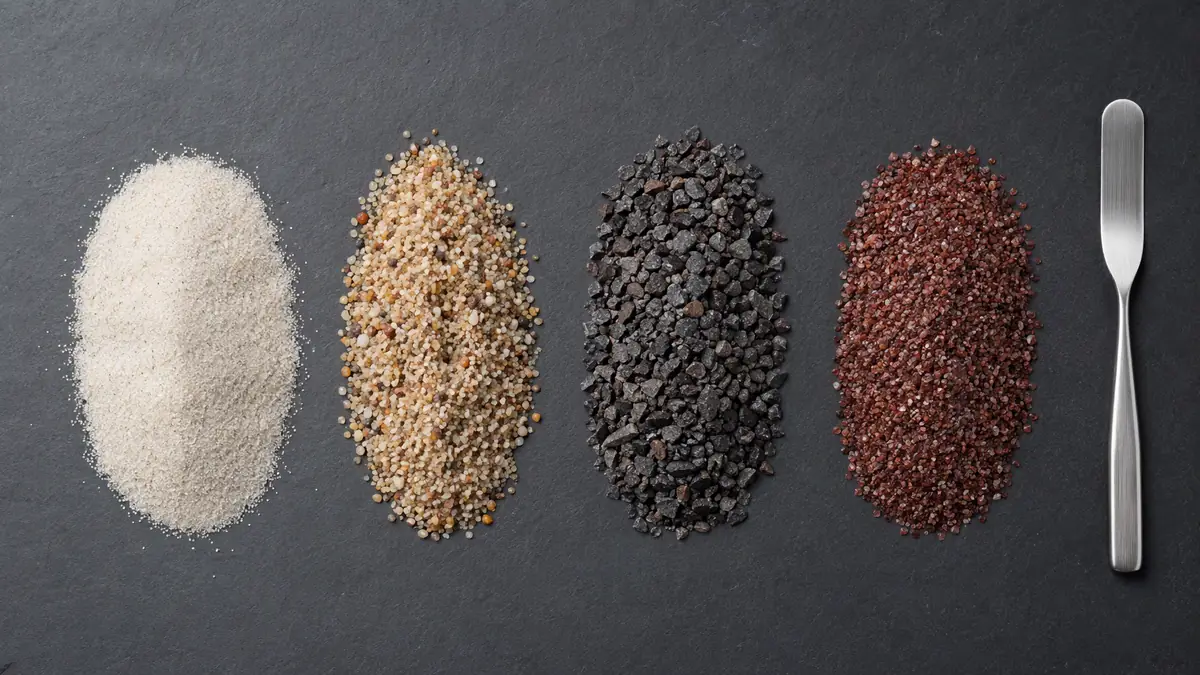
Free silica content varies dramatically by source: silica sand, river sand, slag, and garnet have distinct mineralogical profiles.
A clinical flat-lay photograph showing four piles of abrasive blast media: silica sand, river sand, copper slag, and garnet. A lab spatula rests beside the garnet, highlighting the visual and textural differences that indicate varying free silica content.
Understanding how silica ends up in your abrasive helps you ask better questions of suppliers:
Source
Typical Free Silica Range
Notes
Silica sand
80–99%
Historically common; now banned or heavily restricted in most industrial blasting applications due to extreme health risk
River sand / beach sand
Variable, often 20–60%
Uncontrolled mineral composition; not suitable for industrial blasting without full characterization
Copper slag / coal slag
<1–5% (typical)
Byproduct abrasives; silica content depends on source ore and smelting process—always verify per batch via SDS
Garnet
<0.5–1% (typical)
Naturally low free silica; primarily almandine garnet with silica bound in silicate structure
Aluminum oxide
<0.1% (typical)
Synthetic or fused mineral; essentially free of crystalline silica
Steel grit / shot
0%
Metallic abrasive; no silica hazard
Crushed glass
<0.1% (typical)
Amorphous (non-crystalline) silica; does not present the same respiratory hazard as crystalline forms
Staurolite / olivine
<1–5% (typical)
Naturally low free silica; confirm by deposit source
Note: Ranges above are approximate and based on typical industry data. Individual products vary by mine source, manufacturing process, and supplier quality control. Always consult the product-specific SDS.
06 How to Read an SDS for Free Silica Content
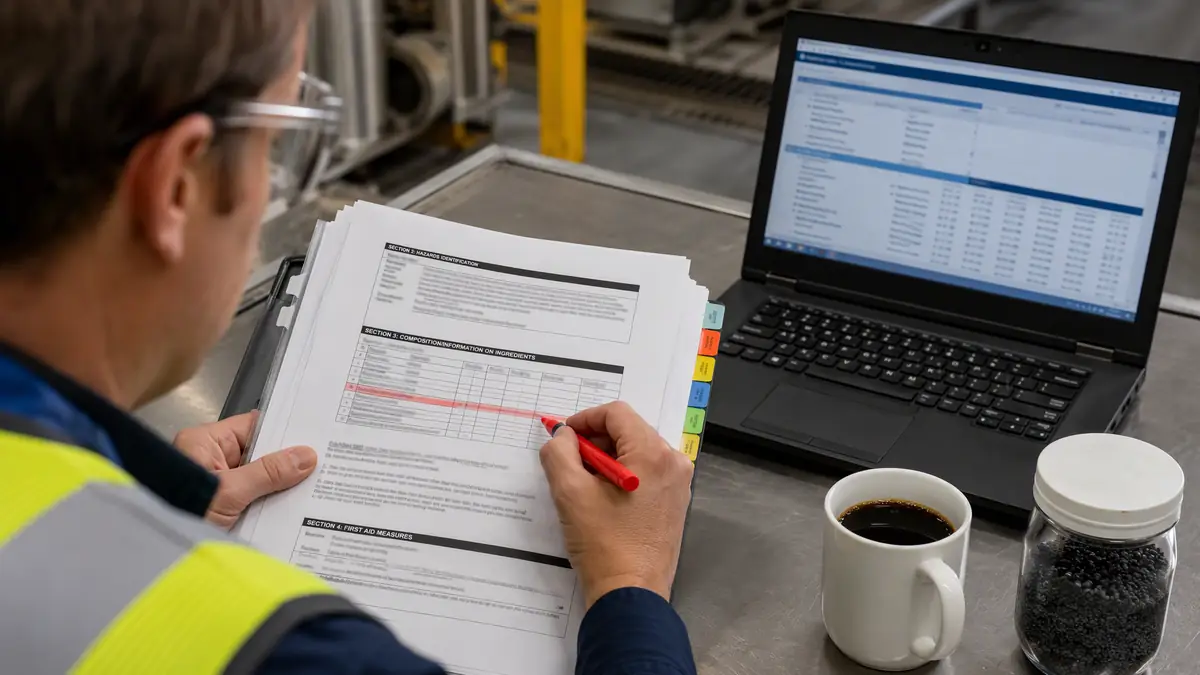
Section 3 of the SDS is the critical area to verify crystalline silica, quartz, or respirable silica fractions.
An over-the-shoulder view of an EHS officer using a highlighter to mark the ingredients section of an SDS document. A laptop and a sample jar of abrasive media are on the desk, illustrating the verification process for free silica content.
The SDS is your primary verification tool. Do not rely on marketing claims, product names, or verbal assurances. Here is what to check, section by section:
Section 2: Hazard Identification
Look for hazard statements related to crystalline silica. Signal words such as "Danger" or "Warning" combined with phrases like "May cause cancer by inhalation" or "Causes damage to lungs through prolonged or repeated exposure" indicate the presence of reportable crystalline silica content.
Section 3: Composition / Information on Ingredients
This is the critical section. Search for entries such as:
- Quartz (SiO₂)
- Crystalline silica
- Silica, crystalline (respirable fraction)
- CAS number 14808-60-7 (quartz)
The percentage or range listed here is your direct indicator of free silica content. A well-prepared SDS will distinguish between total silica and the respirable fraction. If the section lists only "silicon dioxide" without specifying crystalline form, request clarification from the supplier—amorphous silica (such as in glass or diatomaceous earth processed above 800°C) does not carry the same hazard classification.
Section 8: Exposure Controls / Personal Protection
This section should reference occupational exposure limits for respirable crystalline silica and recommend appropriate respiratory protection. The recommended assigned protection factor (APF) and respirator type give you a practical sense of the hazard level the supplier anticipates.
Section 11: Toxicological Information
Look for references to silicosis, IARC Group 1 classification, and known target organs (lungs, respiratory system). This section confirms the supplier's awareness of the chronic health effects.
Red flags in an SDS:
- Section 3 lists no crystalline silica but the product is a natural mineral abrasive—question whether the analysis was performed
- Percentages are listed as "proprietary" or "trade secret" for mineral components—this is uncommon for standard abrasives and warrants supplier follow-up
- The SDS is dated more than three years old or references outdated exposure limits
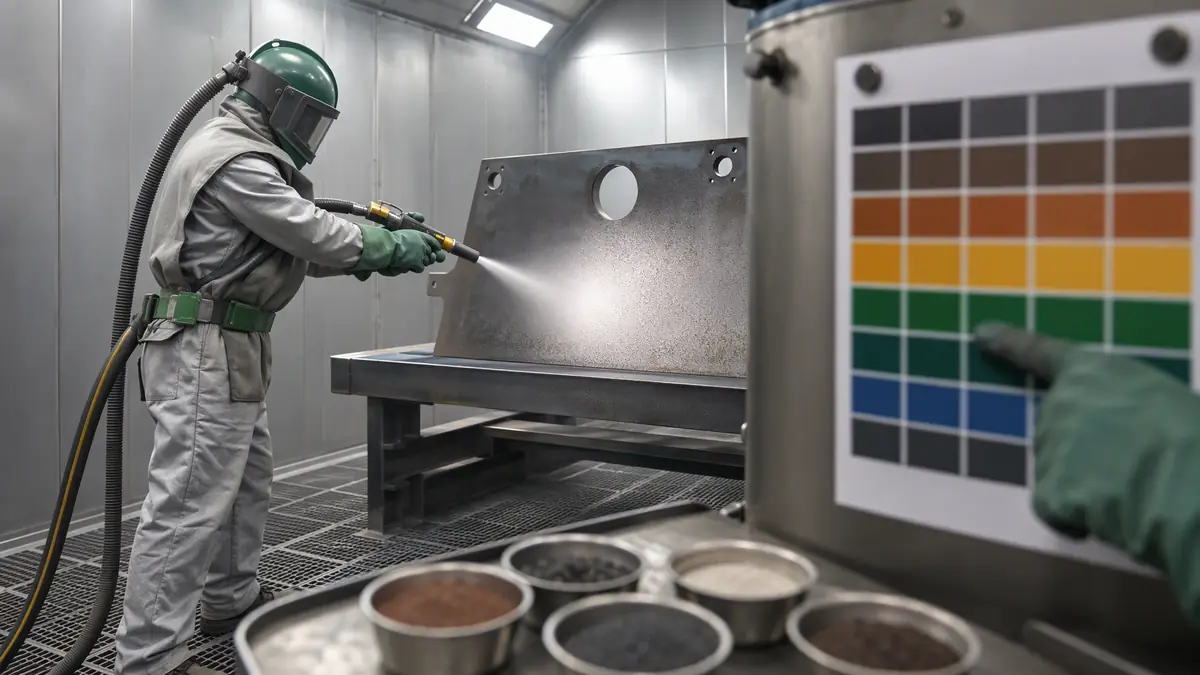
Low-silica alternatives like garnet deliver high performance and a consistent profile with significantly reduced dust.
A worker in a blast room uses a garnet abrasive nozzle on a steel surface, producing a clean impact pattern. A color-coded selection chart on a nearby blast pot is pointed to by a gloved hand, representing the decision framework for choosing lower-silica media.
Reducing free silica exposure does not mean sacrificing blasting performance. The decision framework below helps you evaluate alternatives:
1. Match the Abrasive to the Specification
Start with your surface preparation requirement (SA 2.5, SSPC-SP10, NACE No. 2, etc.) and required profile depth. Many low-silica abrasives meet or exceed the performance of higher-silica alternatives:
- Garnet delivers consistent profile, low dust, and excellent recyclability for high-specification coating work
- Aluminum oxide provides aggressive cutting with extremely low silica content, suitable for hard substrates and reuse in blast rooms
- Steel grit offers zero silica risk and high recyclability for steel preparation in contained environments
2. Evaluate Total Cost, Not Just Media Price
A lower purchase price per ton can be deceptive. Include:
- Respiratory protection program costs (fit testing, cartridges, medical clearance)
- Engineering control requirements (containment, ventilation, dust collection)
- Spent media disposal classification and cost
- Worker downtime for hygiene and decontamination procedures
- Potential regulatory penalties or enforcement actions
3. Request Batch-Specific SDS Documentation
Natural mineral abrasives vary by deposit and processing. A supplier should provide an SDS specific to the product lot or at minimum the current production specification. Generic or multi-product SDS documents are insufficient for your exposure assessment.
4. Verify Through Independent Analysis
For high-volume or high-risk applications, consider sending a representative sample to an accredited laboratory for crystalline silica analysis by X-ray diffraction (XRD). This provides an independent check against supplier claims and strengthens your industrial hygiene documentation.
08 Common Mistakes When Evaluating Silica Content
Mistake 1: Assuming "sand" in the product name means silica sand
Some products marketed as "sand" (such as garnet sand or crushed glass sand) contain negligible free silica. The product name is not a reliable indicator—check the SDS.
Mistake 2: Confusing total silica with free silica
An abrasive may contain 40% silicon dioxide by total composition but have less than 1% in crystalline, respirable form. The mineralogical form matters more than the elemental analysis.
Mistake 3: Overlooking slag variability
Copper slag and coal slag are byproducts of industrial processes. The feedstock ore, smelting conditions, and cooling rate all influence the final crystalline silica content. One supplier's slag may consistently test below 1%, while another's may exceed 5%. Do not generalize across slag products.
Mistake 4: Treating the SDS as a one-time check
Mineral sources change. A supplier may switch mine locations or processing methods without notifying buyers. Make SDS review part of your incoming material verification process, not just the initial qualification.
Mistake 5: Neglecting the combined exposure profile
Even a low-silica abrasive can generate hazardous dust if the substrate coating contains crystalline silica (common in foundry sand residues or certain paints). Evaluate the total exposure scenario, not just the abrasive in isolation.
09 Implementation Notes for EHS Officers
When integrating free silica evaluation into your procurement and safety management system:
Establish a written specification for maximum acceptable free silica content in purchased abrasives, based on your exposure control capabilities and regulatory obligations
Include SDS review as a gate in your purchase order approval workflow—no abrasive enters the facility without documented silica content
Maintain a register of approved abrasives with current SDS documents, accessible to both procurement and operational teams
Train buyers and receiving personnel to recognize when an incoming product does not match the approved SDS and to quarantine material pending verification
Document your selection rationale: If a higher-silica abrasive is used for a specific application (because no lower-silica alternative meets the technical requirement), record the justification and the additional control measures implemented
These steps apply to any industrial facility using abrasive blasting. The specific exposure limits, regulatory requirements, and control technologies appropriate to your site must be confirmed against your local jurisdiction and process conditions.
10 Conclusion
Free silica content in abrasive products is not a secondary specification—it is a primary determinant of worker health risk and regulatory compliance. For EHS officers and industrial buyers, the path to defensible decisions runs through the SDS: verify the crystalline silica percentage in Section 3, confirm the hazard classification in Section 2, and check the exposure controls in Section 8. Low-silica alternatives such as garnet, aluminum oxide, steel grit, and crushed glass are widely available and capable of meeting demanding surface preparation standards without the same respiratory hazard profile.
The most effective silica control is substitution—removing the hazard at the source before it enters your facility. By making free silica content a non-negotiable evaluation criterion in your abrasive procurement process, you protect your workforce and strengthen your compliance position from the point of purchase.
Next step: Apply this SDS-checking framework to your current abrasive shortlist. Review the Section 3 composition data for each product you purchase or are considering. If you need help verifying silica content in specific abrasive products or want to explore lower-silica media options that match your surface preparation requirements, contact SPA2Z for technical specification support and current SDS documentation.
11 Frequently Asked Questions
What exactly is 'free silica' and how is it different from regular silica?
Free silica refers to crystalline silicon dioxide (like quartz) that is uncombined and can become respirable dust when fractured during blasting. This is distinct from silica that is chemically bound within complex silicate minerals, such as in garnet or olivine, which does not generate the same hazardous respirable crystalline dust. The key hazard is specific to the crystalline form that is free to become airborne.
How can I verify the free silica content in an abrasive product?
You must review the product's Safety Data Sheet (SDS), specifically Section 3 (Composition/Information on Ingredients). Look for entries like 'Quartz (SiO₂)', 'Crystalline silica', or CAS number 14808-60-7. Do not rely on marketing names; the percentage listed in this section is your direct indicator. If the information is vague or listed as proprietary, request clarification from the supplier.
What are the main health risks of using abrasives with high free silica?
The primary risk is inhaling respirable crystalline silica (RCS) dust, which can cause silicosis, an irreversible and potentially fatal lung disease. Long-term exposure also increases the risk of lung cancer, chronic obstructive pulmonary disease (COPD), and kidney damage. This is why selecting lower-silica media is a critical part of an exposure control plan.
Which abrasive media have the lowest free silica content?
Steel grit and shot contain 0% free silica and are the safest from a respiratory silica perspective. Synthetic media like aluminum oxide and crushed glass (amorphous silica) typically contain less than 0.1%. Naturally low-silica minerals include garnet, which usually has less than 1% free silica, making them excellent choices for high-performance, lower-risk blasting.
Is 'crushed glass' a safe alternative to silica sand regarding silicosis risk?
Yes, crushed glass is a much safer alternative. It is made from amorphous (non-crystalline) silica, which does not cause silicosis in the same way crystalline silica does. However, you should still check the SDS to confirm it is 100% amorphous glass and implement standard dust controls, as any respirable dust can be an irritant.
What are the red flags on an SDS that indicate a potential silica problem?
Key red flags include an SDS for a natural mineral abrasive that lists no crystalline silica at all, which may indicate testing was not performed. Also, be wary of percentages listed as 'proprietary' or 'trade secret,' and check the document date—an SDS more than three years old may reference outdated exposure limits or product specifications.
Does a lower-silica abrasive cost more overall?
Not necessarily when you calculate total operational cost. While the purchase price per ton might be higher for media like garnet or aluminum oxide, you often save on engineering controls, more expensive respiratory protection programs, waste disposal fees for hazardous material, and potential regulatory penalties. A lower-silica abrasive can be more cost-effective when these factors are included.
What is the first step I should take to switch to a lower-silica blasting media?
Start by matching your surface preparation specification and required profile depth to the performance data of low-silica alternatives like garnet or aluminum oxide. Then, request a batch-specific SDS from the supplier for the product you intend to use and compare its stated free silica content. You can then run a controlled test to confirm it meets your production and safety requirements before full adoption.
12 Solution
Use the guidance to shortlist Abrasives, then open related product pages or contact SPA2Z for confirmation
13 Get a quote
Get a quote
Tell us what you need. We reply within one business day.