How to Match Nozzle Pressure to Abrasive Mesh Size
Getting the pressure right for your abrasive mesh size determines whether your blast operation runs efficiently or wastes media and time. This guide explains ho...
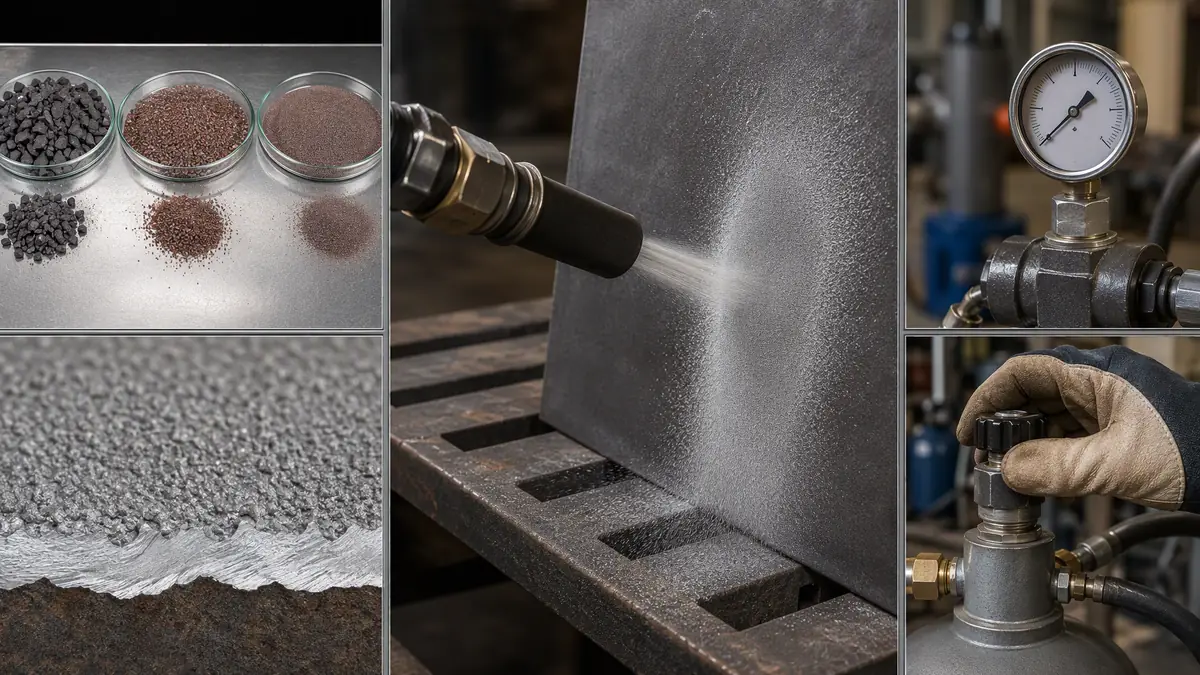
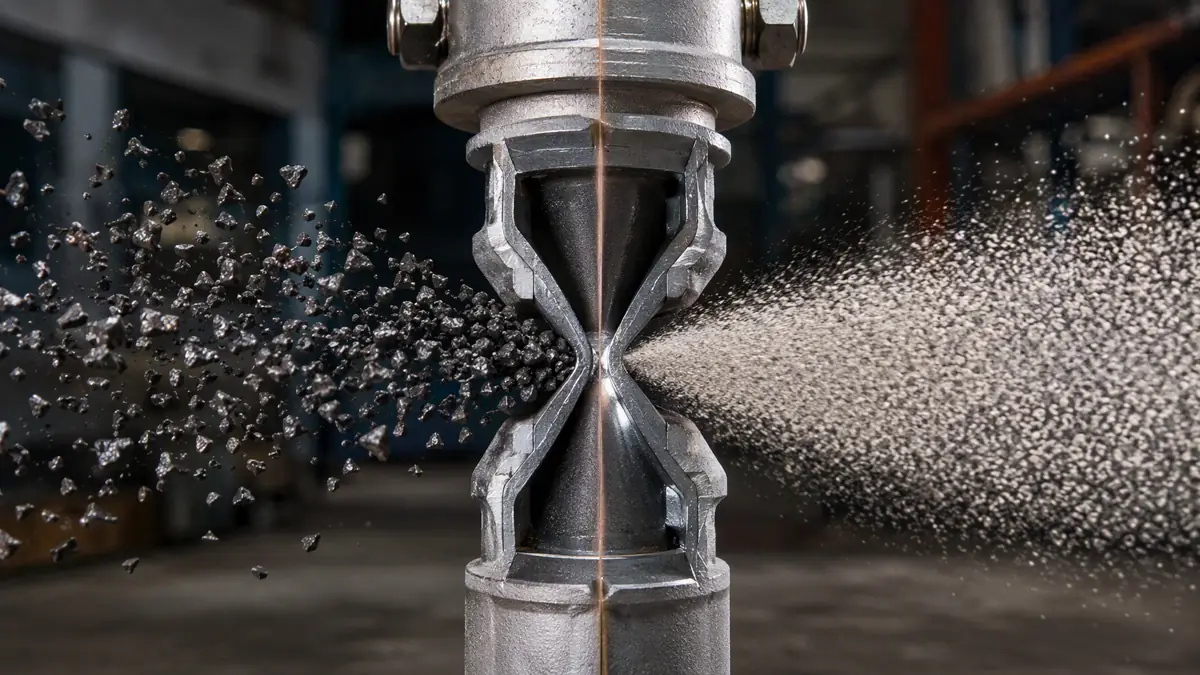
Professional industrial editorial image featuring a multi-section collage about matching sandblasting nozzle pressure to abrasive mesh size. Dominant panel shows a venturi blast nozzle in operation. Supporting panels display abrasive mesh size comparison samples, a needle pressure gauge measurement,
01 Introduction
Getting the pressure right for your abrasive mesh size determines whether your blast operation runs efficiently or wastes media and time. This guide explains how nozzle pressure, abrasive particle size, and air volume work together so you can set up…
02 Introduction
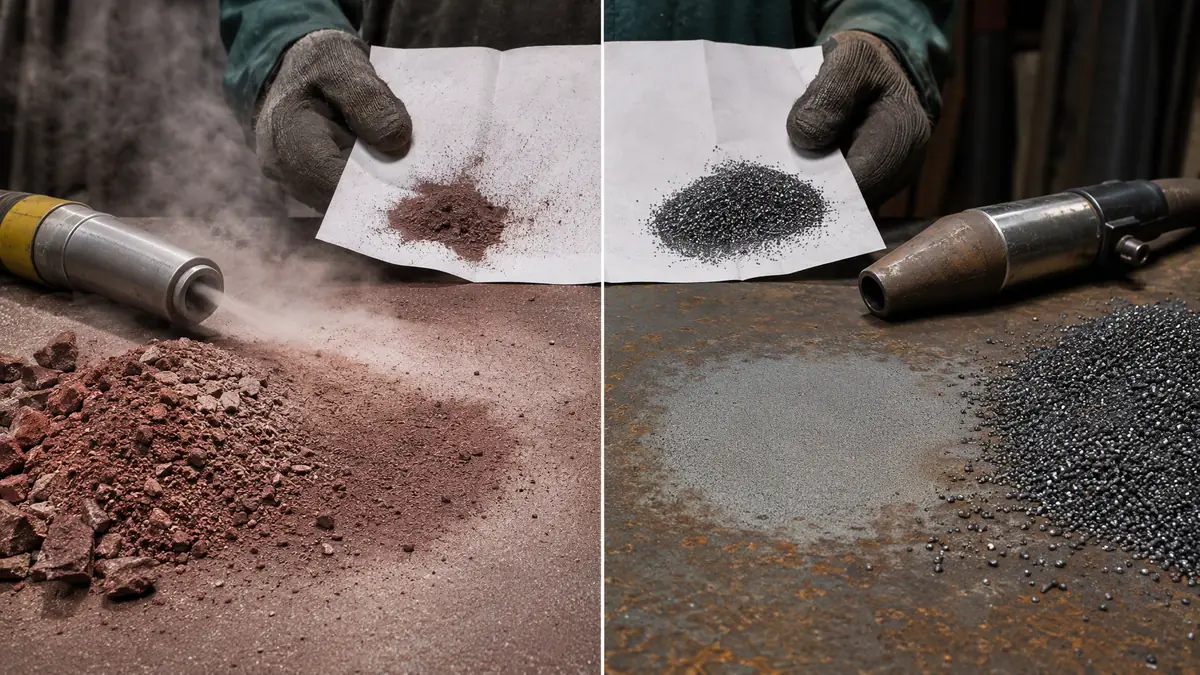
Two common outcomes of pressure-mesh mismatch: shattered fine media creating dust and coarse media failing to clean the surface.
Industrial workshop scene showing a split comparison of incorrect sandblasting setups. Left side displays shattered fine garnet abrasive with excessive dust. Right side shows coarse steel grit producing inadequate surface cleaning on a rusty steel plate. A gloved operator holds abrasive specificatio
A blast operator who runs fine garnet at the same pressure as coarse steel grit will see two very different outcomes: one media shatters on impact, the other barely cleans the surface. The relationship between nozzle pressure and abrasive mesh size is not a fixed number — it is a balancing act between particle mass, velocity, and the air volume available to carry the media through the nozzle.
This article is written for operators, maintenance teams, and supervisors who need practical, actionable knowledge to stop wasting abrasive, reduce nozzle wear, and hit their surface preparation targets. By the end, you will understand how to pair pressure settings with mesh size, recognize when your setup is mismatched, and know what to check before adjusting your blast parameters.
03 What Is Nozzle Pressure in Abrasive Blasting?
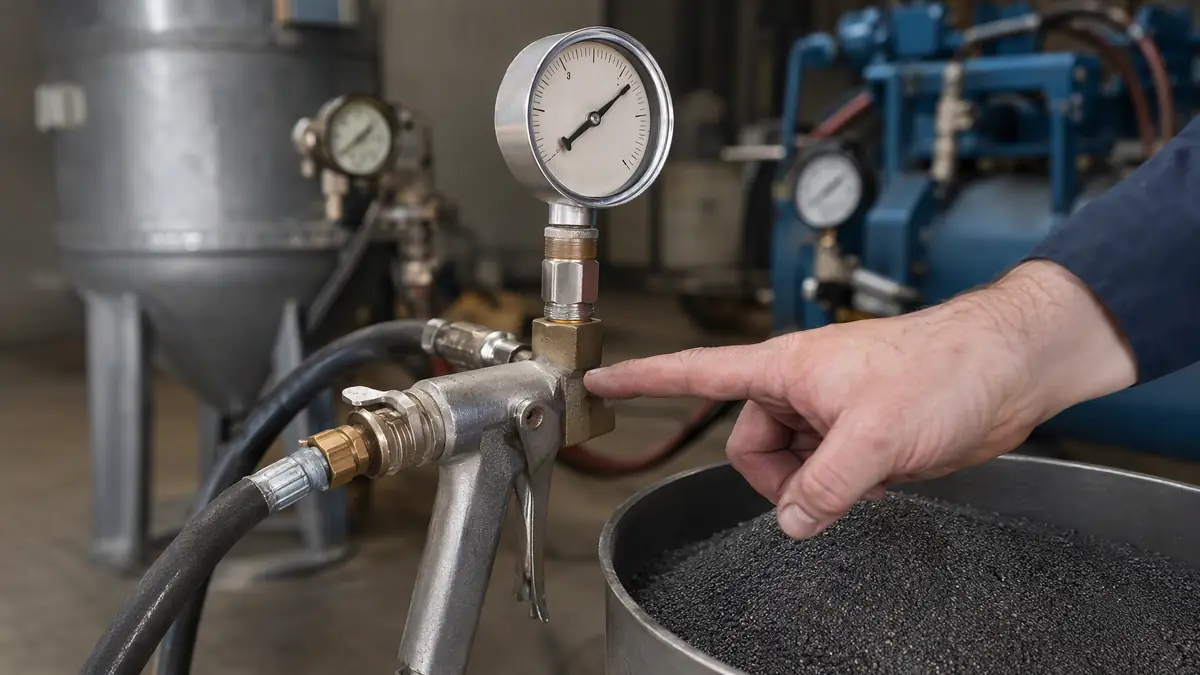
Nozzle pressure must be measured at the nozzle entry point, not at the compressor or blast pot gauge, to get accurate readings.
Close-up industrial photograph of a sandblasting nozzle assembly with a needle pressure gauge inserted at the nozzle holder entry point. The gauge dial is clearly visible. Background shows a blurred blast pot and compressor with their own gauges. A technician's hand indicates the correct measurement
Nozzle pressure is the air pressure measured at the nozzle entry point — not at the compressor or the blast pot gauge. It is typically expressed in PSI (pounds per square inch). This is the force that accelerates abrasive particles through the nozzle and onto the workpiece.
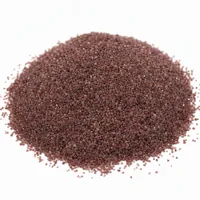
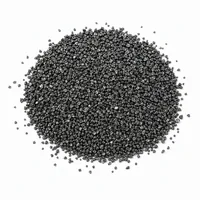
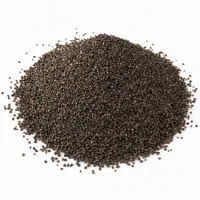
Abrasive mesh size refers to the particle size distribution of the media, measured by the number of openings per linear inch in a sieve screen. A higher mesh number means finer particles: 80-mesh garnet is much finer than 16-mesh garnet. The mesh size directly affects particle mass and how much air energy is needed to propel each grain effectively.
When the industry talks about "nozzle pressure abrasive mesh" matching, the core question is: does the air stream have enough energy to accelerate this specific particle size to a velocity that achieves the required cleaning or profiling work?
04 Why Matching Pressure to Mesh Size Matters
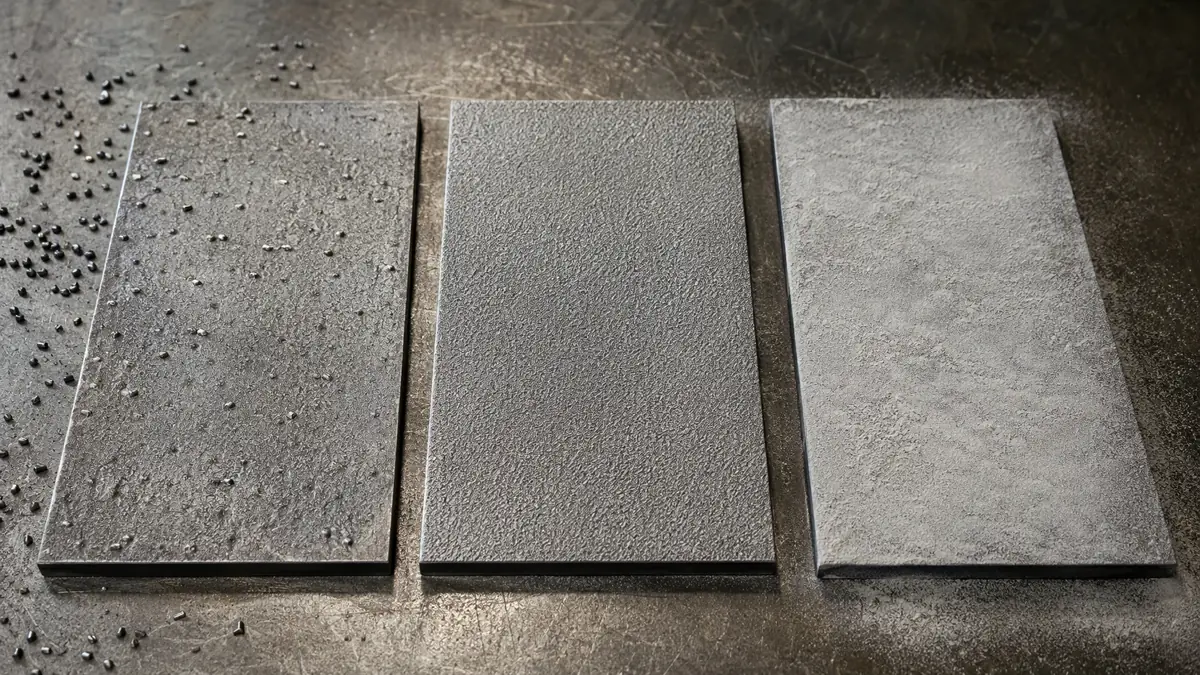
From left: insufficient pressure with coarse media, optimal pressure-mesh match, and excessive pressure shattering fine media into dust.
Industrial triptych photograph showing three blasted steel plate samples. Left sample displays shallow impact craters from under-pressured coarse grit. Center sample shows ideal uniform anchor profile from correctly matched pressure and mesh size. Right sample reveals shattered fine media residue an
Every abrasive particle needs a minimum velocity to do useful work. Too little velocity and the particle bounces off the surface without cutting or deforming it. Too much velocity and the particle shatters on impact, turning into dust that contributes nothing to the blast while consuming media at an accelerated rate.
Three practical consequences of a mismatch:
Undersized pressure for coarse media: Large, heavy particles (low mesh numbers like 12 or 16) require substantial kinetic energy. If nozzle pressure is too low, the particles exit the nozzle sluggishly. Cleaning rates drop, operators compensate by slowing down or making multiple passes, and labor costs climb.
Oversized pressure for fine media: Fine particles (80-mesh and above) have low individual mass. Excessive pressure accelerates them beyond their fracture toughness. The media disintegrates into fines on first impact, generating dust, reducing visibility, and consuming abrasive at two to three times the normal rate with no improvement in surface profile.
Inconsistent surface profile: Surface preparation standards like SA 2.5 or SSPC SP 10 require a specific anchor pattern depth. That profile is a function of particle shape, hardness, velocity, and impact angle. Pressure that is mismatched to mesh size produces uneven profiles that coating inspectors will reject.
05 How Particle Velocity Depends on Pressure and Mesh Size
Larger 16-mesh particles show greater velocity lag compared to finer 36-mesh particles exiting the same venturi nozzle at identical pressure.
High-speed industrial macro photograph showing a split-frame comparison of abrasive particle velocity from a venturi blast nozzle. Left frame captures slow-moving large 16-mesh steel grit particles with visible velocity lag. Right frame shows faster, denser stream of finer 36-mesh grit particles. Pa
Particle velocity is not the same as air velocity. Air exits a venturi nozzle at supersonic speeds, but abrasive particles — being much denser than air — lag behind. The heavier the particle relative to the air stream's momentum, the greater the velocity lag.
For a given nozzle pressure, a 16-mesh steel grit particle (approximately 1.2 mm) accelerates more slowly and reaches a lower exit velocity than a 36-mesh grit particle (approximately 0.5 mm). To bring the larger particle up to an effective working velocity, you need either:
Higher nozzle pressure (more air energy), or
A longer venturi nozzle (more acceleration distance), or
Both
This is why blast pressure settings and media size cannot be selected independently. The air compressor's CFM (cubic feet per minute) output must also support the chosen pressure at the nozzle orifice size. A common mistake is setting a high pressure on the regulator while the compressor cannot sustain the required CFM, causing pressure to sag during continuous blasting.
The CFM Constraint
Nozzle pressure and CFM are linked by the nozzle orifice diameter. A №6 nozzle (3/8-inch orifice) at 100 PSI demands roughly 200 CFM. If the compressor delivers only 150 CFM at that pressure, actual nozzle pressure will drop once blasting begins. The operator sees the static gauge reading and assumes the setup is correct, but dynamic pressure under flow is lower — and particle velocity suffers accordingly.
When matching pressure to mesh size, always verify that the compressor and air delivery system (hoses, couplings, filters) can sustain the target pressure at the required CFM for the nozzle in use.
06 General Pressure Ranges by Abrasive Type and Mesh
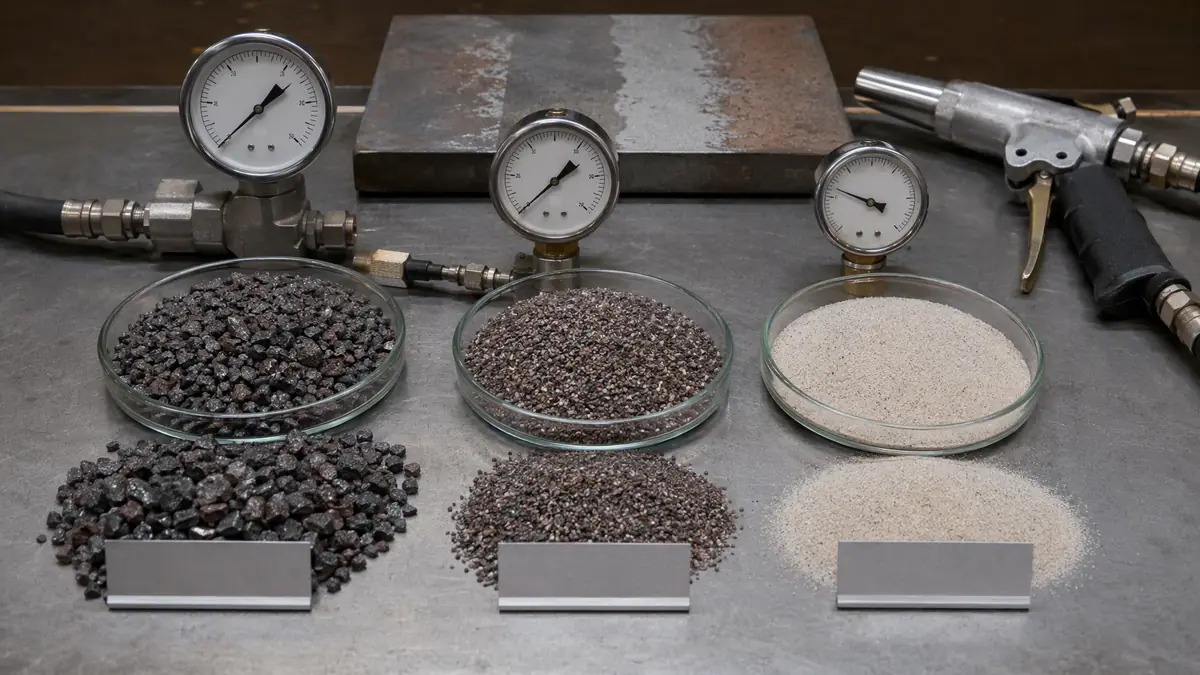
Coarse, medium, and fine abrasive mesh size groups displayed with their typical industrial pressure range indicators for blasting operations.
Industrial still-life photograph showing three groupings of abrasive media samples on a workshop bench. Coarse 12-20 mesh dark minerals displayed with a higher-range pressure gauge. Medium 30-60 mesh abrasives with mid-range gauge. Fine 80-120 mesh light-colored media with lower-range gauge. Backgro
The following guidance reflects typical industrial practice. Actual optimal settings depend on the specific abrasive material, nozzle type, standoff distance, and surface preparation specification. Always confirm against the coating specification and conduct a test patch before full production.
Mineral Abrasives (Garnet, Aluminum Oxide, Coal Slag)
Mesh Size
Typical Nozzle Pressure (PSI)
Notes
12–20 mesh (coarse)
90–110 PSI
Heavy rust, thick coatings, deep profile. Higher mass needs higher pressure.
Fine garnet at 100 PSI will produce a cloud of dust with little useful work. Operators who experience excessive dust with fine media should reduce pressure before changing media type — the problem is often pressure, not the abrasive.
Metallic Abrasives (Steel Grit, Steel Shot)
Mesh Size
Typical Nozzle Pressure (PSI)
Notes
G-12 to G-25 (coarse grit)
90–110 PSI
Deep anchor profile, aggressive cleaning. Requires sustained CFM.
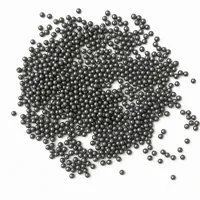
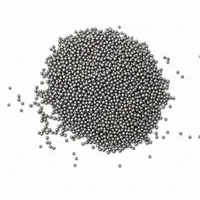
Steel grit is denser than mineral abrasives. A G-25 steel grit particle at 90 PSI carries significantly more kinetic energy than a 16-mesh garnet particle at the same pressure. This is why metallic abrasives can achieve deeper profiles at moderate pressures — and why switching from garnet to steel grit without adjusting pressure can damage thin substrates.
07 When Lower Pressure Is the Correct Choice
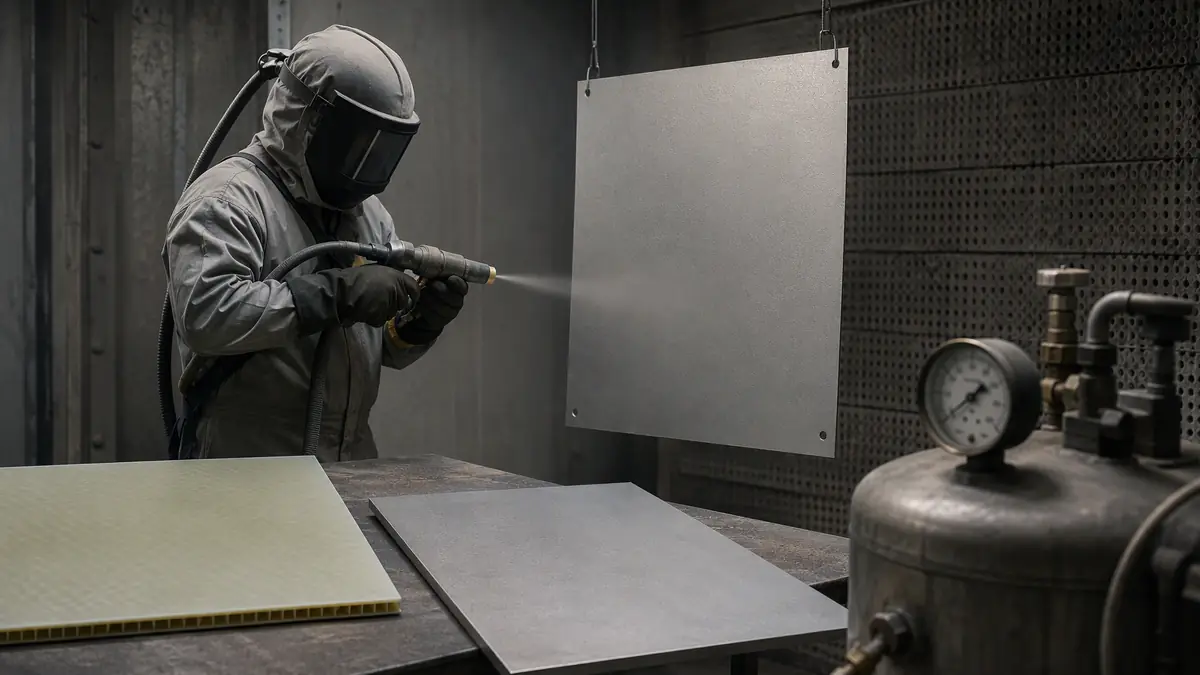
Lower nozzle pressure with fine mesh media prevents warping on thin sheet metal and substrate damage on fiberglass or composites.
Industrial photograph showing a blast operator in PPE carefully blasting a thin sheet metal panel at reduced pressure with fine mesh abrasive. The metal shows no warping. Foreground displays additional examples: a fiberglass panel and a steel surface with light brush blast finish. Blast pot pressure
There are specific situations where reducing nozzle pressure below typical ranges is not only acceptable but necessary:
Blasting thin sheet metal: High pressure combined with heavy media causes warping from peening stress. Reducing pressure to 50–60 PSI with fine media prevents distortion.
Removing coatings from fiberglass or composites: Excessive particle velocity erodes the substrate. Lower pressure with fine mesh media preserves the underlying material.
Achieving a light brush blast (SSPC SP 7): The specification requires removal of loose material only, not a full profile. Lower pressure with medium mesh prevents over-blasting.
Dustless or wet blasting applications: Water injection changes particle behavior. Pressure settings often run 10–20 PSI lower than dry blasting with the same mesh size.
08 Common Mistakes and How to Correct Them
Mistake 1: Setting Pressure by the Compressor Gauge
The gauge at the compressor or blast pot reads static pressure. Pressure drop across hoses, couplings, and the abrasive regulator means nozzle pressure is typically 10–20 PSI lower. Use a needle pressure gauge inserted at the nozzle holder to measure actual nozzle pressure. Adjust the regulator upward to compensate for system losses.
Mistake 2: Using One Pressure for All Mesh Sizes
A shop that runs 100 PSI for every job — whether using 16-mesh coal slag or 80-mesh garnet — is wasting abrasive on fine media jobs and potentially under-performing on coarse media jobs. Train operators to adjust pressure when changing media mesh size.
Mistake 3: Ignoring Nozzle Wear
As a nozzle wears, the orifice enlarges. A nozzle that started as a №6 (3/8-inch) may wear to a №7 or №8 equivalent. The larger orifice demands more CFM to maintain the same pressure. If the compressor cannot supply the additional air, nozzle pressure drops and particle velocity falls. Operators then increase the pressure setting to compensate, which further increases CFM demand — a cycle that ends with inadequate velocity and high media consumption. Replace nozzles when the orifice diameter increases by 1/16 inch beyond the original size.
Mistake 4: Overlooking Hose Diameter and Length
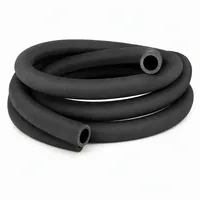
A 1-inch ID blast hose 50 feet long introduces less pressure drop than a 3/4-inch hose 100 feet long. When running coarse media at high pressure, undersized hoses choke the air supply. The pressure gauge may show 100 PSI at the pot, but the nozzle sees 75 PSI. Match hose diameter to the nozzle orifice and required CFM.
09 How to Set Up a Pressure-Mesh Pairing: A Practical Sequence
When preparing for a new blasting job, follow this sequence to establish the correct nozzle pressure for your abrasive mesh size:
Identify the specification requirement: What surface preparation standard applies? What anchor profile depth is specified? This determines the abrasive type and mesh size range.
Select the abrasive mesh size: Choose based on the required profile and the substrate material. Confirm the mesh size from the abrasive supplier's data sheet — sieving tolerances vary between manufacturers.
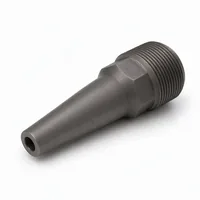
Choose the nozzle type and orifice: Long venturi nozzles improve particle velocity for coarse media at moderate pressures. Straight bore nozzles are adequate for fine media at lower pressures. Orifice size must match available CFM.
Calculate the required CFM: Use the nozzle manufacturer's air consumption chart. Confirm the compressor can deliver this CFM at the target pressure continuously.
Set the static pressure higher than the target: Account for pressure drop across the system. If the target nozzle pressure is 90 PSI and system losses are estimated at 15 PSI, set the regulator to 105 PSI.
Measure nozzle pressure under flow: Insert a needle gauge at the nozzle holder while blasting. Adjust the regulator until the dynamic nozzle pressure matches the target.
Run a test patch: Blast a small area and inspect the surface profile using replica tape or a profile gauge. Check media breakdown by examining spent abrasive for excessive fines. Adjust pressure up or down in 5 PSI increments based on results.
10 Evaluating Results: Signs Your Pressure-Mesh Pairing Is Correct
A well-matched setup produces:
Consistent surface profile across the blasted area, within the specified range
Minimal dust generation relative to the abrasive type — fine media will always produce some dust, but it should not be excessive
Steady media flow without surging or sputtering at the nozzle
Acceptable media consumption rate — compare against the abrasive supplier's estimated consumption for the job conditions
Nozzle pressure holding stable during continuous blasting, not dropping after the first minute
If any of these indicators are off, revisit the pressure setting before changing media or nozzle type.
11 Conclusion
Matching nozzle pressure to abrasive mesh size is a fundamental skill that directly affects blasting productivity, media cost, and surface quality. The principle is straightforward: heavier particles need more energy to reach effective working velocity; lighter particles need less energy and will fracture if over-accelerated. Applying this principle requires measuring actual nozzle pressure under flow, accounting for system pressure drops, and verifying results with a test patch.
Operators who adjust pressure deliberately when changing media mesh size will see immediate improvements in cleaning rate, media life, and profile consistency. Those who set one pressure and forget it will continue to experience the frustration of wasted abrasive and rejected surface preparation.
12 Frequently Asked Questions
What happens if I use too much nozzle pressure with fine abrasive mesh?
Excessive pressure accelerates fine particles beyond their structural limits, causing them to shatter on impact instead of cutting. This creates excessive dust, reduces visibility, and can double or triple media consumption without improving the surface profile. The shattered fines do no useful work, so you are essentially turning abrasive into dust.
Why does my nozzle pressure gauge drop when I start blasting?
The static pressure you read before blasting is not the same as the dynamic pressure under flow. Pressure drops across hoses, couplings, and the abrasive metering valve. If your compressor cannot supply the required CFM for your nozzle orifice at the target pressure, the dynamic pressure will sag. Use a needle gauge at the nozzle holder to measure actual blasting pressure.
Can I use the same pressure setting for 16-mesh and 80-mesh garnet?
No, using one pressure for all mesh sizes is a common and costly mistake. Coarse 16-mesh garnet typically needs 90-110 PSI to achieve effective velocity, while fine 80-mesh garnet works best at 50-80 PSI. Running fine media at high pressure wastes abrasive and creates dust, while coarse media at low pressure cleans slowly and wastes labor.
How does nozzle wear affect my pressure and media performance?
As a nozzle wears, its orifice enlarges, demanding more CFM to maintain the same pressure. If your compressor cannot supply the additional air volume, nozzle pressure drops and particle velocity decreases. Operators often raise the pressure setting to compensate, which further increases CFM demand, creating a cycle of poor performance and high media consumption.
When should I deliberately lower my blast pressure below typical ranges?
Lower pressure is necessary when blasting thin sheet metal to prevent warping, removing coatings from fiberglass or composites to avoid substrate erosion, performing a light brush blast per SSPC SP 7, or running dustless wet blasting applications where water injection changes particle behavior.
Does steel grit need different pressure settings than garnet for the same mesh size?
Yes, steel grit is significantly denser than mineral abrasives. A G-25 steel grit particle at 90 PSI carries much more kinetic energy than a 16-mesh garnet particle at the same pressure. This means metallic abrasives can achieve deeper profiles at moderate pressures, and switching from garnet to steel grit without lowering pressure can damage thinner substrates.
What should I check first if my blast cleaning rate suddenly drops?
First, measure actual nozzle pressure with a needle gauge to rule out pressure drop from compressor limitations, hose restrictions, or coupling leaks. Then inspect the nozzle orifice for wear, as an enlarged orifice reduces particle velocity. Also verify that the abrasive mesh size matches your pressure setting and that the media is not contaminated or damp.
13 Solution
Use the pressure ranges and setup sequence in this guide to evaluate your current blast parameters. If you are experiencing high media consumption, inconsistent profiles, or excessive dust, check your nozzle pressure against your abrasive mesh size first — it is the most common root cause and the simplest to correct.
When you are ready to select abrasives or upgrade nozzles, hoses, and regulators for better pressure control, explore the Abrasives and Sandblasting Spares categories at SPA2Z. For help confirming the correct pressure-mesh pairing for your specific application, contact the SPA2Z technical team with your job details and current setup.
14 Get a quote
Get a quote
Tell us what you need. We reply within one business day.
Recommended products
Catalogue products matched to this article. Ask for grade, quantity and destination.