How to Read Abrasive Mesh and Grit Designation Charts
Selecting the wrong abrasive size is one of the fastest ways to ruin a surface finish, waste media, and drive up rework costs. Yet product pages and data sheets...
Published
18 Jan 2022
Category
Abrasives
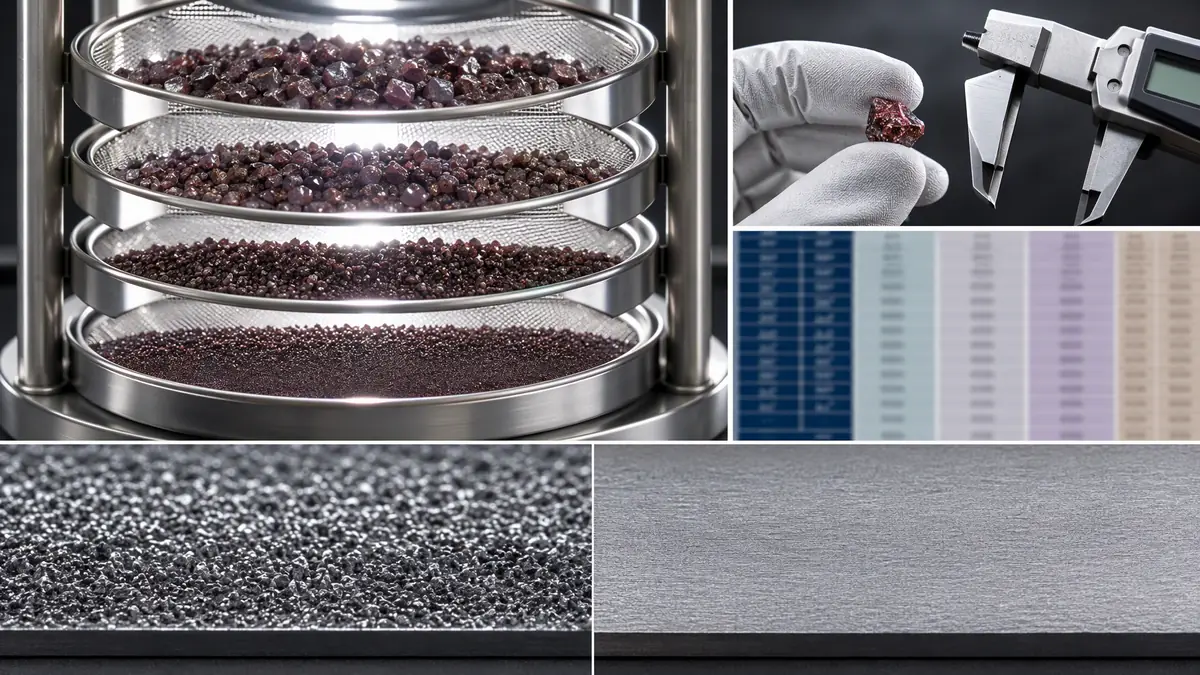
FIG. 01A multi-panel visual guide breaking down t...
A professional editorial collage for an industrial blog. The dominant panel shows a backlit sieve stack separating garnet particles. Supporting panels show a technician measuring a grain with a caliper, an abstract blurred technical data chart, and a steel surface profile comparison. The image visua
01 Introduction
Selecting the wrong abrasive size is one of the fastest ways to ruin a surface finish, waste media, and drive up rework costs. Yet product pages and data sheets often present sizing information in two very different numbering systems—mesh and grit—l…
02 Introduction
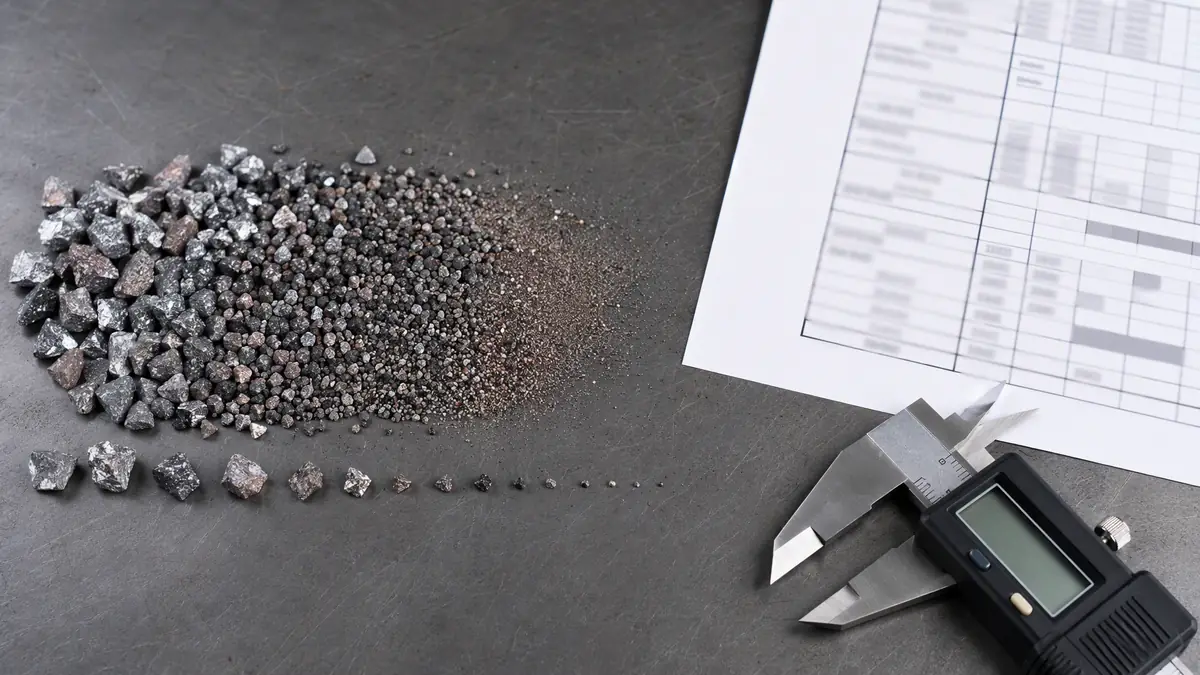
Mixed abrasive grains next to a technical data sheet highlight the common confusion between mesh and grit sizing systems.
A top-down view of various aluminum oxide grains scattered on a dark workbench next to a blurred technical data sheet and a digital caliper. The scene visually represents the initial confusion buyers face when encountering different abrasive sizing labels.
If you have ever looked at a specification for aluminum oxide, garnet, or silicon carbide and seen labels like "F80," "80 grit," or "80 mesh," you have encountered the core confusion in abrasive sizing. These numbers are not interchangeable, and assuming they are can lead to a profile that is too deep, too shallow, or completely inconsistent. This article is written for industrial buyers, maintenance technicians, and engineers who need to decode abrasive sizing systems—particularly the mesh scale, the grit scale, and the relationship between them—before placing an order or writing a blast specification.
By the end, you will understand what mesh and grit numbers actually measure, how to read a typical abrasive mesh size chart, when to trust one numbering system over the other, and what practical checks to apply before committing to a media grade.
03 What Is an Abrasive Mesh Size Chart?
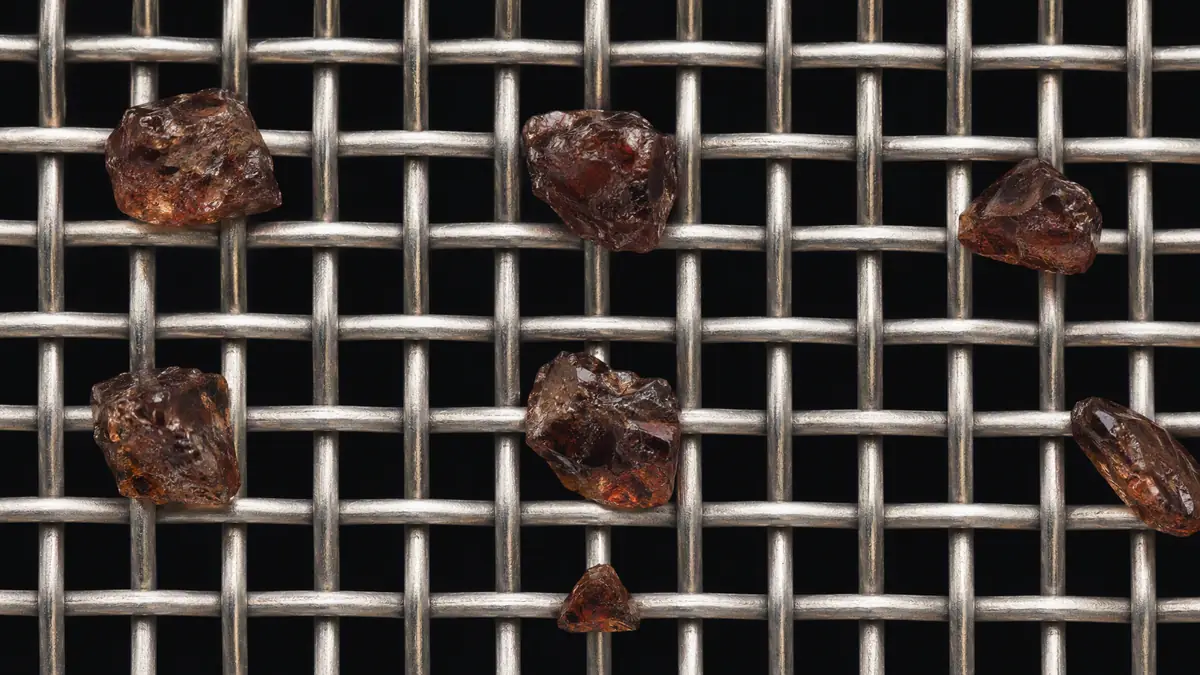
A macro view of a sieve screen showing how mesh number relates to the physical size of openings that sort abrasive particles.
An extreme close-up of a metallic laboratory sieve screen. The precise wire grid is in sharp focus, with irregular garnet particles caught in the openings, visually explaining the concept of mesh number as a physical measurement of openings per linear inch.
An abrasive mesh size chart is a reference table that links a "mesh number" to the physical particle size of the abrasive grain. The mesh number tells you how many openings per linear inch exist in the sieve screen through which the particles were sorted. A higher mesh number means a finer screen and therefore smaller particles; a lower mesh number means a coarser screen and larger particles.
For example, a particle that passes through a 30-mesh screen but is retained on a 40-mesh screen is typically described as 30/40 mesh. In practice, many industrial charts simplify this to a single number that represents the nominal sieve size, and the actual particle size distribution is controlled by a standard such as ASTM E11 (test sieves) or ISO 565.
A typical abrasive mesh size chart will show:
Mesh number (e.g., 24, 36, 60, 80, 120)
Approximate particle size in microns or thousandths of an inch
A corresponding grit designation where applicable
04 Mesh vs. Grit Numbering: What Is the Difference?
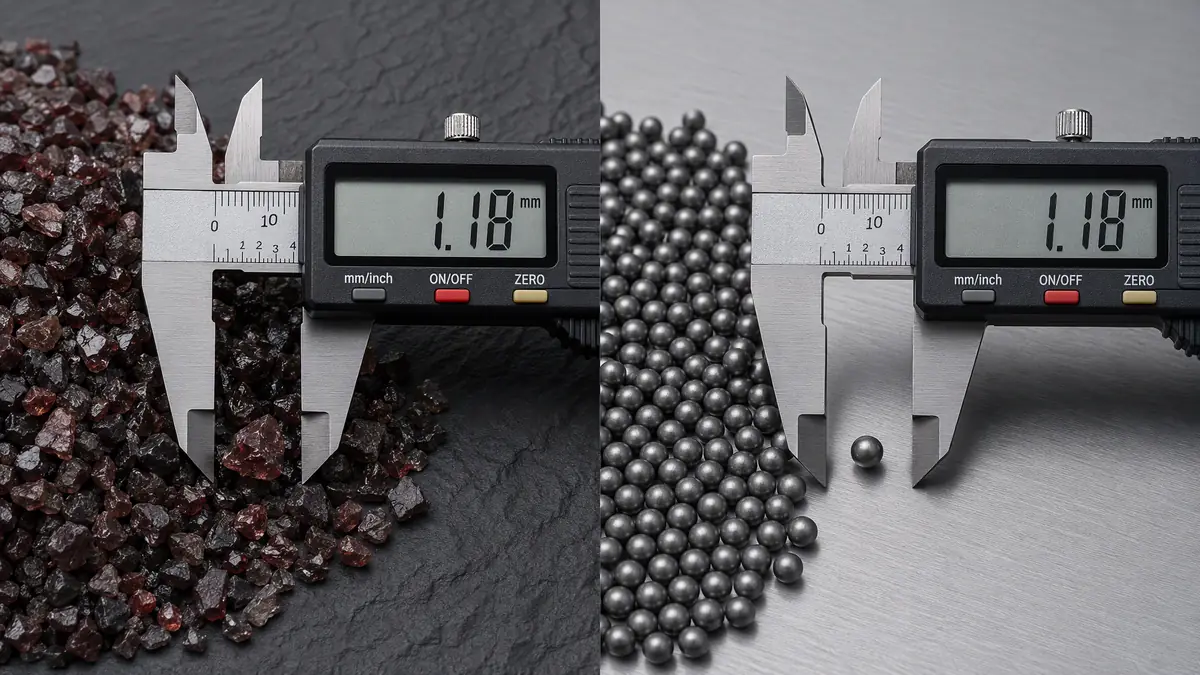
A visual comparison of irregular garnet particles and uniform steel shot, illustrating the fundamental difference between mesh and grit sizing philosophies.
A split-screen macro photograph comparing two abrasive types. The left shows irregular crushed garnet particles typical of mesh sizing. The right shows uniform spherical steel shot typical of grit designation. A caliper measures a particle from each side, highlighting the difference in sizing philos
The terms "mesh" and "grit" are often used as if they mean the same thing, but they originate from different sizing philosophies. Understanding the distinction is the first step in reading any product label correctly.
Mesh Sizing
Mesh sizing is defined by sieving. The number refers to the count of wires per inch in a square sieve screen. It is a direct physical measurement: a 60-mesh screen has 60 wires per inch, leaving smaller openings than a 30-mesh screen. Mesh sizing is common for softer or more friable abrasives like garnet, silica sand (where still permitted), and some grades of aluminum oxide used in blasting.
Key points about mesh sizing:
It describes the screen that the particles passed through, not the particle shape.
It works well for blocky or irregular grains.
Two different abrasives with the same mesh number can behave differently because of differences in density, shape, and friability.
Grit Sizing (SAE and ISO Grit)
Grit sizing, by contrast, is defined by industry standards that specify a controlled particle size distribution. The most frequently encountered standards in industrial blasting are:
SAE J444 (commonly called SAE grit) – used primarily for metallic abrasives like steel grit and cast iron grit. An SAE grit designation such as G40 or G25 refers to a specific screen distribution defined by the standard.
ISO 11126 / ISO 11127 and the older FEPA F-series – used for non-metallic abrasives such as aluminum oxide and silicon carbide. An "F80" designation under FEPA means a defined size band, not simply "passed through an 80-mesh screen."
The critical point: an SAE G40 steel grit is not the same size as a 40-mesh garnet particle. The numbering systems are not directly transferable, which is why reading the designation chart for the specific abrasive type matters.
Why the Confusion Persists
The confusion exists because some non-metallic abrasive suppliers label their products with a single number that looks like a grit designation but is actually a nominal mesh size. A product labeled "80 grit garnet" may in reality be an 80-mesh garnet. Without checking the accompanying micron range or the standard referenced, the buyer cannot be certain what they are getting.
05 Why Abrasive Size Designation Matters
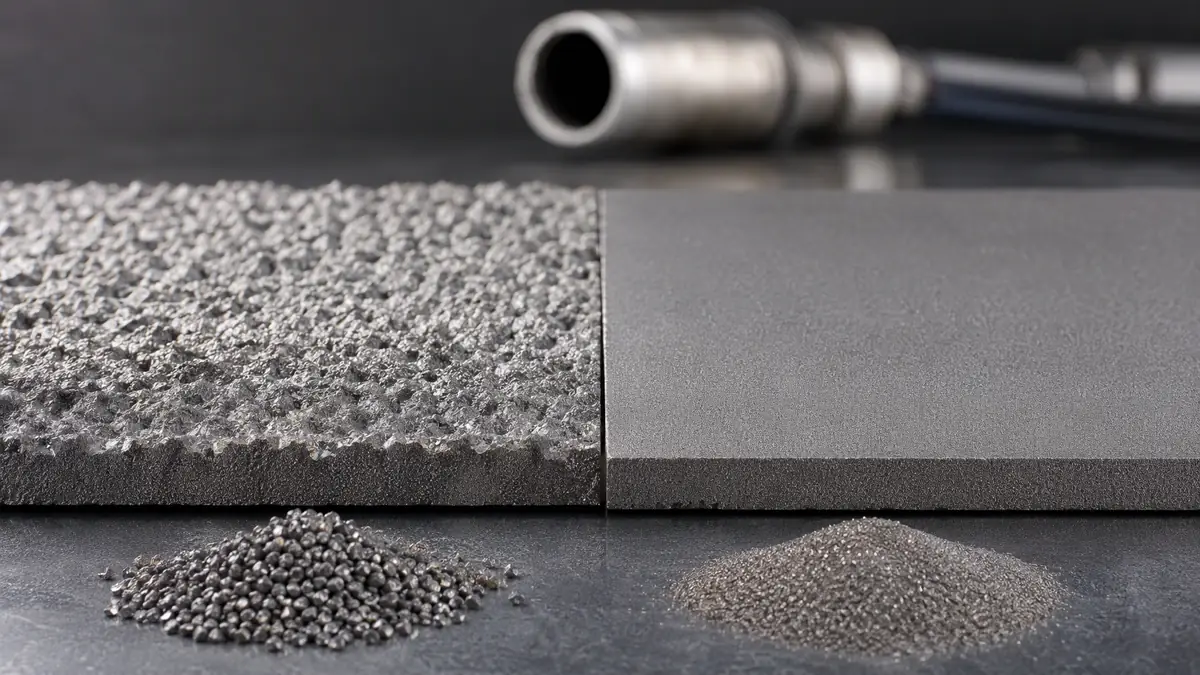
A comparison of steel surface profiles demonstrating how abrasive particle size directly controls peak and valley depth.
A close-up comparison of two steel surfaces after abrasive blasting. The left side shows a deep, jagged profile created by coarse particles. The right side shows a fine, uniform profile created by smaller particles. The image illustrates the critical importance of correct abrasive size designation f
Abrasive particle size directly controls:
Surface profile depth – larger particles cut deeper peaks and valleys; smaller particles produce a finer profile.
Coverage rate – finer abrasives tend to cover more square area per kilogram but cut more slowly.
Media consumption and dust generation – undersized particles can shatter on impact, creating excessive dust without useful work.
Nozzle and equipment wear – abrasive that is coarser than the system is designed for accelerates wear on blast nozzles, hoses, and metering valves.
Selecting the wrong size can result in a profile that fails to meet the specified standard (such as SSPC SP10 or SA 2.5), leading to coating adhesion failure and costly rework.
06 When Mesh Sizing Is Appropriate—and When It Is Not
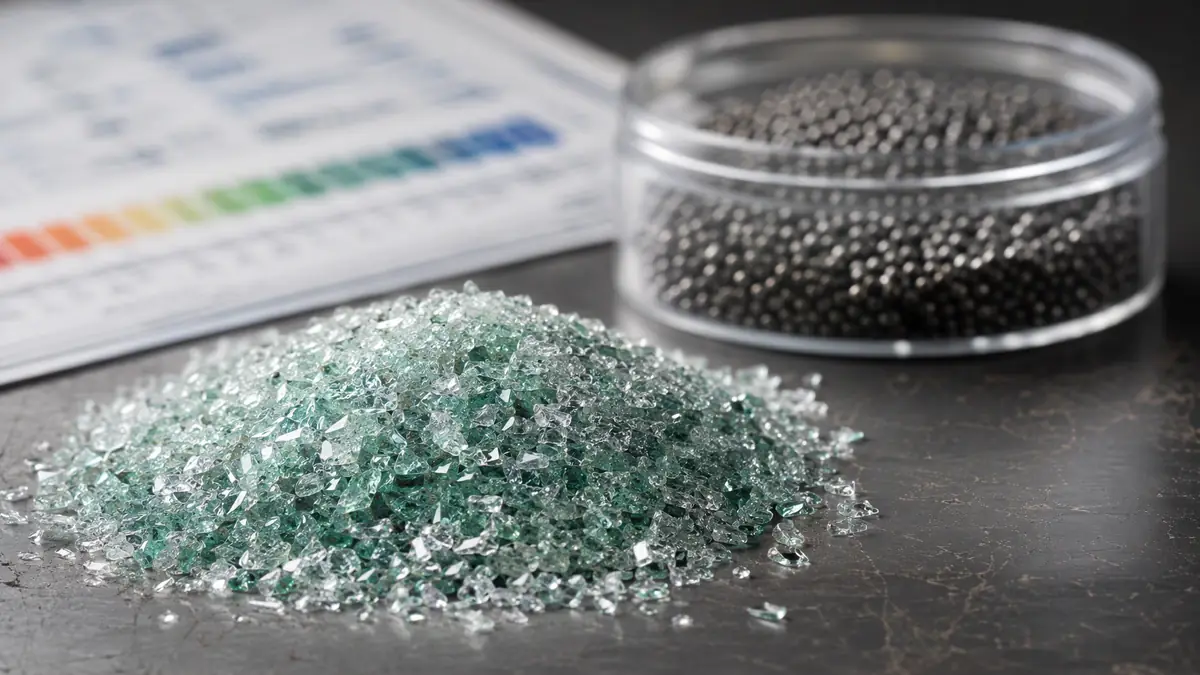
Sharp focus on irregular crushed glass suitable for mesh sizing, while spherical steel grit sits blurred in the background.
A photograph using selective focus to distinguish appropriate mesh sizing applications. Irregular crushed glass abrasive is sharp in the foreground. A container of uniform steel grit is blurred in the background, visually indicating that mesh sizing is a poor fit for metallic abrasives.
Mesh sizing is most reliable when:
The abrasive is a natural or crushed mineral with irregular particle shapes (garnet, crushed glass, some aluminum oxides).
The supplier provides a clear micron range alongside the mesh number.
The application does not demand extremely tight particle distribution control—typical for general blast cleaning and rust removal.
Mesh sizing alone is a poor fit when:
You are specifying metallic abrasives (steel grit, steel shot, cast iron grit). These should always be ordered by SAE grit designation or an equivalent standard.
The surface preparation specification calls for a tightly controlled profile range, such as 50–75 microns for a high-performance coating. In these cases, request the actual particle size distribution data from the supplier.
You are comparing two different abrasive types. A 36-mesh garnet and a 36-mesh aluminum oxide will not produce identical results because of differences in hardness, density, and particle shape.
07 How to Read a Typical Abrasive Mesh Size Chart
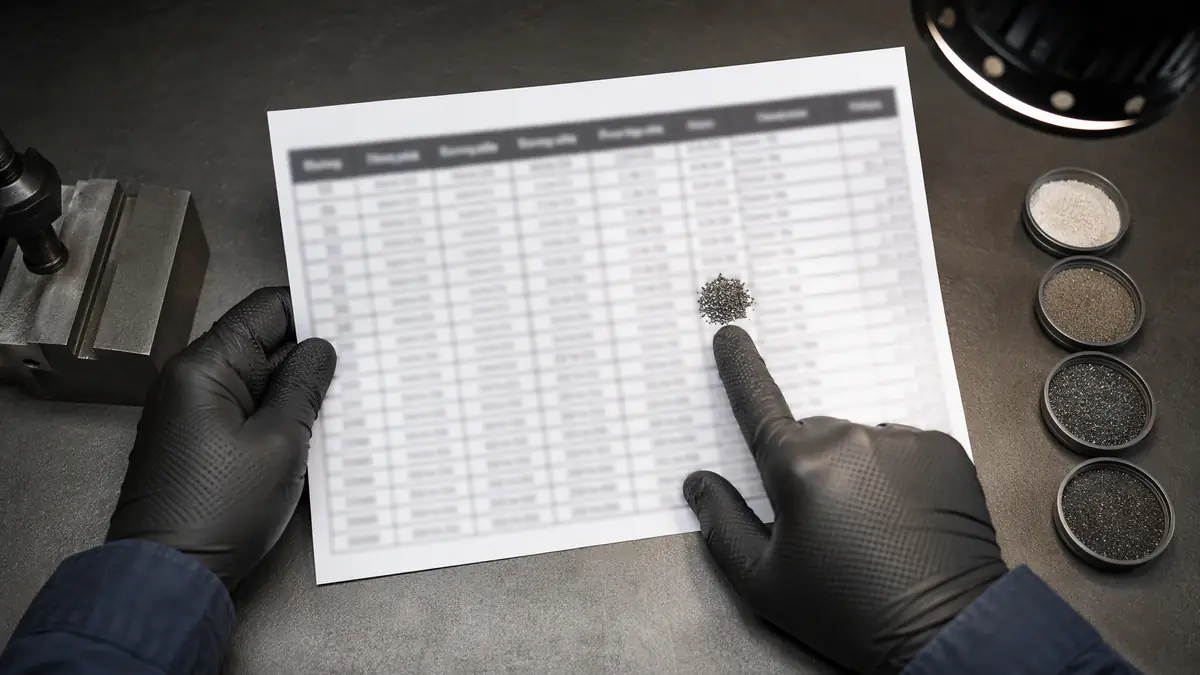
A technician's hands point to the micron range on a size chart, demonstrating the systematic approach to reading abrasive data sheets.
A first-person perspective of a technician using a printed abrasive mesh size chart. A finger points to the micron range column while a sample of the corresponding abrasive grain rests on the paper. The image illustrates the systematic approach of cross-referencing mesh numbers with objective micron
When you encounter an abrasive mesh size chart on a product page or technical data sheet, approach it systematically:
Identify the abrasive type. The chart should state whether it applies to garnet, aluminum oxide, silicon carbide, or another media. Do not use a garnet chart to interpret a steel grit designation.
Locate the mesh number column. This is your entry point if the product label uses a mesh designation (e.g., 30/60 mesh).
Find the corresponding micron range. Reputable charts will show the approximate particle size in microns (µm) or mils (thousandths of an inch). This is the most objective measure and allows comparison across different sizing systems.
Check for a grit cross-reference column. Some charts include an approximate FEPA F-grade or ANSI grit equivalent. Treat this as a rough guide only—confirm against the actual specification if the application is critical.
Note the application guidance if provided. Many charts suggest typical uses (e.g., "60 mesh – light rust removal, anchor profile 25–40 µm"). Use this as a starting point, not a substitute for trial on your specific substrate.
Example Walkthrough
Suppose a chart shows the following row:
Mesh
Microns (approx.)
Typical Application
36
500–600
Heavy rust removal, thick coating stripping
This tells you that a 36-mesh abrasive will pass particles roughly in the 500–600 micron range. If your specification requires a surface profile of 75–100 microns, this abrasive is likely too coarse. You would look further down the chart—perhaps at 60 or 80 mesh—to find a particle size that can produce the required profile without exceeding it.
08 Common Mistakes When Interpreting Abrasive Size Charts
Mistake 1: Assuming Mesh Number Equals Grit Number
This is the most frequent error. A buyer sees "80" on a garnet bag and assumes it is equivalent to an SAE G80 steel grit. In reality, SAE G80 is a much finer particle than 80-mesh garnet. Always verify which sizing system the number belongs to.
Mistake 2: Ignoring the Particle Size Distribution
A mesh number gives a nominal sieve size, but real abrasive contains a distribution of particle sizes. Two different 60-mesh abrasives can have different proportions of fines and oversize particles, affecting performance. When consistency matters, ask for the full sieve analysis.
Mistake 3: Selecting by Mesh Number Without Considering Hardness
A finer mesh of a soft abrasive may break down too quickly to achieve the desired profile. Conversely, a coarser mesh of a very hard abrasive like aluminum oxide may cut deeper than expected. Mesh size is only one variable; hardness, shape, and impact energy all matter.
Mistake 4: Using a Single Number When a Range Is Specified
Some abrasives are sold as a range (e.g., 30/60 mesh). This means the particles pass a 30-mesh screen and are retained on a 60-mesh screen. Ordering "30 mesh" when the specification calls for 30/60 mesh will give you a different product entirely—one with a wider or narrower distribution depending on the supplier's interpretation.
09 Practical Selection Steps for Buyers and Technicians
When you need to choose an abrasive size for a specific job, follow this sequence:
Start with the surface preparation specification. What profile depth is required? What standard applies (SSPC, ISO, NACE)? The specification should guide your particle size range.
Identify the abrasive type you intend to use. Metallic or non-metallic? This determines whether you work from an SAE grit chart, an ISO/FEPA chart, or a mesh chart.
Consult the appropriate abrasive mesh size chart or grit designation table. Match the required profile to the recommended particle size range in microns, then find the corresponding mesh or grit number.
Verify with the supplier. Ask for the actual micron range and the standard to which the abrasive is sized. A reliable supplier will provide this without hesitation.
Run a test patch if possible. No chart replaces a quick blast test on the actual substrate with the actual equipment. Measure the resulting profile and adjust if needed.
10 Conclusion
Abrasive sizing systems are not complicated once you recognize that mesh and grit are different languages describing the same physical property: particle size. Mesh numbers refer to sieve screens; grit numbers refer to standardized distribution bands defined by SAE, ISO, or FEPA. The key to reading any abrasive mesh size chart is to focus on the micron equivalent, understand which sizing system applies to your abrasive type, and never assume that a number in one system means the same thing in another.
For new buyers and technicians, the safest approach is to work from the required surface profile backward: determine the micron range you need, consult the correct chart for your abrasive type, and confirm the specification with your supplier before ordering in volume.
11 Frequently Asked Questions
What is the difference between abrasive mesh and grit sizing?
Mesh sizing is a physical sieve measurement, where the number indicates the wires per inch in the screen the particles passed through. Grit sizing, such as SAE or FEPA standards, defines a controlled particle size distribution. A 40-mesh garnet is not the same size as an SAE G40 steel grit, and the numbers are not directly interchangeable.
How do I read an abrasive mesh size chart?
First, confirm the chart applies to your specific abrasive type, like garnet or aluminum oxide. Locate your mesh number, then find the corresponding micron range for an objective size comparison. Use any application guidance as a starting point, but always verify with a trial on your actual substrate.
When should I use mesh sizing versus grit sizing?
Use mesh sizing for crushed minerals like garnet or crushed glass, especially when a micron range is provided. Always use grit designations, such as SAE J444, for metallic abrasives like steel grit or shot. For high-performance coatings requiring a tight profile range, request the full particle size distribution data regardless of the label.
Is 80-mesh garnet the same as 80-grit sandpaper?
No, they are not the same. An 80-mesh garnet particle is sized by passing through an 80-mesh screen, while sandpaper grit follows a different standard (often FEPA or ANSI) for coated abrasives. The resulting particle size and performance will differ, so do not use these numbers interchangeably.
What is the most common mistake when selecting abrasive size?
The most frequent error is assuming a mesh number equals a grit number, such as treating 80-mesh garnet as equivalent to SAE G80 steel grit. Another common mistake is ignoring the particle size distribution, as two 60-mesh abrasives can have different amounts of fines and oversize particles, leading to inconsistent results.
What does a mesh range like '30/60' mean?
A '30/60 mesh' designation means the abrasive particles pass through a 30-mesh screen but are retained on a 60-mesh screen. This provides a controlled size distribution. Ordering simply '30 mesh' instead of '30/60 mesh' will likely give you a different product with a wider or narrower particle spread.
How does abrasive size affect my surface profile?
Larger, coarser particles create a deeper anchor profile with higher peaks and valleys, while smaller particles produce a finer, shallower profile. Selecting a size that is too coarse can cause a profile that exceeds your coating specification, leading to adhesion failure and costly rework.
12 Solution
Use the principles in this guide to shortlist abrasive grades that match your surface preparation requirements. When you are ready to compare specific products—whether aluminum oxide grit, garnet sand, or other blast media—explore the Abrasives category on SPA2Z. If you need help confirming which mesh or grit designation is right for your substrate and equipment, contact the SPA2Z team with your specification details for technical guidance and a quotation.
13 Get a quote
Get a quote
Tell us what you need. We reply within one business day.
Recommended products
Catalogue products matched to this article. Ask for grade, quantity and destination.