When manual deburring with hand tools or tumblers produces inconsistent edges on high-value components, precision machining shops look for a repeatable, control...
Published
27 Dec 2017
Category
Abrasives
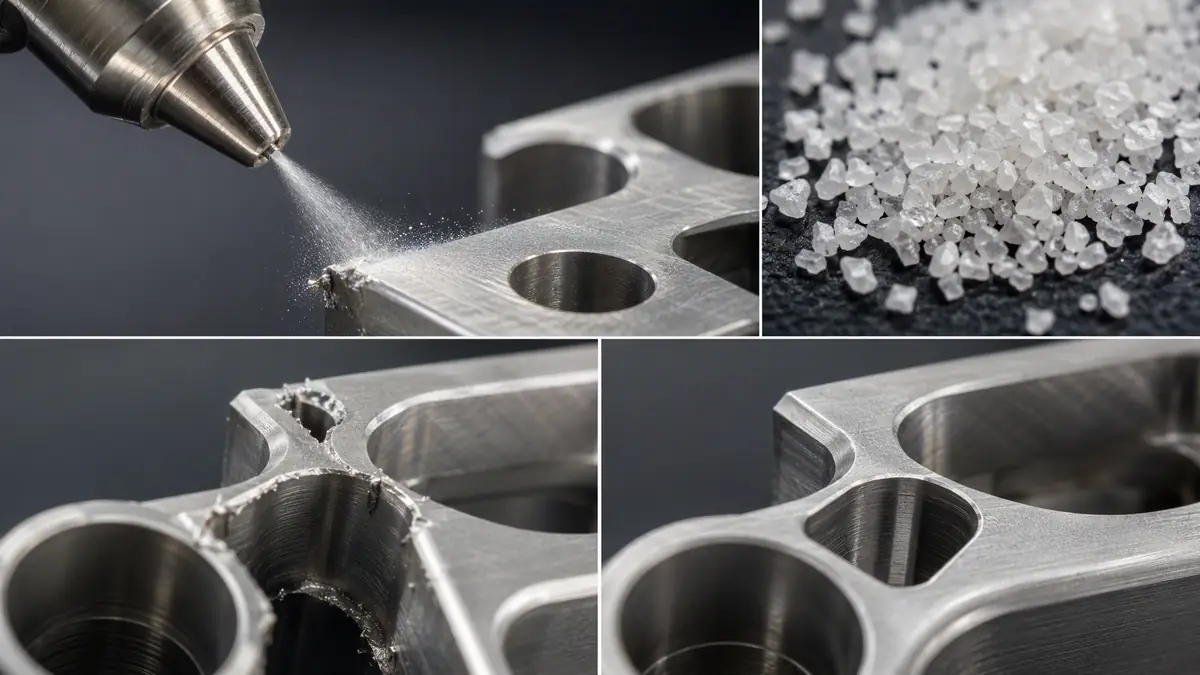
FIG. 01Micro-abrasive blasting deburring: from pr...
A professional multi-panel industrial collage illustrating the micro-abrasive blasting deburring process. The main panel features a close-up of a precision nozzle blasting a metal part. Supporting panels show the fine abrasive grit, a raw machined part with burrs, and the final smooth, deburred edge
01 Introduction
When manual deburring with hand tools or tumblers produces inconsistent edges on high-value components, precision machining shops look for a repeatable, controllable alternative. Micro-abrasive blasting deburring uses a focused stream of fine-grit m…
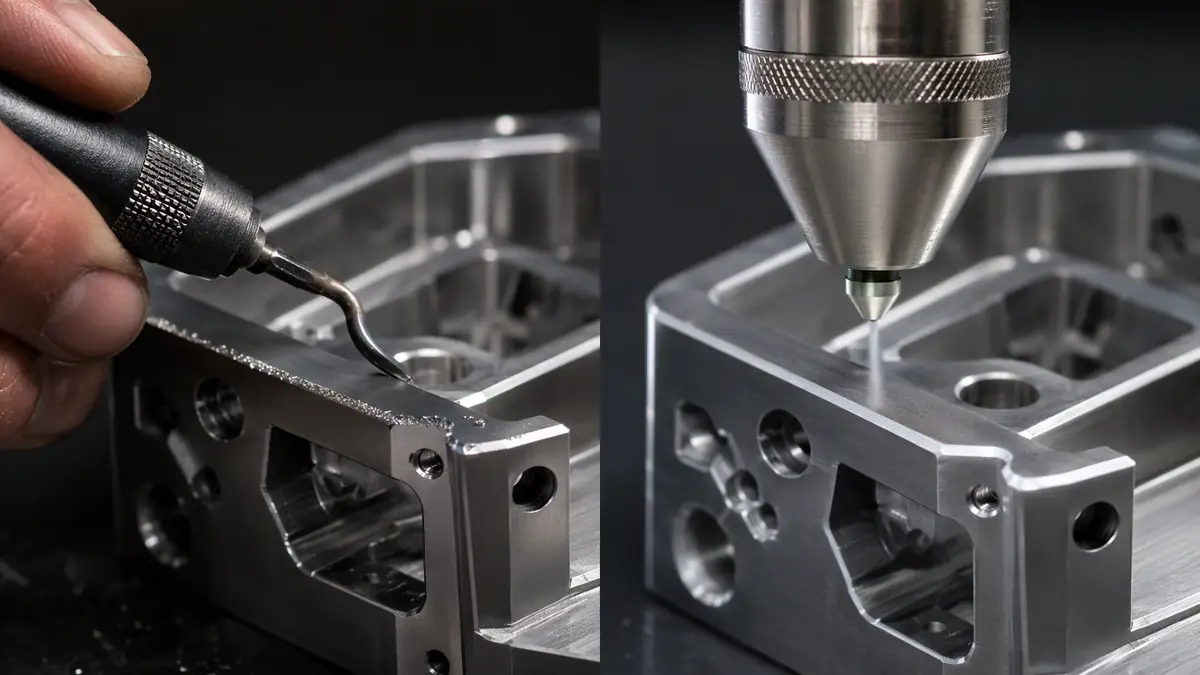
A side-by-side comparison in a machining shop. The left side shows an operator manually deburring a part with inconsistent results. The right side displays a perfectly deburred part achieved through micro-abrasive blasting, emphasizing the process's repeatability and precision for high-value compone
Every precision machining shop knows the frustration: a CNC cycle produces a near-perfect part, but the final manual deburring step introduces variability. Operators apply different pressure, miss internal intersections, or inadvertently round a feature that was meant to stay sharp. For fuel system components, medical implants, micro-moulds, and aerospace actuators, that inconsistency is unacceptable.
Micro-abrasive blasting deburring addresses this problem directly. It replaces hand scraping, tumbling, and uncontrolled wire brushing with a directed abrasive stream that reaches blind holes, undercuts, and intersecting cross-drillings that fingers and tools cannot access. The process is fast, repeatable, and — when set up correctly — gentle enough to preserve surface finishes measured in fractions of a micron.
This article explains what micro-abrasive blasting is, where it excels, how to select the right media and nozzle combination, and what can go wrong when process parameters drift. If you are evaluating whether microblast technology fits your shop floor, the following sections will give you the practical criteria to decide.
03 What Is Micro-Abrasive Blasting Deburring?
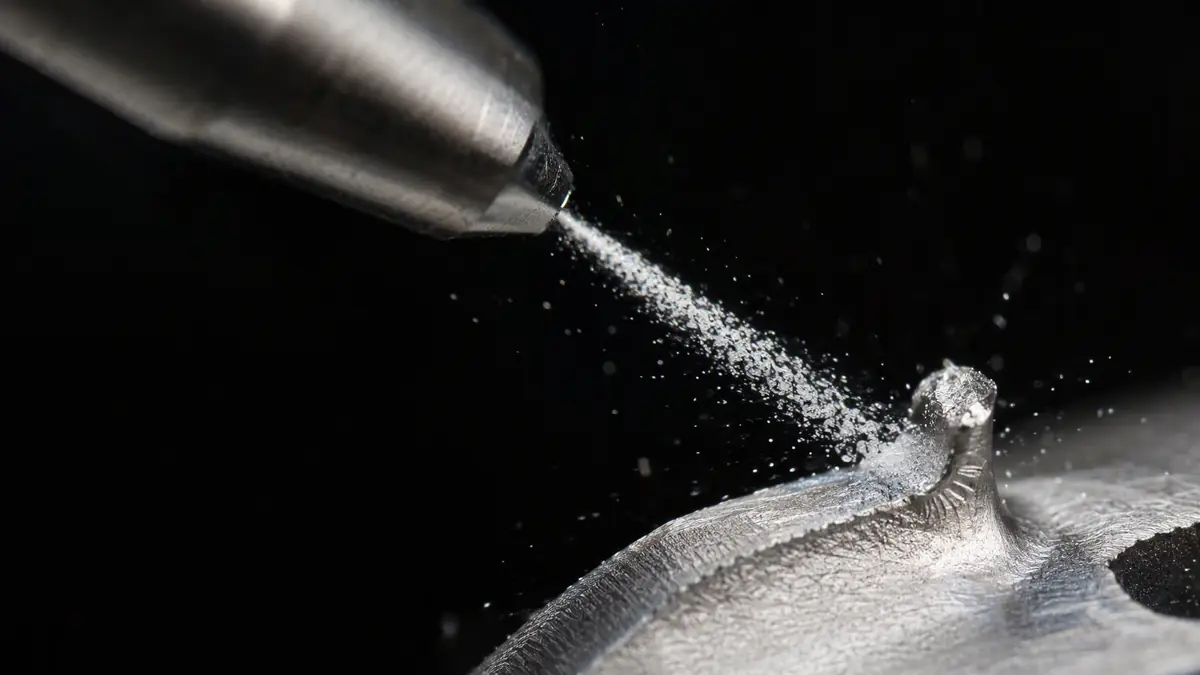
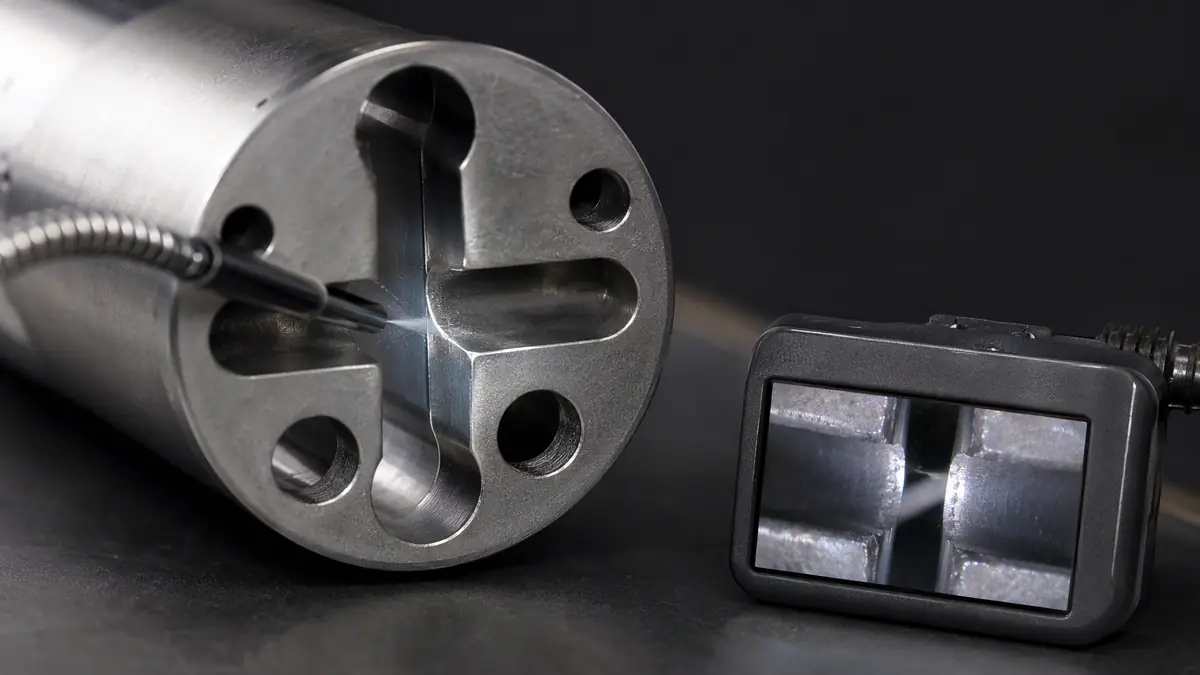
A 0.5mm nozzle directs a focused abrasive stream to selectively remove a burr without affecting the surrounding surface.
A highly detailed macro photograph showing the core principle of micro-abrasive blasting. A precision tungsten carbide nozzle emits a concentrated stream of fine abrasive particles, precisely targeting and fracturing a burr on a metal component, illustrating selective material removal.
Micro-abrasive blasting — often called microblast deburring — is a dry, air-propelled process that accelerates fine abrasive particles through a precision small-diameter nozzle (typically 0.25 mm to 1.5 mm orifice) at a tightly controlled pressure, usually between 2 bar and 7 bar (30–100 psi). The abrasive stream is small enough to target individual burrs on delicate features without affecting adjacent surfaces.
Unlike conventional sandblasting, which prioritises high coverage rates and surface profile creation, microblast deburring is about selective material removal. The operator or automated system directs the stream at the burr root, and the kinetic energy of the particles fractures or erodes the unwanted material. Because the media is exceptionally fine — often 10 µm to 50 µm particle size — the process can deburr edges without measurable dimensional change to the parent material.
Key components of a microblast system include:
Precision powder feeder that meters abrasive at consistent mass flow rates
Small-bore nozzle made from tungsten carbide, boron carbide, or sapphire for wear resistance
Regulated air supply with moisture separation to prevent media clumping
Enclosed work chamber or glove box to contain spent media and protect the operator
The process is inherently controllable. By adjusting air pressure, media type, nozzle distance, and feed rate, shops can dial in a deburring recipe that is documented and repeatable across shifts.
04 Why Microblast Deburring Matters in Precision Machining
Micro-abrasive blasting reaches internal burrs in a 1mm cross-hole, a task impossible for manual deburring tools.
A detailed image demonstrating the unique access capability of microblast deburring. The scene focuses on a tiny intersecting hole inside a precision component, where a microblast nozzle can direct abrasive to remove burrs, solving a key challenge in precision machining for industries like aerospace
The business case for micro-abrasive blasting rests on three pillars: consistency, access, and part integrity.
Consistency. A documented microblast recipe — pressure, media grade, nozzle standoff, dwell time — produces the same edge condition on part one as on part ten thousand. This eliminates operator-dependent variability, which is the primary driver of scrap and rework in manual deburring cells.
Access. Intersecting cross-holes, internal thread runouts, undercuts, and narrow slots defeat most mechanical deburring tools. A microblast nozzle with a 0.5 mm orifice can direct abrasive into a 1 mm bore and deburr the intersection where a drill broke through. No hand tool can match that reach.
Part integrity. Because the abrasive particles are small and the impact energy is low, microblast deburring removes burrs without peening the surface, embedding media, or altering heat-treated edge hardness. For components that have already been ground, lapped, or EDM-finished, this is critical.
When It Is a Good Fit
Burr thickness under 50 µm on machined features
Parts with internal intersections, cross-drillings, or recessed edges
High-value, low-volume production where scrap cost justifies process investment
Pre-coating or pre-plating edge preparation requiring clean, radiused edges
When It Is a Poor Fit
Large, heavy burrs from rough machining or saw-cutting — these require mechanical pre-deburring
High-volume, low-cost parts where vibratory finishing or barrel tumbling is more economical
Soft, gummy materials (certain aluminium grades, pure copper) that tend to absorb abrasive rather than fracture cleanly
Applications requiring heavy stock removal rather than burr removal
05 Selecting Micro-Abrasive Media for Precision Edges
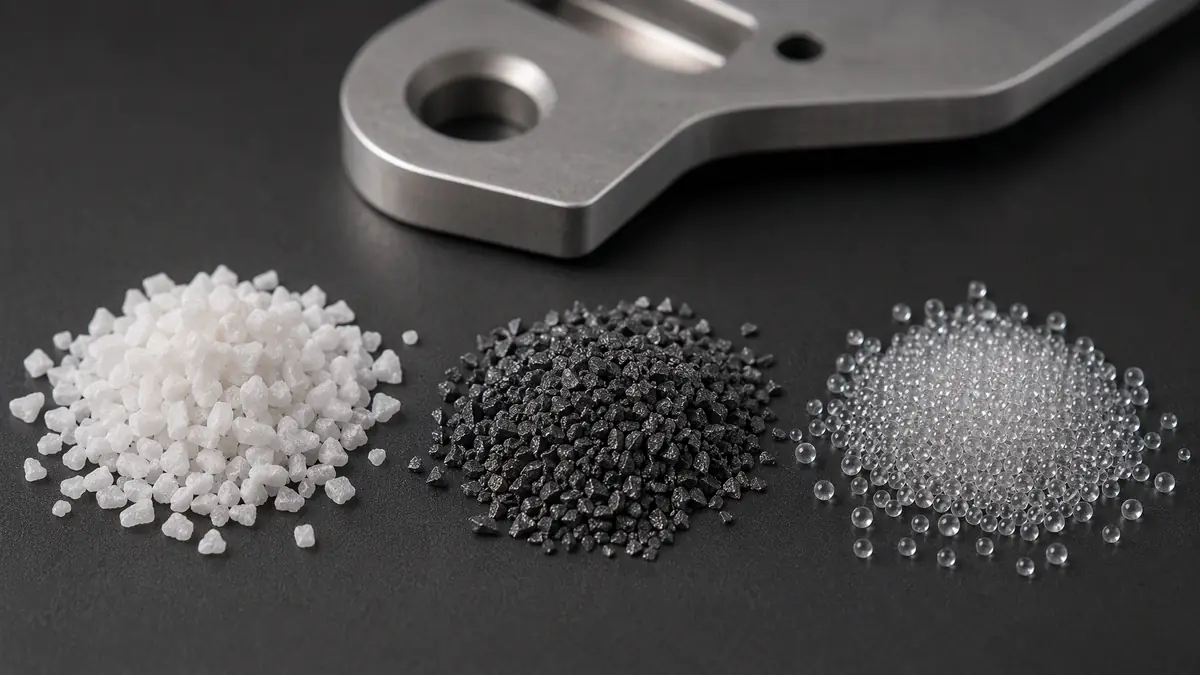
Media choice is critical: angular aluminium oxide and silicon carbide for cutting, glass beads for peening and finer finishes.
A macro comparison of three common micro-abrasive blasting media types. The image clearly shows the angular shape of aluminium oxide and silicon carbide, suited for aggressive deburring, alongside spherical glass beads used for surface finishing, helping machinists understand media selection for dif
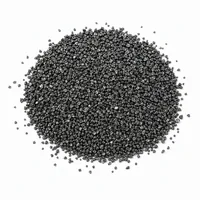
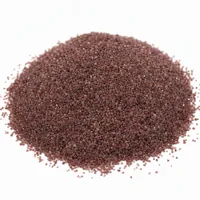
Media selection is the single most influential variable in microblast deburring. The abrasive type, particle size (mesh), and shape determine cutting speed, edge radius, and surface finish.
Common Microblast Media Types
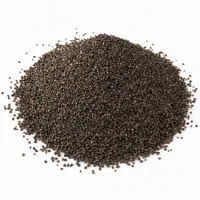
Aluminium Oxide (White or Brown)
- Hard, angular particles; aggressive cutting action
- Suitable for hardened steels, stainless alloys, and titanium
- Typical particle sizes: 10 µm to 50 µm (approximately 320 to 1200 grit equivalent)
- Leaves a matte finish; may require post-blast cleaning to remove embedded fragments on softer substrates
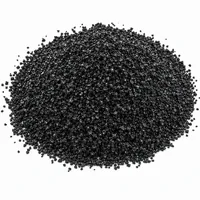
Silicon Carbide
- Sharper and harder than aluminium oxide; fractures into fresh cutting edges during use
- Preferred for very hard materials: tungsten carbide, ceramics, hardened tool steel above 60 HRC
- Higher cost per kilogram; justified when cycle time reduction matters or when aluminium oxide wears too quickly
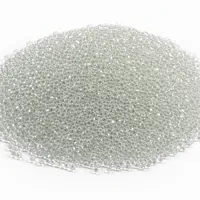
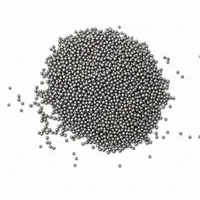
Glass Beads
- Spherical particles; peening action rather than cutting
- Used when the goal is edge radiusing without stock removal, or when a cosmetically uniform satin finish is required
- Less effective on tough, ductile burrs that require fracture rather than deformation
Sodium Bicarbonate (Armex-type)
- Soft, crystalline particles that shatter on impact
- Suitable for deburring soft metals (brass, aluminium) or cleaning without substrate removal
- Water-soluble; simplifies post-process cleaning but requires absolutely dry air supply
Fine Mesh and Particle Size Considerations
The term "fine mesh" in microblast deburring typically refers to media screened through sieves with openings below 50 µm. At this scale, standard mesh designations become less common; suppliers often specify particle size distribution in microns.
40–50 µm media: faster burr removal; may produce a visible edge radius on very fine features
Finer media flows less readily through feed systems and is more susceptible to moisture clumping. Shops using sub-25 µm powders must invest in dry air systems and may need vibratory hopper agitation to maintain consistent feed.
06 Small Nozzles: The Precision Delivery System
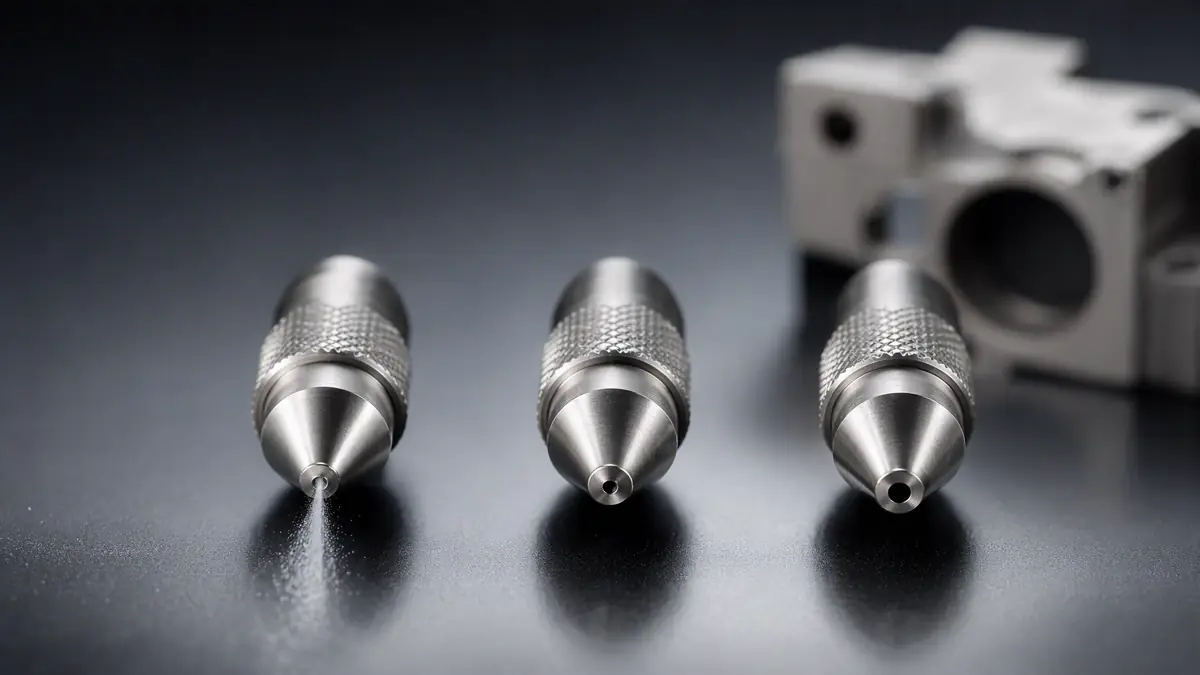
Nozzle orifice diameter dictates stream size and energy density, from a 0.25mm needle-point to a 1.0mm broader coverage.
A detailed product shot comparing microblast nozzles with different orifice diameters. The image highlights how a smaller orifice, like 0.25mm, creates an extremely fine, high-precision abrasive stream, while a larger 1.0mm orifice covers more area, illustrating the trade-off between precision and c
The nozzle is not merely a conduit; it determines the size, shape, and energy density of the abrasive stream. In microblast deburring, nozzle selection is as important as media selection.
Orifice diameter. A 0.25 mm to 0.5 mm nozzle produces a needle-sharp stream for targeting individual burrs inside small bores. A 0.75 mm to 1.0 mm nozzle covers a broader area and suits edge radiusing along external contours. The trade-off is straightforward: smaller orifice = higher precision but lower coverage rate.
Nozzle material. Boron carbide and tungsten carbide nozzles resist the erosive wear that would quickly enlarge a steel orifice. For the finest work, sapphire nozzles offer extreme wear life and consistent stream geometry but are brittle and must be protected from mechanical shock.
Standoff distance. Typical working distance ranges from 3 mm to 25 mm. Closer distances concentrate energy for faster cutting; greater distances spread the stream for blending and finishing. The relationship is non-linear, and each media-nozzle combination should be characterised on a test coupon before production use.
Angle of attack. Directing the stream perpendicular to the burr root maximises cutting efficiency. Angled blasting can be used to direct burr removal away from critical surfaces or to create a controlled edge radius.
07 Common Mistakes and How to Avoid Them
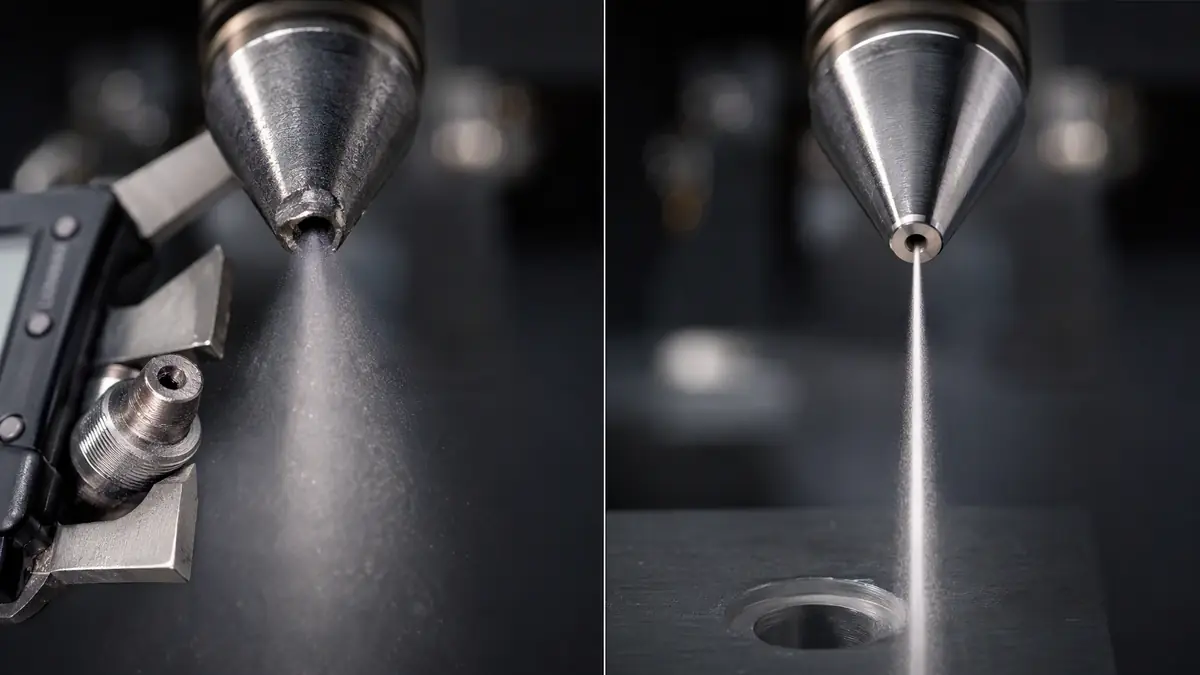
An unnoticed worn nozzle (left) widens the stream and drops efficiency, a common mistake fixed by scheduled orifice measurement.
A visual troubleshooting guide showing a common mistake in microblast deburring. The image contrasts a worn nozzle with an irregular orifice and ineffective stream against a new nozzle with a precise, focused stream, emphasizing the importance of regular nozzle inspection and replacement to maintain
Even with the right equipment, microblast deburring processes can drift. The following problems are common in shops new to the technology.
1. Inconsistent media feed.
- Cause: Moisture in the air supply, clumped media in the hopper, or worn feeder components.
- Consequence: Pulsing abrasive stream, uneven deburring, and occasional nozzle clogging.
- Prevention: Install a refrigerated air dryer and coalescing filter upstream of the microblast unit. Agitate the hopper regularly and inspect feeder seals.
2. Nozzle wear going unnoticed.
- Cause: Operators do not measure orifice diameter at scheduled intervals.
- Consequence: Stream widens, cutting efficiency drops, cycle times drift, and edge quality becomes inconsistent.
- Prevention: Check nozzle orifice with a pin gauge weekly. Replace when diameter increases by more than 10% from nominal.
3. Using the wrong media for the burr type.
- Cause: Selecting abrasive based on availability rather than burr characteristics.
- Consequence: Glass beads on a tough stainless burr will peen it over rather than remove it. Aluminium oxide on a soft brass part may embed and cause later corrosion.
- Prevention: Characterise the burr — thickness, material, location — before selecting media. Run a test coupon and inspect under magnification.
4. Excessive blast pressure.
- Cause: Assuming higher pressure always improves productivity.
- Consequence: Media shatters on impact without cutting, dust generation increases, and delicate features may be eroded.
- Prevention: Start at the lowest pressure that removes the burr in an acceptable cycle time. For most precision deburring, 2–4 bar (30–60 psi) is sufficient.
5. Neglecting part cleaning after blasting.
- Cause: Assuming the air stream removes all spent media.
- Consequence: Residual abrasive trapped in blind holes or recesses can cause assembly problems or act as a lapping compound in service.
- Prevention: Establish a verified cleaning protocol — ultrasonic wash, pressurised solvent flush, or air blow-off with magnification check — appropriate to the part geometry.
08 Evaluating Results and Qualifying the Process
A microblast deburring process is only as good as the verification method behind it. Shops should define acceptance criteria before production begins.
Visual inspection under magnification (10x–30x). Confirm complete burr removal at all specified locations. Look for residual burr flags, folded material, or embedded media.
Edge radius measurement. If the print specifies a maximum edge break, use a contour tracer or optical comparator to verify that the microblast process stays within tolerance. Document the correlation between blast parameters and resulting edge radius.
Surface finish check. Measure Ra or Rz before and after blasting on a representative surface. A well-tuned microblast process should not degrade finish by more than the customer specification allows.
Cleanliness verification. For critical applications (fuel systems, medical), perform a particle count or solvent extraction test to confirm no abrasive residue remains.
09 Alternatives to Microblast Deburring
Micro-abrasive blasting is not the only precision deburring method, and understanding the alternatives helps shops make sound process decisions.
Electrochemical deburring (ECD): Excellent for internal intersections and consistent edge breaks, but requires conductive workpieces, electrolyte management, and higher capital investment. No mechanical stress on the part.
Thermal deburring (TEM): Uses a combustible gas mixture to oxidise burrs in a sealed chamber. Effective for many materials and internal features simultaneously, but can alter surface metallurgy and is unsuitable for thin-walled or heat-sensitive parts.
Abrasive flow machining (AFM): Extrudes an abrasive-laden polymer through internal passages. Ideal for complex internal geometries but slower and more expensive per part than microblasting for external or simple internal features.
Laser deburring: Emerging technology offering non-contact, programmable edge treatment. High capital cost; best suited to high-value, automated production lines.
Microblast deburring occupies a middle ground: lower capital cost than ECD or laser, more controllable than manual methods, and applicable to both conductive and non-conductive materials.
10 Conclusion
Micro-abrasive blasting deburring gives precision machining shops a repeatable method for removing micro-burrs from features that manual tools cannot reach. By matching fine-mesh media to the burr material, selecting the correct small-nozzle geometry, and controlling pressure and standoff, shops can eliminate operator-dependent variability and protect the dimensional integrity of high-value components.
The process is not a universal solution — it is poorly suited to heavy burrs, high-volume low-cost parts, and certain soft metals — but for the precision applications where edge quality is non-negotiable, microblast deburring is a proven, documentable, and cost-effective choice.
11 Frequently Asked Questions
What is the difference between micro-abrasive blasting and regular sandblasting for deburring?
Micro-abrasive blasting uses a highly focused stream of fine particles (typically 10–50 µm) through a small nozzle to selectively remove individual burrs without affecting the parent material. Regular sandblasting prioritises high coverage rates and surface profile creation, making it too aggressive for precision edges. Microblast systems offer tighter control over pressure, media feed, and stream size for repeatable, delicate work.
How do I select the right abrasive media for microblast deburring?
Selection depends on the burr material, thickness, and desired edge condition. Aluminium oxide is a good general-purpose choice for hardened steels and titanium. Silicon carbide is preferred for very hard materials like tungsten carbide. Glass beads are used for edge radiusing without stock removal, while sodium bicarbonate suits soft metals where substrate integrity is critical. Always test on a coupon first.
What nozzle size is best for deburring small internal cross-holes?
A nozzle with an orifice diameter between 0.25 mm and 0.5 mm is ideal for targeting burrs inside small bores and intersecting cross-drillings. This produces a needle-sharp stream that can reach features inaccessible to hand tools. The trade-off is a lower coverage rate compared to larger nozzles.
Can micro-abrasive blasting handle large, heavy burrs from rough machining?
No, micro-abrasive blasting is not suitable for large or heavy burrs. It is designed for thin burrs, typically under 50 µm, on precision-machined features. Large burrs from saw-cutting or aggressive milling require mechanical pre-deburring before a microblast process can be used for final edge refinement.
What causes inconsistent media feed, and how can I prevent it?
Inconsistent feed is usually caused by moisture in the air supply, clumped media in the hopper, or worn feeder components. This leads to a pulsing abrasive stream and uneven deburring. Prevent it by installing a refrigerated air dryer and coalescing filter, agitating the hopper regularly, and inspecting feeder seals as part of routine maintenance.
How often should I check the microblast nozzle for wear?
Nozzle orifice diameter should be checked weekly with a pin gauge. A worn nozzle causes the abrasive stream to widen, reducing cutting efficiency and edge quality. Replace the nozzle when the orifice diameter increases by more than 10% from its nominal size to maintain process consistency.
Is microblast deburring safe for parts that have already been ground or lapped?
Yes, it is an excellent fit. Because the abrasive particles are small and impact energy is low, the process removes burrs without peening the surface, embedding media, or altering heat-treated edge hardness. This preserves the surface finishes and dimensional integrity of components that have already undergone grinding, lapping, or EDM finishing.
12 Solution
Selecting the right micro-abrasive media and nozzle combination starts with understanding your burr characteristics and part material. Compare abrasive types, mesh sizes, and compatible nozzle specifications to match your application requirements.
Explore the range of abrasives available on SPA2Z, and contact the sales team to enquire about technical specifications, compatibility with your existing microblast equipment, and current availability.
13 Get a quote
Get a quote
Tell us what you need. We reply within one business day.
Recommended products
Catalogue products matched to this article. Ask for grade, quantity and destination.