ABRASIVES GUIDE

Best Abrasive for Removing Heavy Mill Scale

Heavy mill scale on hot-rolled steel demands an abrasive that cuts aggressively without shattering on impact. Choosing the wrong media leads to slow production,...

Published
05 Feb 2018
Category
Abrasives
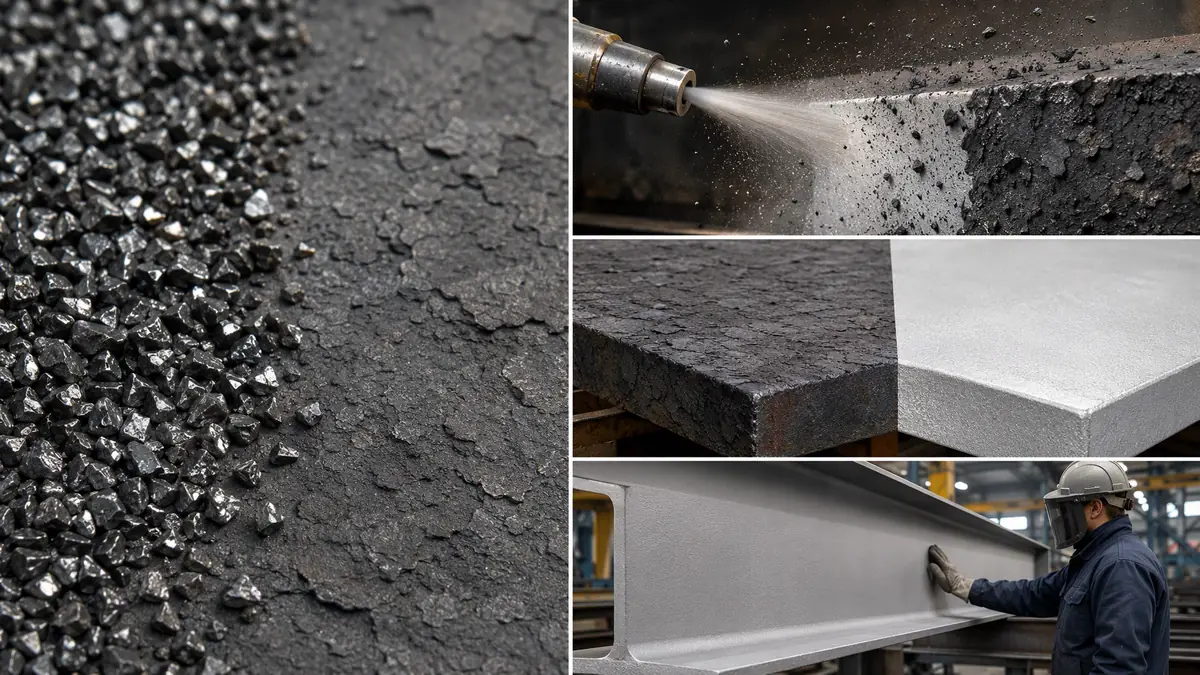
Multi-panel collage showing steel grit abrasive, blasting process, and mill scale removal from hot-rolled steel to achieve a
FIG. 01A visual guide to aggressive abrasive blas...

Featured image for an article on the best abrasive for removing heavy mill scale. A multi-section industrial collage showing angular steel grit abrasive, a blast nozzle fracturing thick mill scale, a comparison of scaled versus clean profiled steel, and a fabricator inspecting a blasted structural b

Introduction

Heavy mill scale on hot-rolled steel demands an abrasive that cuts aggressively without shattering on impact. Choosing the wrong media leads to slow production, excessive dust, and surfaces that fail coating adhesion tests. This guide helps steel pr…

Introduction

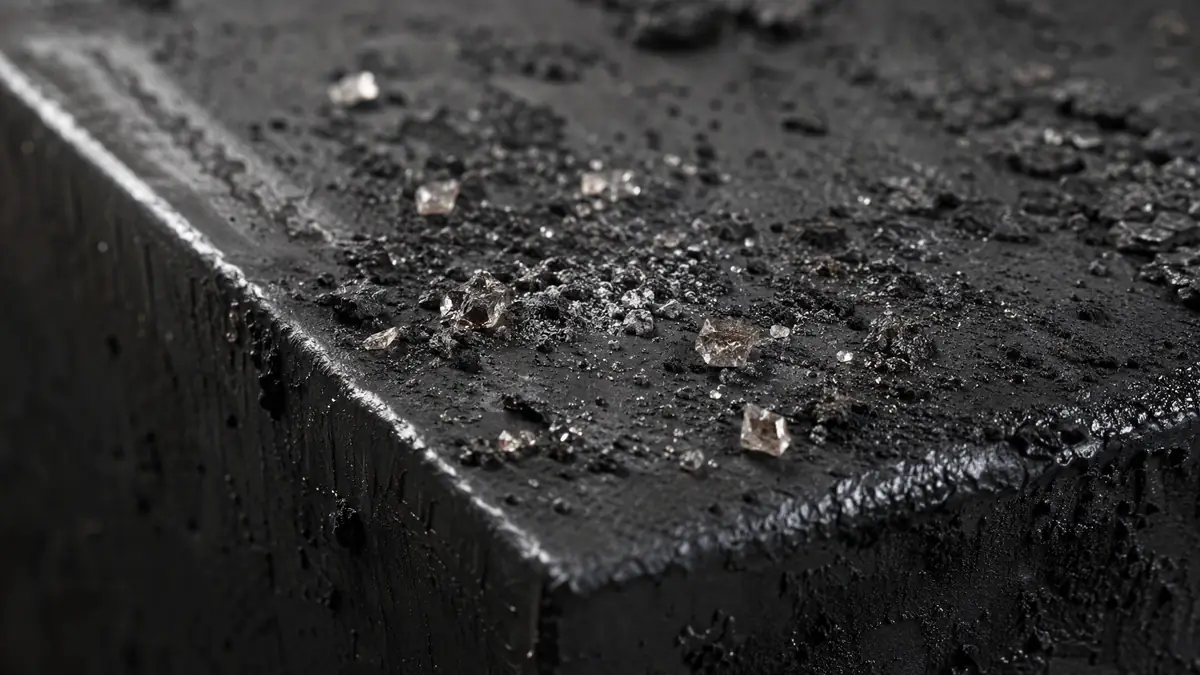
Close-up of shattered garnet abrasive failing to penetrate thick mill scale on hot-rolled steel.
Light, friable abrasives like garnet shatter on impact with hard mill scale, creating dust instead of a clean surface profile.

An image illustrating the introduction of an article on mill scale removal. A macro photograph shows a thick layer of black mill scale on steel with shattered particles of a light-colored abrasive, visually explaining why standard media fails and aggressive abrasives are required.

Close-up of shattered garnet abrasive failing to penetrate thick mill scale on hot-rolled steel.

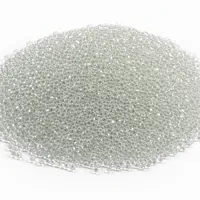
If you have ever watched a garnet or glass bead blast bounce harmlessly off a thick layer of mill scale, you already know the problem. Mill scale—the hard, brittle iron oxide layer formed during hot rolling—is chemically bonded to the steel surface. It resists light abrasives and clogs conventional blasting setups. The result: wasted hours, excessive media consumption, and a surface profile that fails to meet Sa 2½ or Sa 3 requirements.

This article is written for steel processors, fabricators, and blasting contractors who need to strip heavy mill scale efficiently. It covers which abrasives work, why they work, and how to match media to your equipment and surface preparation standard. The focus is exclusively on mill scale removal—not general rust, paint, or light surface contamination.

What Makes Mill Scale Different from Rust or Paint

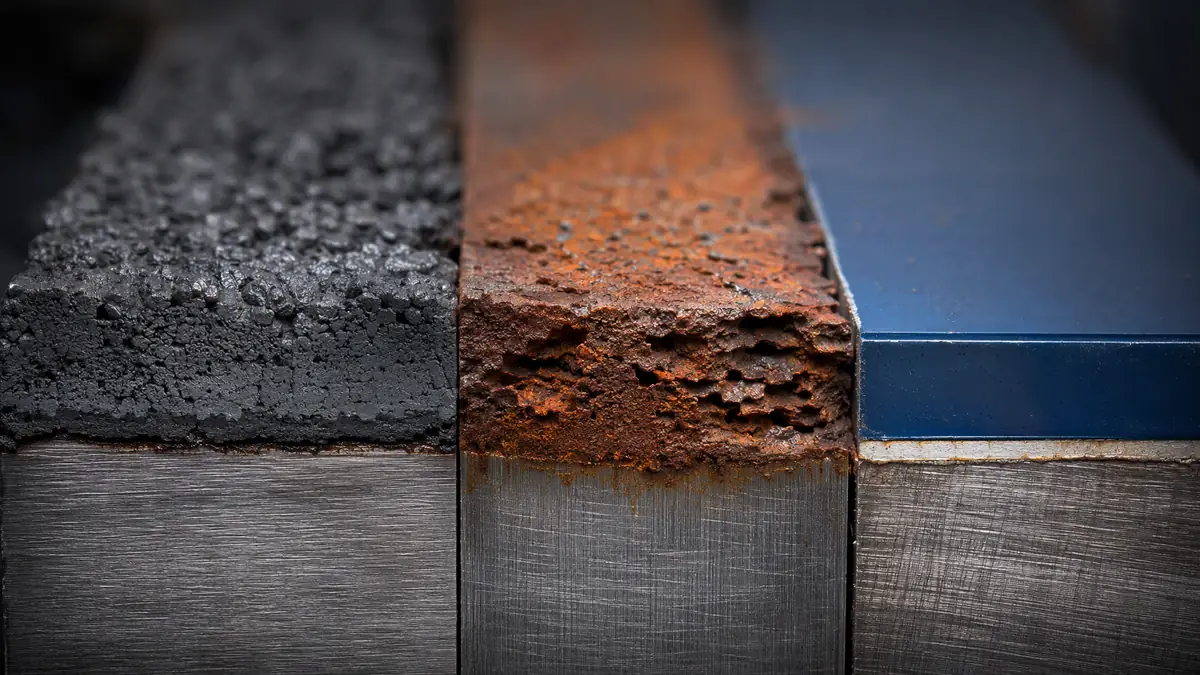
Cross-section comparison of mill scale, rust, and paint layers on steel surfaces showing density and adhesion differences.
Mill scale (left) is a dense, hard, chemically bonded oxide layer, unlike flaky rust or a superficial paint coating.

A visual comparison for an article section explaining the unique properties of mill scale. A macro photograph shows a cross-section of three steel plates with mill scale, rust, and paint, emphasizing the mill scale's thickness, hardness, and tight bond to the base metal.

Cross-section comparison of mill scale, rust, and paint layers on steel surfaces showing density and adhesion differences.

Mill scale is not ordinary rust. It forms at rolling temperatures above 580 °C and consists primarily of magnetite (Fe₃O₄), with a thin outer layer of hematite (Fe₂O₃). The scale adheres tightly to the base metal and can reach a Mohs hardness of 5.5 to 6.5—harder than many common blast media.

Three characteristics define the removal challenge:

  • High hardness means soft or friable abrasives fracture on impact rather than cutting into the scale.
  • Brittle nature means the scale fractures under sharp, high-energy impact—but only if the abrasive delivers sufficient kinetic energy.
  • Variable thickness on hot-rolled plate, structural sections, and pipe means a one-size-fits-all media choice rarely works across all jobs.

Understanding this difference is the first step toward selecting an abrasive for mill scale removal that actually performs.

Why Light Media Fails on Heavy Mill Scale

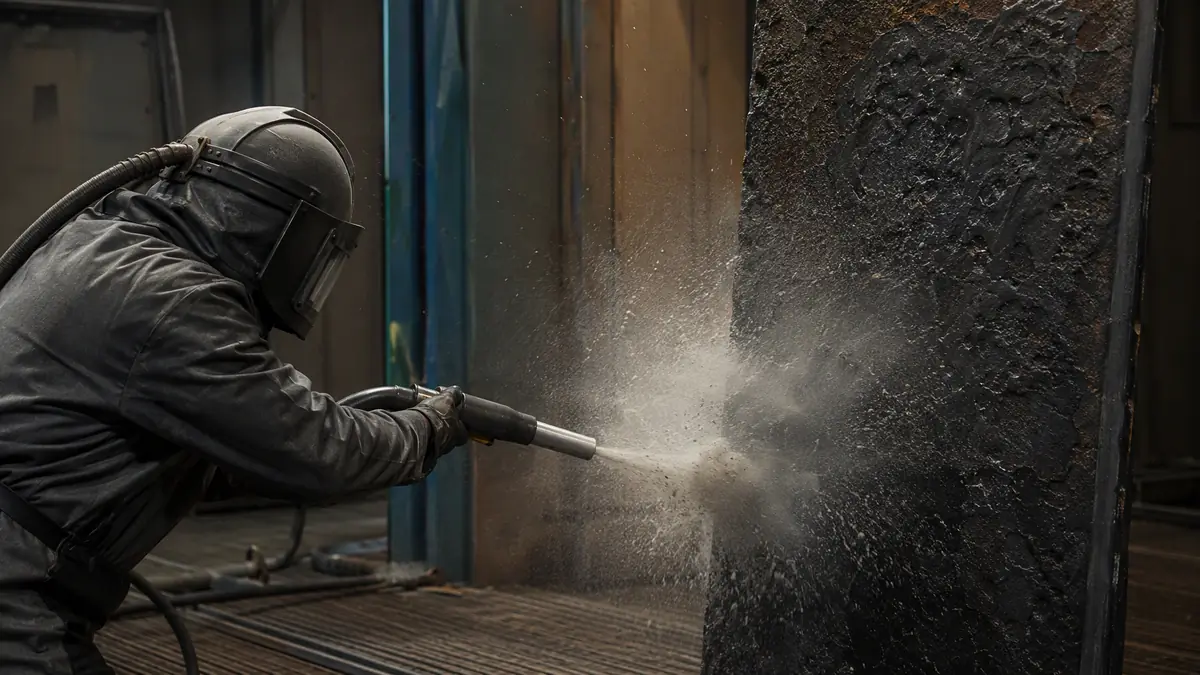
Blast nozzle using light media creating a dust cloud on impact with heavy mill scale without removing it.
Using light media on heavy mill scale results in particle shattering, excessive dust, and minimal scale removal, slowing production.

An image for a section on why light media fails. An action shot in a blast room shows a nozzle applying a light-colored abrasive to a thick mill scale layer, resulting in a large dust cloud and no scale removal, illustrating the inefficiency and economic cost of incorrect media selection.

Blast nozzle using light media creating a dust cloud on impact with heavy mill scale without removing it.

The most common mistake steel processors make is using the same scale blast media they use for maintenance coating removal or light rust. Garnet, glass bead, and even some grades of coal slag simply lack the mass and fracture toughness to break through thick mill scale efficiently.

When light media hits mill scale:

  • The particle shatters on contact, creating dust rather than a clean profile.
  • Impact energy dissipates at the surface instead of transferring into the scale layer.
  • Blast pressure must be increased to compensate, raising compressor fuel costs and accelerating nozzle wear.
  • Production speed drops, sometimes by 50% or more compared to using the correct abrasive.

The economics are straightforward: a cheaper abrasive that takes twice as long and generates more waste is rarely cheaper in practice.

Best Abrasives for Mill Scale Removal

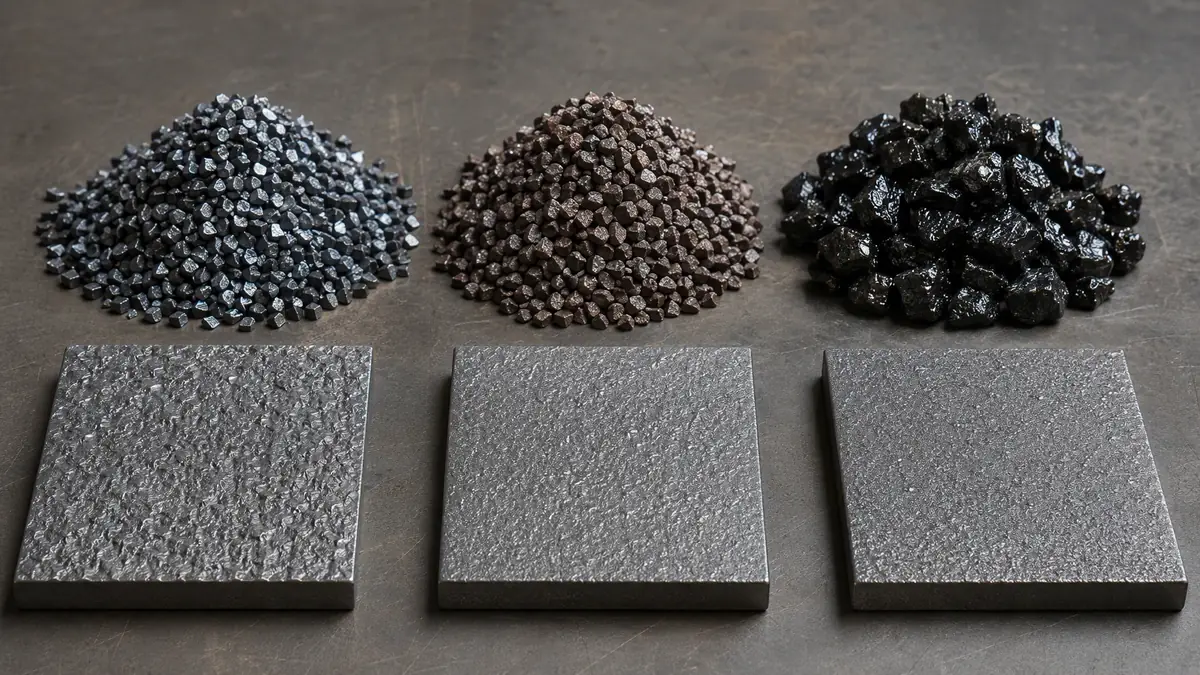
Comparison of steel grit, aluminum oxide, and coal slag abrasives with resulting surface profiles on steel coupons.
A direct comparison of the best mill scale removal media. Steel grit (left) produces the sharpest anchor profile for coating adhesion.

An image for the section on the best abrasives for mill scale removal. A product comparison shot shows piles of steel grit, aluminum oxide, and coal slag next to blasted steel coupons, visually demonstrating the different surface profiles each media creates on mill scale.

Comparison of steel grit, aluminum oxide, and coal slag abrasives with resulting surface profiles on steel coupons.

Steel Grit: The First Choice for Heavy Scale

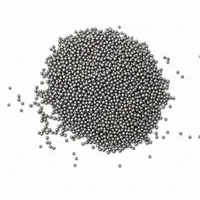
Steel grit is the most effective abrasive for mill scale removal on structural steel, plate, and heavy fabrications. Angular in shape and high in density (approximately 7.6 g/cm³), it delivers the impact energy needed to fracture mill scale and cut a sharp anchor profile.

Key advantages:

  • High bulk density transfers maximum kinetic energy per particle.
  • Angular particles cut rather than peen, creating the sharp profile required for coating adhesion.
  • Recyclable in blast rooms and wheel blasting machines, reducing media cost per square metre over multiple cycles.
  • Available in multiple hardness grades: GP (general purpose, ~42–52 HRC), GL (low hardness, ~56–60 HRC), and GH (high hardness, ~60+ HRC). For heavy mill scale, GH or GL grit provides the best balance of cutting speed and particle durability.

Typical grit sizes for mill scale removal range from G25 to G40 (coarse) for heavy scale on thick plate, down to G50–G80 for thinner sections where profile depth must be controlled. Confirm the required profile against your coating specification before selecting grit size.

Limitations: Steel grit is not suitable for stainless steel or non-ferrous metals where iron contamination is unacceptable. It also requires dry, enclosed blasting environments to enable recycling. For open-nozzle, single-pass blasting, the higher initial media cost may not be justified unless productivity gains offset it.

Aluminum Oxide: The Alternative for Single-Pass and Non-Ferrous Work

When steel grit cannot be used—for stainless steel, aluminium, or open blasting where recycling is impractical—aluminum oxide is the next best abrasive for mill scale removal.

Brown fused aluminum oxide has a Mohs hardness of 9 and a blocky, angular particle shape. It cuts mill scale effectively and can be used in both suction and pressure blast systems. It is also non-metallic, eliminating the risk of ferrous contamination on stainless or non-ferrous substrates.

For heavy mill scale, select a coarse grade—typically 16 to 36 mesh. Finer grades (60 mesh and above) remove scale too slowly for production blasting and are better suited to surface finishing after scale removal.

Limitations: Aluminum oxide fractures under impact and generates dust. It is not recyclable in the same way as steel grit, making it more expensive per square metre in high-volume applications. Dust extraction and operator respiratory protection are essential.

Copper Slag and Coal Slag: Budget Options with Trade-Offs

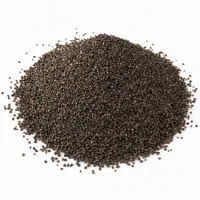
Copper slag and coal slag are widely used as low-cost, single-pass scale blast media. They are harder and denser than garnet, making them more effective on mill scale than many operators expect.

Copper slag (Mohs ~6–7, bulk density ~3.5 g/cm³) cuts faster than garnet on mill scale and produces an acceptable profile for many coating systems. Coal slag offers similar performance at a lower price point in some markets.

However, both have significant trade-offs:

  • High dust generation increases clean-up time and may require additional containment.
  • Single-use media generates substantial waste for disposal.
  • Inconsistent particle size in some supply chains can produce uneven profiles.
  • Silica content in coal slag (typically <1% in quality-controlled product, but variable) requires verification against occupational exposure limits.

These abrasives are best suited to open blasting of large structural steel where speed matters, recycling is not required, and waste disposal arrangements are in place.

Garnet: Limited Role in Mill Scale Removal

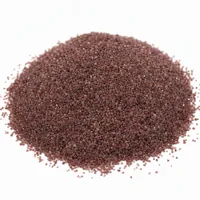
Garnet is an excellent abrasive for many surface preparation tasks, but heavy mill scale is not one of them. Its moderate hardness (Mohs 7–8) and tendency to fracture on impact make it inefficient for thick, hard scale. Blasting contractors who attempt to remove mill scale with garnet typically report slow production rates and high media consumption.

Garnet may be appropriate for light mill scale or for final blasting after the bulk of the scale has been removed by a more aggressive media. It is not recommended as the primary abrasive for heavy mill scale removal.
Matching Abrasive to Surface Preparation Standards

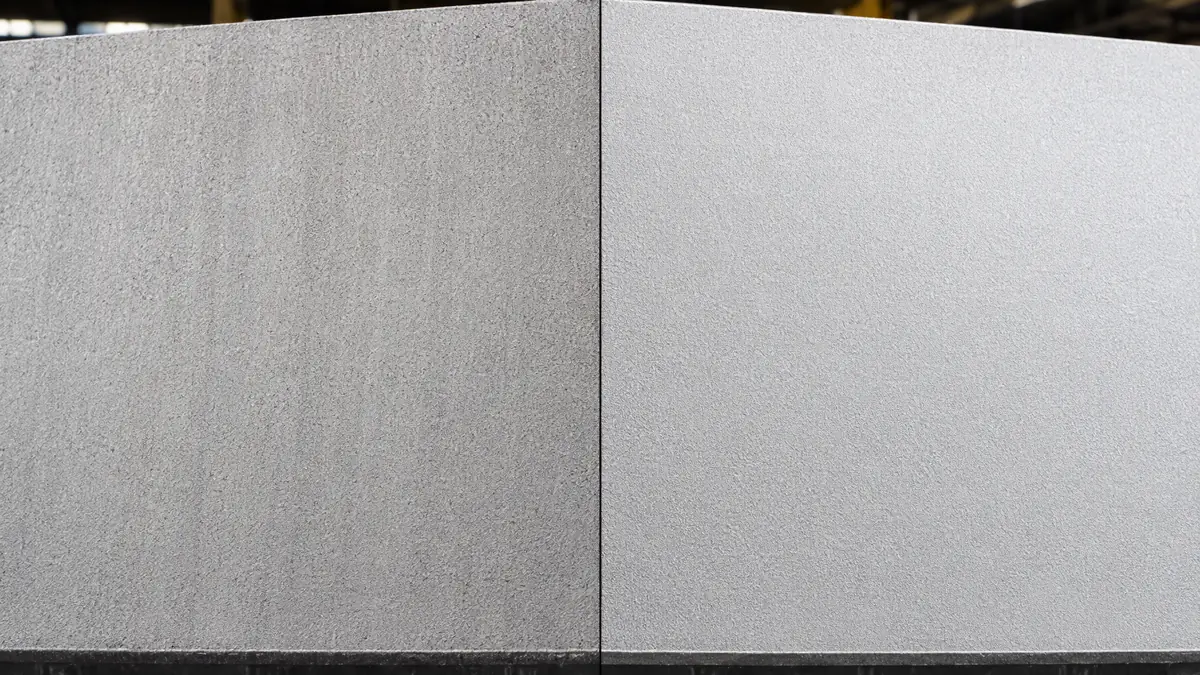
Split-screen comparison of Sa 2.5 near-white blast cleaned steel and Sa 3 white metal blast cleaned steel.
The difference between an Sa 2.5 near-white finish (left) with slight staining and a completely clean Sa 3 white metal finish (right).

An image for a section on surface preparation standards. A split-screen photo compares two blasted steel plates: one with an Sa 2.5 finish showing light stains, and another with a perfect Sa 3 white metal finish, illustrating the visual standard required for high-performance coatings.

Split-screen comparison of Sa 2.5 near-white blast cleaned steel and Sa 3 white metal blast cleaned steel.

The required surface preparation standard directly influences abrasive selection. The two most common standards for mill scale removal are:

Sa 2½ (Near-White Blast Cleaning): Mill scale, rust, and foreign matter must be removed to the extent that only light stains in the form of spots or stripes remain. This is the typical requirement for high-performance protective coatings. Steel grit G40–G50 or aluminum oxide 24–36 mesh generally achieves this standard efficiently.

Sa 3 (White Metal Blast Cleaning): All mill scale, rust, and foreign matter must be removed completely. The surface must have a uniform metallic colour. This standard requires a sharp, angular abrasive—typically steel grit GH grade or coarse aluminum oxide—and may require a second pass with finer media to achieve the specified profile without embedding.

Always confirm the specified Sa grade and required surface profile (in microns or mils) before selecting abrasive type and size. The coating manufacturer's data sheet is the authoritative reference.

Selection Checklist for Mill Scale Abrasives

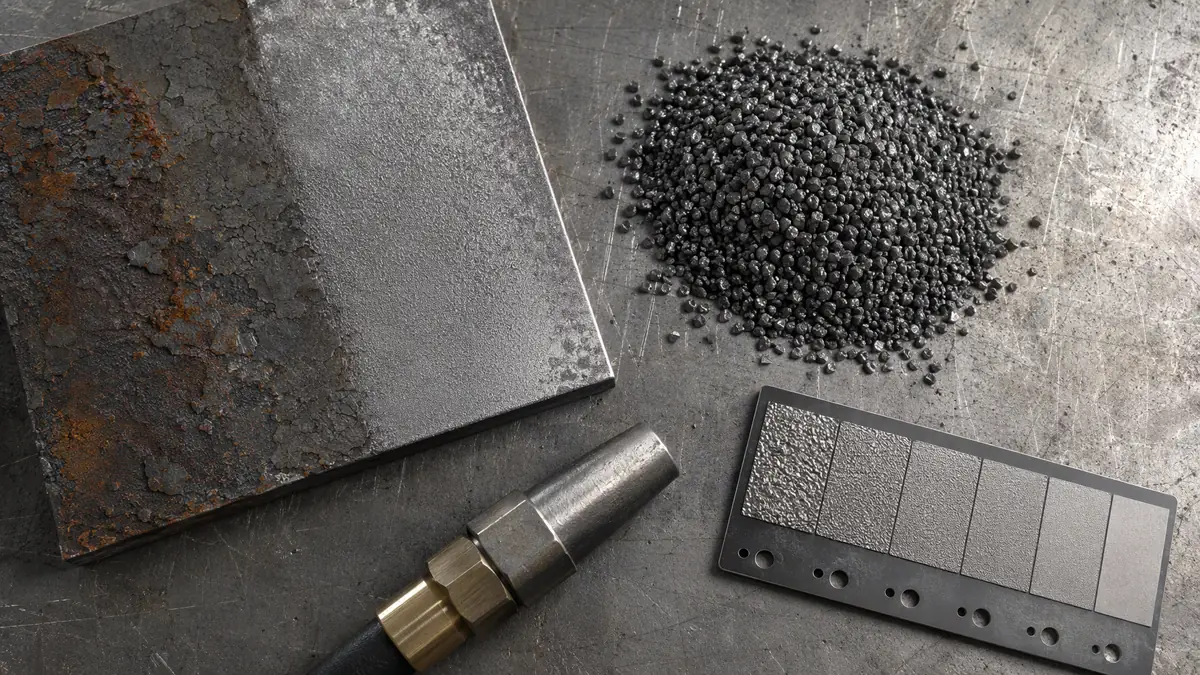
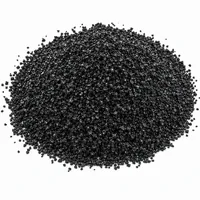
Flat lay of hot-rolled steel, steel grit abrasive, blast nozzle, and surface profile gauge on a workbench.
Key elements for selecting a mill scale abrasive: the substrate, the media, the blasting equipment, and the target surface profile.

An image for a selection checklist section. A flat-lay photograph on a steel workbench shows a piece of heavily scaled steel, a pile of angular steel grit, a blast nozzle, and a surface profile comparator, visually representing the factors in choosing the correct abrasive for mill scale removal.
Flat lay of hot-rolled steel, steel grit abrasive, blast nozzle, and surface profile gauge on a workbench.

Use this checklist when choosing an abrasive for mill scale removal:

  • Substrate type: Carbon steel (steel grit acceptable) or stainless/non-ferrous (aluminum oxide or slag required)?
  • Scale thickness: Heavy mill scale on hot-rolled plate, or light scale on pickled and oiled material?
  • Blasting method: Wheel blasting (recyclable steel grit preferred) or open-nozzle blasting (single-pass media may be more practical)?
  • Required standard: Sa 2½ or Sa 3? What is the specified anchor profile depth?
  • Production rate target: Square metres per hour required to meet project schedule?
  • Recycling capability: Does the site have media recovery and cleaning equipment?
  • Waste disposal: Are arrangements in place for spent abrasive disposal, and what are the associated costs?
  • Contamination risk: Is ferrous contamination acceptable, or must it be avoided?

Common Mistakes and How to Avoid Them

Using undersized abrasive: Fine grit lacks the mass to break mill scale. Match grit size to scale thickness—coarser for heavy scale, finer only for thin scale or profile control.

Running excessive blast pressure: Operators sometimes compensate for wrong media by increasing pressure. This accelerates nozzle wear, increases media breakdown, and may embed abrasive fragments in the surface. Correct media selection eliminates the need for excessive pressure.

Neglecting media cleanliness in recycling systems: In wheel blasting machines, contaminated or worn steel grit loses cutting efficiency. Monitor working mix regularly and maintain the correct proportion of new grit addition.

Ignoring profile depth requirements: An abrasive that removes scale aggressively may also create a profile deeper than the coating specification allows. Verify profile with test coupons or replica tape before full production.

Assuming all slag media are equivalent: Quality varies significantly between suppliers. Specify particle size distribution and free silica content when purchasing slag abrasives. Request a certificate of analysis for critical projects.

Conclusion

Heavy mill scale demands an abrasive that matches its hardness and tenacity. Steel grit is the most effective choice for carbon steel in recycling blasting systems. Aluminum oxide provides a capable alternative for stainless steel and single-pass applications. Copper slag and coal slag offer budget-conscious options for open blasting, provided their dust and disposal trade-offs are managed. Garnet and other light media are generally unsuitable as primary abrasives for this task.

The right abrasive for mill scale removal is the one that meets your surface preparation standard at the lowest total cost per square metre—factoring in media cost, consumption rate, production speed, and waste disposal. Test your media against a representative sample of the actual workpiece before committing to a full production run.

Frequently Asked Questions

What is the single most effective abrasive for removing heavy mill scale from carbon steel?

Steel grit is the most effective abrasive for heavy mill scale on carbon steel. Its high density and angular shape deliver the impact energy needed to fracture the hard, brittle scale and cut a sharp anchor profile. It is also recyclable in enclosed blasting systems, reducing long-term media costs.

Can I use garnet to remove heavy mill scale?

Garnet is not recommended as a primary abrasive for heavy mill scale. Its tendency to fracture on impact against hard scale leads to slow production, high media consumption, and excessive dust. It may be suitable for a final blasting pass after the bulk of the scale has been removed by a more aggressive media like steel grit.

Which abrasive should I choose for mill scale on stainless steel?

Aluminum oxide is the best choice for removing mill scale from stainless steel. It is non-metallic, so it eliminates the risk of ferrous contamination that can cause pitting corrosion. For heavy scale, use a coarse grade like 16 to 36 mesh in a pressure or suction blast system.

What grit size of steel grit is best for heavy mill scale?

For heavy mill scale on thick plate, coarse steel grit sizes from G25 to G40 are typically most effective. For thinner sections where profile depth must be tightly controlled, a medium grit like G50 to G80 is more appropriate. Always match the grit size to the anchor profile depth specified by the coating manufacturer.

Why does my current blast media just bounce off the mill scale?

This happens when the media lacks sufficient mass and fracture toughness. Light, friable abrasives like glass bead or fine garnet shatter on impact, dissipating energy at the surface instead of transferring it into the scale. Switching to a high-density, angular abrasive like steel grit or coarse aluminum oxide solves this problem.

What are the trade-offs of using a cheap, single-pass media like copper slag?

Copper slag cuts faster than garnet and has a lower upfront cost, but it generates high dust levels, creates significant waste for disposal, and is a single-use product. Inconsistent particle sizing can also produce an uneven surface profile. It is a practical budget option for large, open blasting jobs where recycling is not required.

How do I choose an abrasive to meet an Sa 2½ surface preparation standard?

To achieve an Sa 2½ near-white blast on mill scale, you need a sharp, angular abrasive. Steel grit in the G40 to G50 range or aluminum oxide in 24 to 36 mesh are excellent starting points. The abrasive must remove all scale, leaving only light stains, and create the specific anchor profile depth required by your coating system.

What is the most common mistake when blasting mill scale?

The most common mistake is using an undersized or overly friable abrasive that lacks the mass to break the scale. Operators often try to compensate by increasing blast pressure, which accelerates nozzle wear, wastes energy, and can embed abrasive fragments in the surface without solving the core problem of slow production.

Solution

Selecting the correct abrasive is a decision best made with complete technical data. Compare steel grit, aluminum oxide, and slag abrasives on the SPA2Z abrasive product pages to review specifications, available grades, and typical applications. For assistance with media selection for a specific mill scale removal project, contact the SPA2Z sales team with your substrate details, required Sa grade, and blasting method—a technical recommendation can help you avoid costly trial and error.

Get a quote

Get a quote

Tell us what you need. We reply within one business day.

Sending…
Need a price? Ask us here.