ABRASIVES GUIDE

Coastal Plants: Salt Contamination and Abrasive Workflow

For coastal fabricators and blasting crews, the salt-laden air that corrodes the steel before it even reaches the shop is the same contaminant that quietly dest...

Published
18 Apr 2015
Category
Abrasives
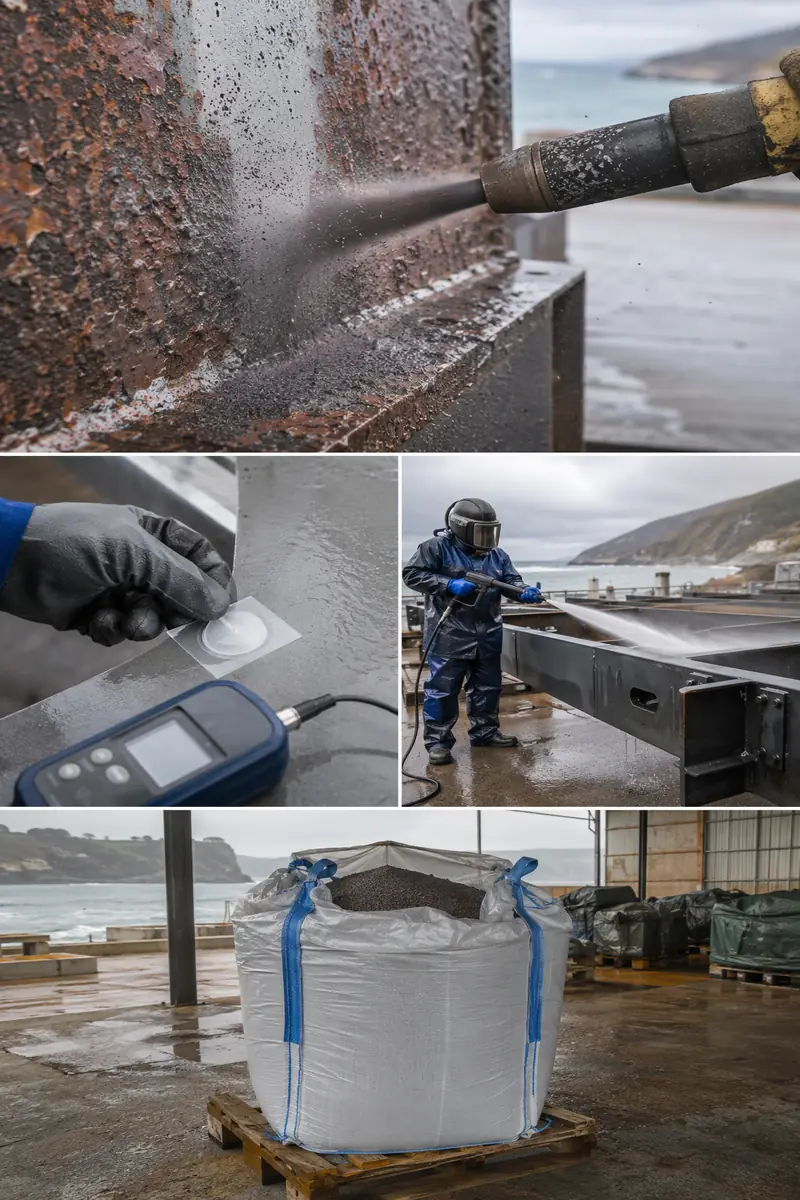
Multi-panel editorial collage showing coastal abrasive blasting workflow: garnet blasting steel, Bresle chloride test, fresh
FIG. 01A multi-panel industrial collage illustrat...

Featured image for an article on managing salt contamination in coastal abrasive blasting. The photorealistic collage shows four key panels: a dominant view of garnet blasting on pitted steel, a Bresle patch test for chlorides, a high-pressure fresh water wash-down in a coastal yard, and sealed abra

Introduction

For coastal fabricators and blasting crews, the salt-laden air that corrodes the steel before it even reaches the shop is the same contaminant that quietly destroys a coating system from the inside out. Understanding how chlorides survive the abrasi…

Introduction

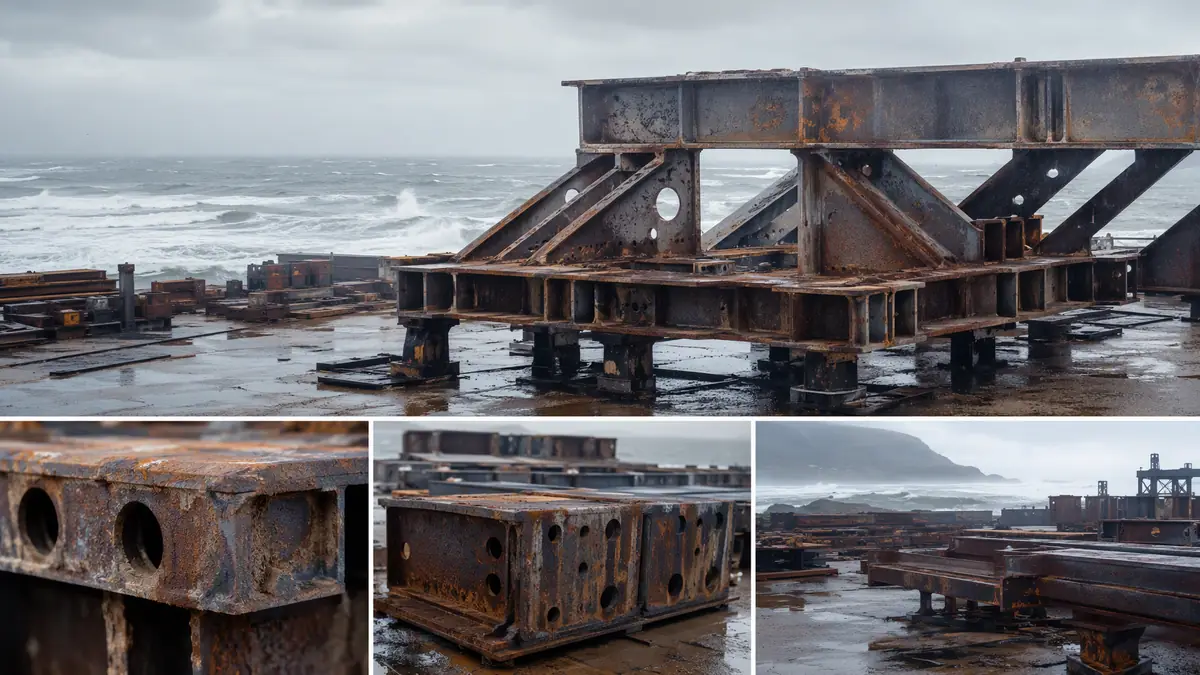
Coastal industrial fabrication yard with rusted steel structure exposed to marine aerosol and ocean background.
A coastal fabrication yard where steel structures are continuously exposed to chloride-rich marine aerosol, the primary source of pre-blast salt contamination.

A wide, photorealistic image of a coastal industrial yard. A large, unpainted steel fabrication with surface rust sits in the foreground. The background features a grey, turbulent ocean, visually communicating the constant exposure to wind-borne marine aerosol that deposits corrosive chloride salts

Coastal industrial fabrication yard with rusted steel structure exposed to marine aerosol and ocean background.

If your facility is within a few kilometres of the coast, you are not just fighting visible rust. You are fighting an invisible, ionic enemy: chloride salts. These salts settle on steel surfaces from marine aerosol, become trapped in surface pits, and—if not removed before painting—trigger osmotic blistering and underfilm corrosion that no topcoat can stop.

This article is written for coastal fabricators, surface preparation contractors, and quality managers who need a practical, technically sound workflow for managing salt contamination during abrasive blasting. You will learn how chlorides behave in a coastal environment, why standard blasting alone is often insufficient, how to test for residual salts using field methods like the Bresle test, and what adjustments to your abrasive media and process flow can reduce costly coating failures.

What Is Coastal Blasting Salt Contamination?

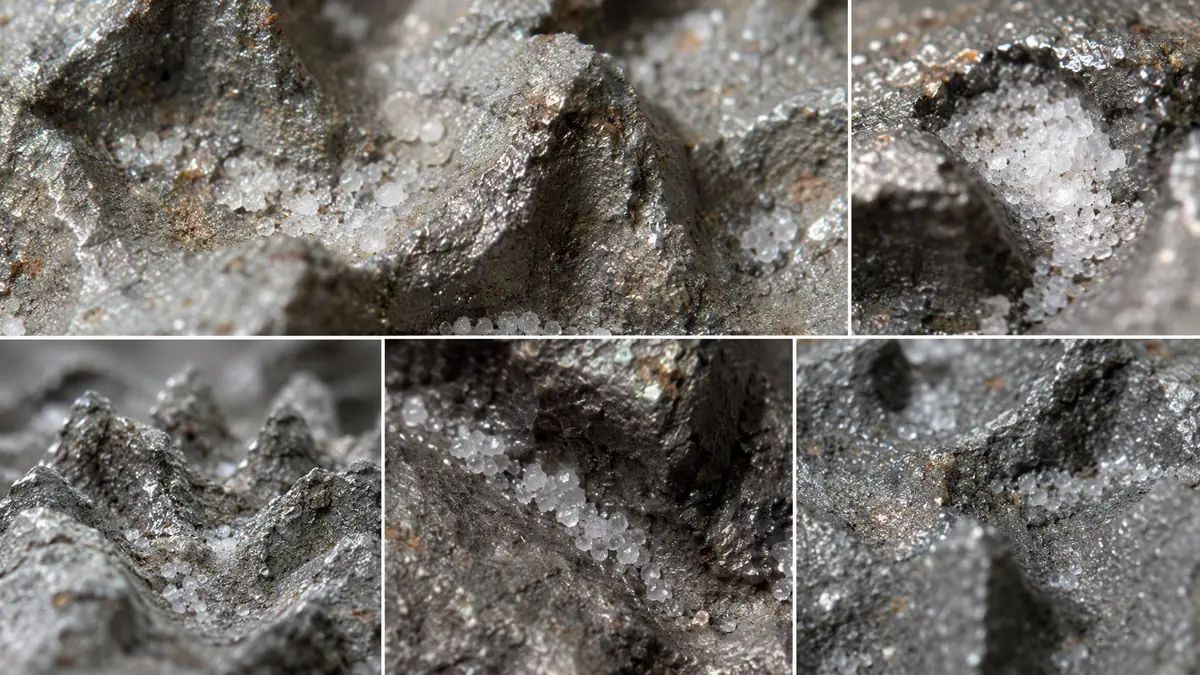
Extreme macro view of crystalline salt deposits trapped in the anchor profile valleys of freshly blasted steel.
A macro photograph revealing how chloride salts crystallize and remain trapped in the deep valleys of a blast-cleaned steel surface profile, invisible to the na

An extreme macro, photorealistic image showing the anchor profile of freshly blasted steel. The focus is on deep surface valleys containing tiny, white, crystalline chloride salt deposits. The image explains why dry abrasive blasting alone is often insufficient for complete salt removal, as the ions

Extreme macro view of crystalline salt deposits trapped in the anchor profile valleys of freshly blasted steel.

Salt contamination in a blasting context refers to soluble salts—primarily sodium chloride and to a lesser extent calcium and magnesium chlorides—that deposit on steel surfaces from marine atmosphere, seawater spray, or handling with contaminated abrasives. These salts are hygroscopic: they attract moisture through a coating film, creating a corrosion cell at the steel-coating interface.

The problem is particularly acute for coastal plants because:
- Pre-blast contamination is continuous. Steel stored outdoors near the coast accumulates chlorides daily, not just from direct seawater contact but from wind-borne aerosol that can travel several kilometres inland.
- Post-blast flash rust accelerates when residual chlorides remain. A surface that looks clean at first can develop a thin orange-brown rust film within 30–60 minutes in humid coastal air—far faster than the same surface inland.
- Abrasive media itself can become a chloride carrier if stored improperly. Garnet or slag stored in open bays near the waterfront absorbs salt-laden moisture and transfers it directly to the blasted surface.

The core mechanism is straightforward: chlorides are invisible to the naked eye at concentrations that cause coating failure. Industry guidance generally considers soluble salt levels below 3–5 µg/cm² (as chloride) acceptable for most protective coating systems, though some high-performance marine specifications demand less than 2 µg/cm². A surface that looks perfectly white-metal clean under ISO 8501-1 Sa 2½ can still carry enough chloride to destroy a three-coat epoxy system within the first year of service.

Why Salt Contamination Matters for Coastal Fabricators

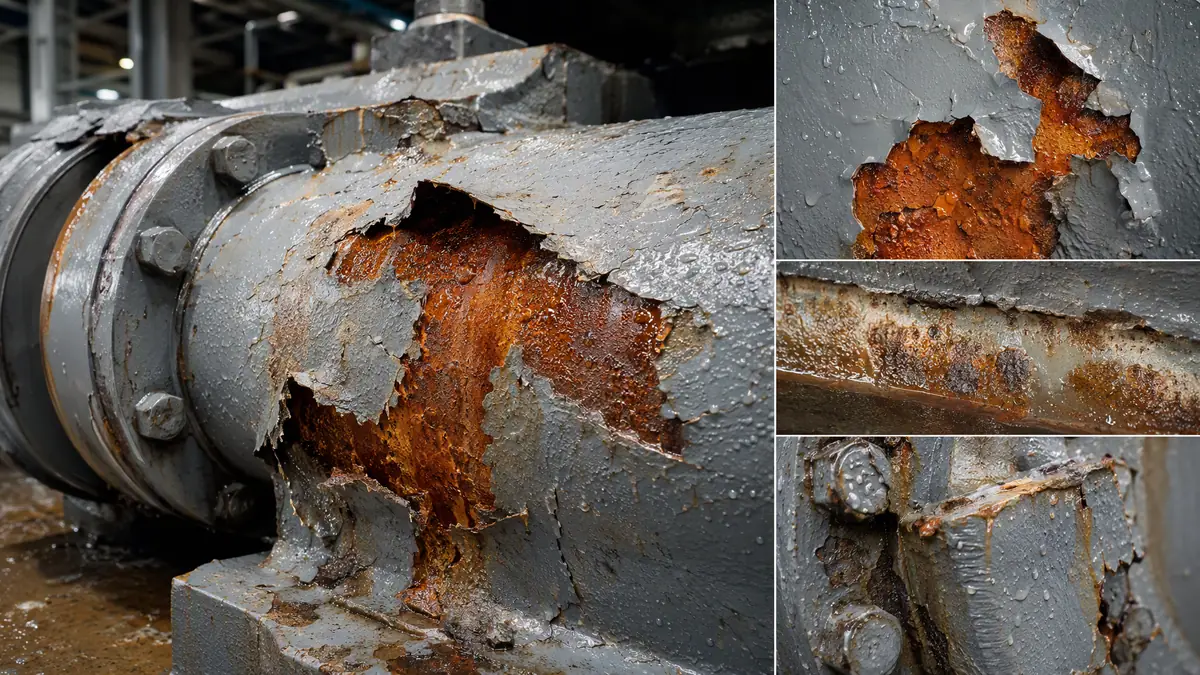
Close-up of peeling epoxy coating and wet underfilm corrosion on a steel component due to salt contamination.
The costly consequence of ignoring chlorides: osmotic blistering causes an epoxy coating to peel from the steel substrate, revealing active underfilm corrosion.

A detailed, photorealistic close-up of a failed industrial coating. Large flakes of a grey epoxy coating are peeling back from a steel surface, exposing bright orange, wet rust underneath. The image visually represents the warranty claims, rework costs, and production bottlenecks caused by salt-indu

Close-up of peeling epoxy coating and wet underfilm corrosion on a steel component due to salt contamination.

The cost of ignoring chlorides is not theoretical. When a coating fails prematurely on a structural steel assembly, a pressure vessel, or a ship section, the consequences cascade:
- Warranty claims and rework costs that can exceed the original contract value.
- Production bottlenecks when completed fabrications must be returned for stripping and re-coating.
- Reputation damage with engineering firms and asset owners who specify surface preparation standards.

For the coastal fabricator, the challenge is compounded by geography. An inland shop can often rely on dry storage and a single blast cycle to achieve acceptable salt levels. A coastal shop—particularly one within 500 metres of the shoreline—must treat chloride management as a distinct process step, not an afterthought.

How Chlorides Survive the Blasting Process

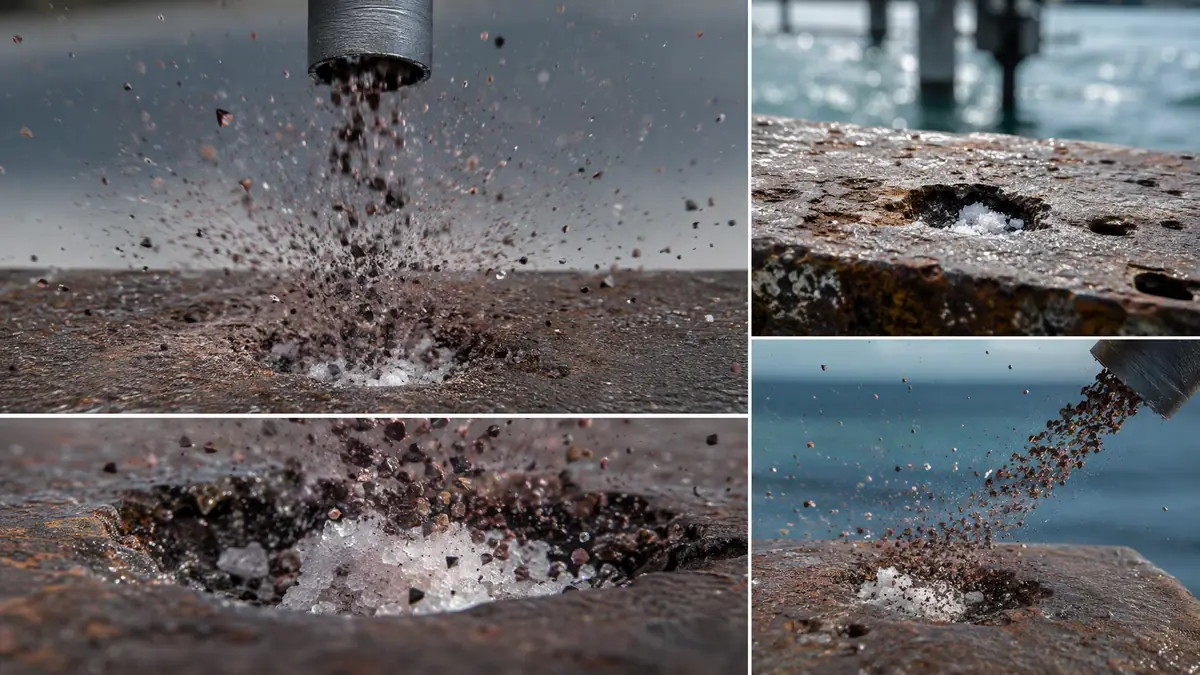
High-speed shot of garnet abrasive blasting a steel pit while a salt deposit remains untouched inside.
A high-speed capture showing abrasive particles impacting a steel surface but failing to dislodge a chloride salt deposit sheltered within a deep corrosion pit.

A dynamic, high-speed photorealistic image of the abrasive blasting process. A stream of dark garnet particles hits a pitted steel surface. The key detail is a visible white salt crystal remaining intact inside a deep pit, demonstrating how water-soluble chlorides survive mechanical blasting because

High-speed shot of garnet abrasive blasting a steel pit while a salt deposit remains untouched inside.

A common misconception is that abrasive blasting automatically removes salt contamination. It does not—at least not reliably. Here is why:

  1. Chlorides are water-soluble, not mechanically bound. Abrasive impact removes mill scale, rust, and old coatings by kinetic energy. Chloride ions, however, are dissolved in microscopic moisture films or crystallised in surface pits. The abrasive particle may pass right over them without dislodging the ion.

  2. Surface profile traps salts. When you blast to create an anchor profile (typically 50–100 µm for protective coatings), you create peaks and valleys. Chlorides concentrate in the valleys, where subsequent abrasive impacts may not reach effectively.

  3. Contaminated abrasive adds salt during blasting. If your garnet or slag has been exposed to coastal humidity, it carries its own chloride load. Every particle that hits the surface can deposit as much salt as it removes. This is a self-defeating cycle that many shops do not recognise until coating failures accumulate.

  4. Compressed air quality matters. Oil-free compressors do not guarantee salt-free air. In coastal environments, the intake air itself carries salt aerosol. Without adequate filtration and drying, the compressed air stream becomes a chloride delivery system.

The practical implication: blasting alone is a surface preparation step for profile and cleanliness, not a decontamination step for soluble salts. If your specification demands low chloride levels, you need a deliberate salt removal workflow.

When Blasting Alone Is a Poor Fit

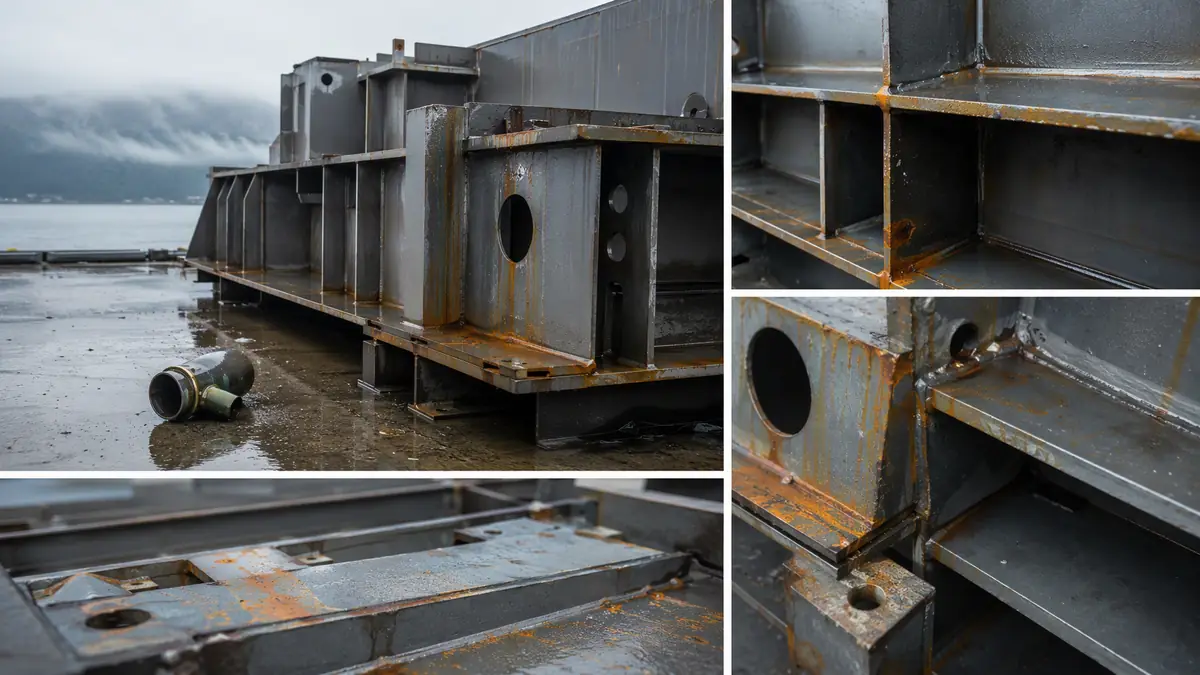
Complex steel fabrication with stiffeners and crevices developing flash rust on a humid coastal morning.
A complex steel structure with moisture-trapping geometries rapidly develops flash rust in high-humidity coastal air, a scenario where dry blasting alone is ins

A photorealistic image of a coastal industrial setting on a foggy morning. A large steel fabrication with complex geometries like stiffeners and lap joints is covered in condensation and developing bright orange flash rust. The scene illustrates the specific conditions where a dry-blast-only workflo

Complex steel fabrication with stiffeners and crevices developing flash rust on a humid coastal morning.

There are specific scenarios where relying solely on dry abrasive blasting for salt removal is likely to fail:

  • Steel stored outdoors near the surf zone for more than 48 hours before blasting.
  • Structures with complex geometries—stiffeners, lap joints, crevices—where salt can concentrate and abrasive access is limited.
  • High-humidity seasons (monsoon periods on the Indian coast, for example) when surfaces remain damp and flash rust appears within minutes.
  • Projects specifying immersion-grade coating systems (e.g., epoxy glass flake for splash zones) where chloride tolerance is near zero.

In these cases, a dry-blast-only workflow is insufficient. You need to integrate washing, testing, and possibly media changes into your process.

The Coastal Abrasive Workflow: A Practical Sequence

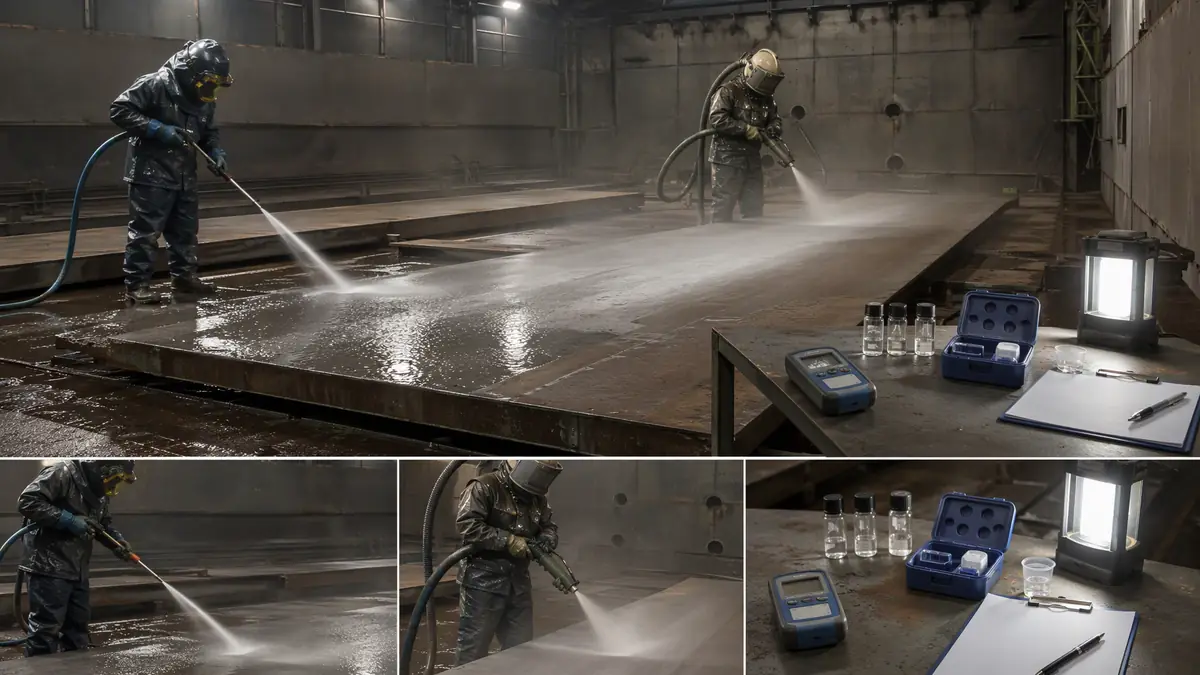
Integrated coastal blasting workflow showing fresh water wash-down, abrasive blasting, and Bresle test hold point in a blast
An integrated view of the chloride-aware workflow: a fresh water wash-down, dry abrasive blasting, and a formal Bresle chloride test hold point before coating.

A single, photorealistic image inside an industrial blast booth showing the practical sequence of a coastal abrasive workflow. One worker performs a high-pressure fresh water wash, another conducts dry abrasive blasting on a separate section, and a formal quality control station with a Bresle test k

Integrated coastal blasting workflow showing fresh water wash-down, abrasive blasting, and Bresle test hold point in a blast

A chloride-aware blasting workflow for coastal plants typically follows this sequence. Adjust the specifics to your project specification and environmental conditions.

1. Pre-Blast Assessment and Storage

Before abrasive ever touches the steel, reduce incoming chloride load:
- Store steel under cover where possible, away from prevailing onshore winds.
- If outdoor storage is unavoidable, orient stock so that rainwater can wash surfaces rather than pool in crevices.
- Consider a freshwater wash-down before blasting for heavily contaminated steel. A high-pressure fresh water wash (below 250 bar to avoid driving salts deeper) can remove a significant fraction of surface chlorides before the blast cycle begins.

2. Abrasive Selection and Media Management

Not all abrasives behave the same way with respect to salt:
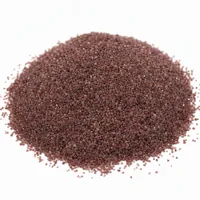
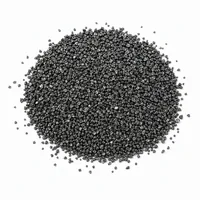
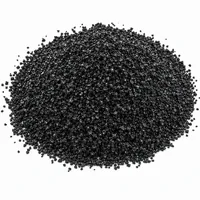
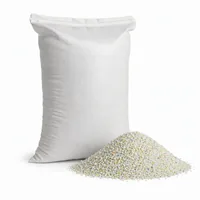
- Garnet is a popular choice for coastal work because it is inert, does not introduce ferrous contamination, and—when sourced and stored correctly—carries low inherent chloride levels. However, garnet stored in open bags near the coast will absorb moisture and salt. Keep bags sealed and stored in a dry area.
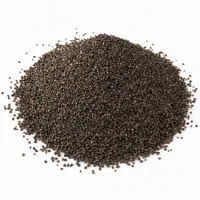
- Copper slag and coal slag can contain residual chlorides from the manufacturing process or from environmental exposure. Verify the supplier's chloride specification if you are blasting for a marine coating system.
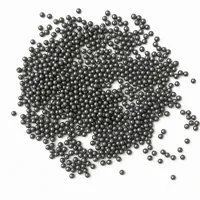
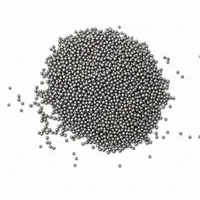
- Steel grit introduces the risk of ferrous contamination that can itself promote corrosion if not properly cleaned from the surface. It is generally not the first choice for salt-sensitive applications unless followed by a wash.
- Recycled abrasives in shot blasting machines require particular attention. The recycling loop can concentrate chlorides over time. Regular testing of the abrasive working mix for chloride content is advisable in coastal shot blast operations.

Practical tip: If you suspect your abrasive is contaminated, run a simple check. Take a sample of the abrasive, mix it with a known volume of deionised water, and test the solution with a chloride titration kit or conductivity meter. This gives you a rough indication of the chloride contribution your media is making to the blasted surface.

3. The Blast Cycle: Profile, Not Decontamination

Execute the blast to achieve the specified cleanliness (e.g., Sa 2½) and surface profile. Do not rely on extended blasting to remove chlorides—it is inefficient and risks embedding salts deeper into the profile.

For coastal work, consider:
- Blasting in lower-humidity windows where possible (early morning before the sea breeze picks up, or during drier seasons).
- Minimising the time between blasting and testing/coating. The longer a blasted surface sits in coastal air, the more chloride it re-accumulates. Some specifications require coating within four hours of blasting in marine environments.

4. Post-Blast Chloride Testing

This is the critical verification step. The most widely used field method is the Bresle test (ISO 8502-6 and ISO 8502-9). The procedure:
- A Bresle patch—a self-adhesive cell with a known internal volume—is applied to the blasted surface.
- A specified volume of deionised water (typically 2.5–3.0 mL for a standard Bresle patch) is injected through the patch membrane.
- The water is agitated against the surface for a prescribed time to dissolve soluble salts.
- The solution is extracted and tested for conductivity using a calibrated conductivity meter.
- The result is converted to surface concentration (µg/cm² or mg/m²) based on the patch volume and surface area.

What the Bresle test tells you: total soluble salts, expressed as chloride equivalent. It does not distinguish between sodium chloride, calcium chloride, and other salts—but for coating failure prediction, the total ionic load is what matters.

Alternative field methods:
- Chloride-specific test strips (e.g., Quantab or similar chloride titration strips) can be used with the Bresle extraction method to measure chloride ions specifically rather than total salts. This is useful when the specification cites a chloride-only limit.
- Conductivity meters are the most common field instrument and are adequate for most applications when properly calibrated. Ensure the meter is temperature-compensated and calibrated against a known standard solution before each shift.

Testing frequency: There is no universal rule, but a practical starting point is one test per 10–20 m² of blasted surface, with additional tests after any process change (new abrasive batch, rain event, shift change). Critical areas like welds, crevices, and horizontal surfaces often harbour higher chloride levels and warrant targeted testing.

5. Interpreting Results and Taking Action

If chloride levels exceed the project specification:
- First action: Re-wash the surface with fresh water (preferably deionised or potable water with known low chloride content) and re-test. A pressure wash followed by drying and re-testing often brings levels within specification.
- If re-washing is insufficient: Consider a specialised salt remover or chloride-neutralising wash. These are proprietary chemical solutions designed to bind or displace chloride ions. Verify compatibility with your coating system before use.
- If levels remain stubbornly high: Investigate the abrasive media, compressed air quality, and ambient conditions. You may need to switch abrasive batches, improve air filtration, or adjust the work schedule to lower-humidity periods.

6. Flash Rust Management

Even with acceptable chloride levels, coastal humidity can produce flash rust—a thin, uniform layer of oxidation that forms on freshly blasted steel within minutes to hours. Flash rust is not necessarily a coating adhesion problem if it is light and uniform, but it must be assessed against the coating specification.

  • Light, tightly adherent flash rust may be acceptable for certain tolerant primer systems (check the coating data sheet).
  • Heavy, loose, or non-uniform flash rust indicates either excessive chlorides, excessive humidity, or excessive time between blasting and coating. Re-blast or re-wash as appropriate.
  • Preventive measures: Dehumidification equipment, tenting, or scheduling blasting for the driest part of the day can reduce flash rust formation. Some shops use vapour-phase corrosion inhibitors (VpCI) as a temporary hold between blasting and coating—confirm compatibility with your paint system.
Common Mistakes in Coastal Chloride Management

Mistake 1: Assuming "White Metal" Means Clean Enough

A Sa 3 "white metal" blast removes all visible mill scale, rust, and coating. It does not guarantee low chloride levels. Visual cleanliness and ionic cleanliness are independent parameters. Always verify with a Bresle test when chlorides are a concern.

Mistake 2: Testing Too Late

Running a Bresle test after the first coat is applied is pointless. The chloride is already sealed under the coating. Testing must happen after blasting and before the primer goes on. Build the test into the workflow as a hold point—no coating proceeds until chloride results are within specification.

Mistake 3: Neglecting the Abrasive Itself

A shop that carefully washes steel but blasts with salt-contaminated garnet is undoing its own work. Include abrasive chloride checks in your quality plan, especially after heavy rain or when using abrasive that has been stored outdoors.

Mistake 4: Using Tap Water Without Checking Its Chloride Content

Not all fresh water is low-chloride. Bore water in coastal areas can be brackish. If you are washing steel to remove salt, using water with unknown chloride levels is a gamble. Test the wash water periodically, particularly in dry seasons when bore water salinity can increase.

Mistake 5: Ignoring Compressed Air Quality

A poorly maintained compressor system in a coastal plant can introduce water, oil, and salt aerosol directly into the blast stream. Drain moisture traps regularly, check filters, and consider a coalescing filter and desiccant dryer for salt-sensitive work.

Selection Factors: Building a Coastal-Capable Blasting Setup

If you are specifying or upgrading equipment for coastal blasting work, consider these factors:

FactorWhy It Matters for Coastal Work
Abrasive typeInert, low-chloride media (e.g., high-quality garnet) reduce contamination risk
Abrasive storageSealed, covered storage prevents moisture and salt absorption
Compressed air treatmentCoalescing filters and dryers remove salt-laden moisture from the air stream
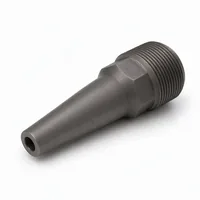
Blast nozzle selectionVenturi nozzles provide higher particle velocity for efficient cleaning; consider nozzle material for abrasive wear life
Wash-down capabilityA dedicated fresh water pressure washer enables pre- and post-blast washing
Testing kit availabilityBresle patches, conductivity meter, and calibration standards should be on-site and maintained
Work schedulingPlan blasting for lower-humidity periods; minimise open time before coating

Conclusion

Coastal blasting salt contamination is a manageable problem, but only if it is treated as a distinct process variable—not an afterthought to the blast cycle. The key principles are straightforward: minimise chloride input through good storage and abrasive management, verify cleanliness with field testing (not just visual inspection), and act on the results before the primer goes on.

For the coastal fabricator, the most important shift in thinking is this: abrasive blasting creates the profile; chloride testing confirms the surface is actually ready to coat. Both steps are non-negotiable for coating systems that must survive a marine environment.

Frequently Asked Questions

Why doesn't abrasive blasting alone remove salt contamination from steel?

Abrasive blasting removes rust and mill scale by mechanical impact, but chloride salts are water-soluble ions trapped in microscopic surface pits. The abrasive particles can pass right over these salts without dislodging them. Additionally, the anchor profile created by blasting has valleys where chlorides concentrate and become even harder to reach. A separate washing or decontamination step is required to dissolve and remove these salts.

What is the Bresle test and when should we use it?

The Bresle test (ISO 8502-6/9) is a field method for measuring soluble salt contamination on a blasted surface. It uses an adhesive patch, deionized water, and a conductivity meter to quantify the ionic load. You should perform it after blasting and before coating, especially on marine or immersion-grade projects, to verify that chloride levels are below the specified limit, typically under 3–5 µg/cm².

How do I know if my abrasive media is contaminated with salt?

You can perform a simple field check by mixing a sample of the abrasive with a known volume of deionized water and testing the solution with a chloride titration kit or conductivity meter. A high reading indicates the media is carrying chlorides. This often happens when abrasives like garnet or slag are stored in open bags near the coast and absorb salt-laden moisture.

What abrasive media is best for blasting in coastal environments?

Garnet is often preferred for coastal work because it is inert, low in inherent chlorides, and produces a clean profile. However, it must be stored dry and sealed. Copper slag can be used but requires verification of its chloride content from the supplier. Steel grit is generally avoided for salt-sensitive applications unless a post-blast wash is guaranteed, as it can introduce ferrous contamination.

How quickly does flash rust form after blasting near the coast?

In humid coastal air, flash rust can appear as a thin orange-brown film within 30 to 60 minutes of blasting if residual chlorides are present. This is much faster than inland. To prevent this, minimize the time between blasting and coating, and adhere to specifications that may require coating within four hours in marine environments.

What is the correct workflow for coating steel in a coastal plant?

A chloride-aware workflow starts with covered storage and a possible freshwater wash-down. Select and store your abrasive to prevent contamination. Blast to achieve the required profile and cleanliness, then immediately perform a Bresle test to verify salt levels are acceptable. Finally, apply the primer within the specified time window to prevent re-contamination and flash rust.

Can I use recycled abrasive in a coastal shot blasting operation?

Yes, but with caution. The recycling loop in shot blasting machines can concentrate chlorides over time, turning the abrasive into a salt carrier. You should regularly test the working mix for chloride content and replace or wash the abrasive if levels rise, to avoid transferring contamination back onto the cleaned steel surface.

Solution

Selecting the right abrasive media is the foundation of a chloride-conscious blasting workflow. Review your current abrasive type, storage conditions, and testing practices against the guidance above. If you need to shortlist abrasives suited for coastal work—or want to verify the chloride specification of your current media—explore the abrasive product range or contact SPA2Z for a technical discussion on your specific application requirements.

Get a quote

Get a quote

Tell us what you need. We reply within one business day.

Sending…
Need a price? Ask us here.