ABRASIVES GUIDE

Marine Immersion Coatings: Abrasive Choices for Ballast Tanks

Selecting the wrong abrasive for ballast tank surface preparation leads to premature coating failure, corrosion, and costly rework — here is how to match blast...

Published
09 Jul 2022
Category
Abrasives
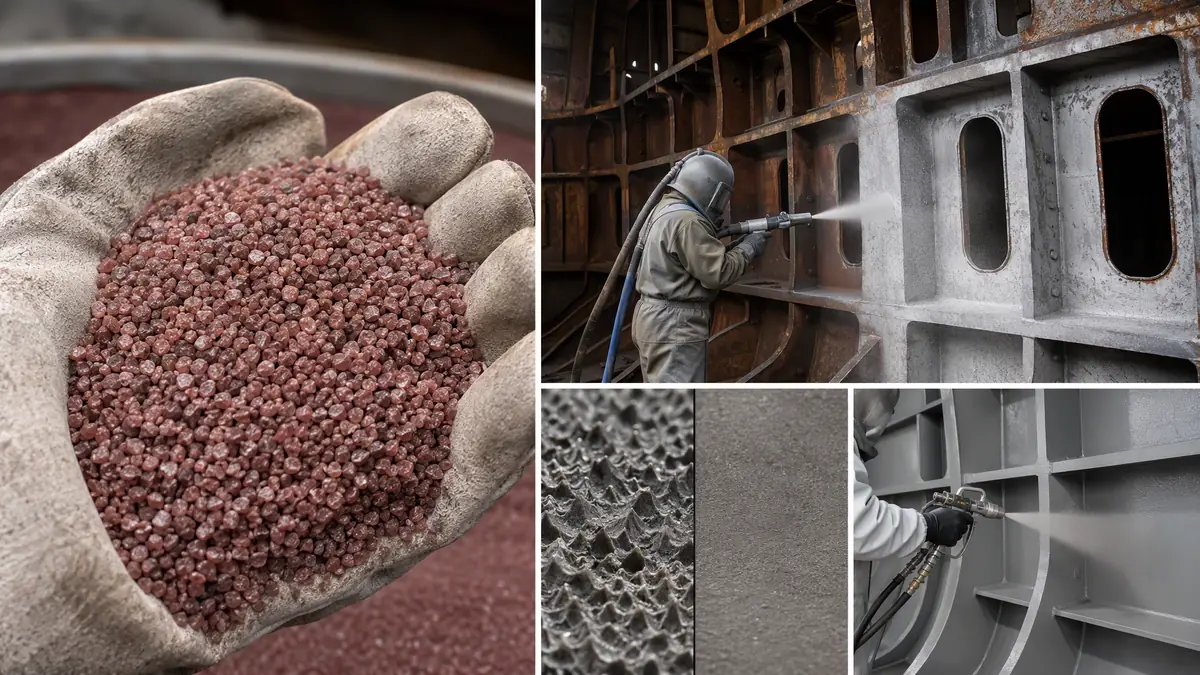
Multi-panel collage showing garnet abrasive, ballast tank blasting, surface profile comparison, and epoxy coating application
FIG. 01A visual guide to abrasive selection for b...

A professional multi-panel industrial collage illustrating the key stages of ballast tank surface preparation for immersion coatings. Panels showcase garnet abrasive, the blasting process inside a tank, a microscopic profile comparison, and the final coating application, emphasizing the importance o

Introduction

Selecting the wrong abrasive for ballast tank surface preparation leads to premature coating failure, corrosion, and costly rework — here is how to match blast media to IMO PSPC requirements and long-term immersion service.

Introduction

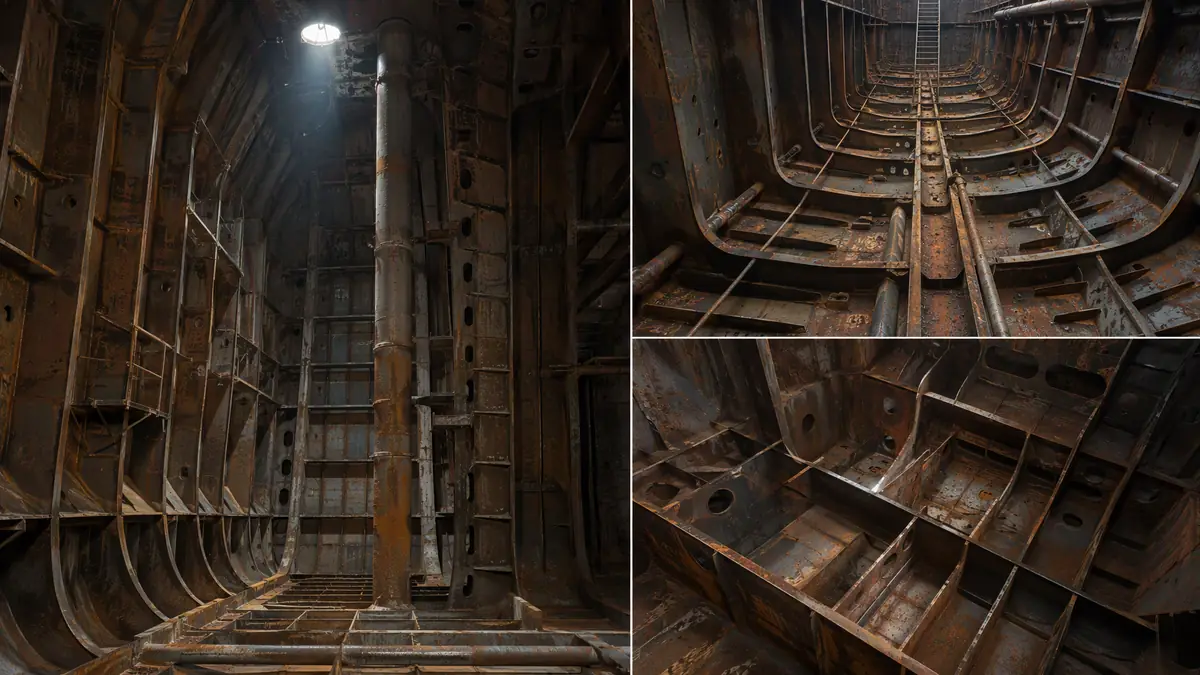
Interior of a rusty, unpainted ship ballast tank showing complex steel structures and surface corrosion.
The interior of a ballast tank presents a severe corrosion environment with complex geometries, demanding meticulous surface preparation before immersion coatin

A wide-angle view inside a ship's ballast tank during construction, revealing a labyrinth of steel stiffeners and stringers covered in mill scale and rust. The dim, confined space illustrates the challenging conditions that necessitate rigorous abrasive blasting for long-term coating performance.

Interior of a rusty, unpainted ship ballast tank showing complex steel structures and surface corrosion.

Ballast tanks represent one of the harshest corrosion environments in marine engineering. Alternating cycles of seawater immersion, atmospheric exposure, and varying temperatures create conditions where coating failure is not merely a maintenance inconvenience — it is a structural and regulatory risk. The International Maritime Organization's Performance Standard for Protective Coatings (IMO PSPC) mandates a 15-year target useful coating life for ballast tanks on newbuild vessels, placing extraordinary demands on surface preparation.

For shipyards, offshore fabricators, and coating applicators, the abrasive used for immersion coating prep directly determines whether that 15-year target is achievable. This article examines the abrasive media choices that support IMO PSPC compliance, the critical surface profile and cleanliness parameters, and the practical trade-offs that procurement and engineering teams must evaluate when selecting ballast tank blast media.

Why Ballast Tank Coating Prep Demands Special Attention

Macro close-up of coating delamination and corrosion on steel caused by embedded abrasive fragment.
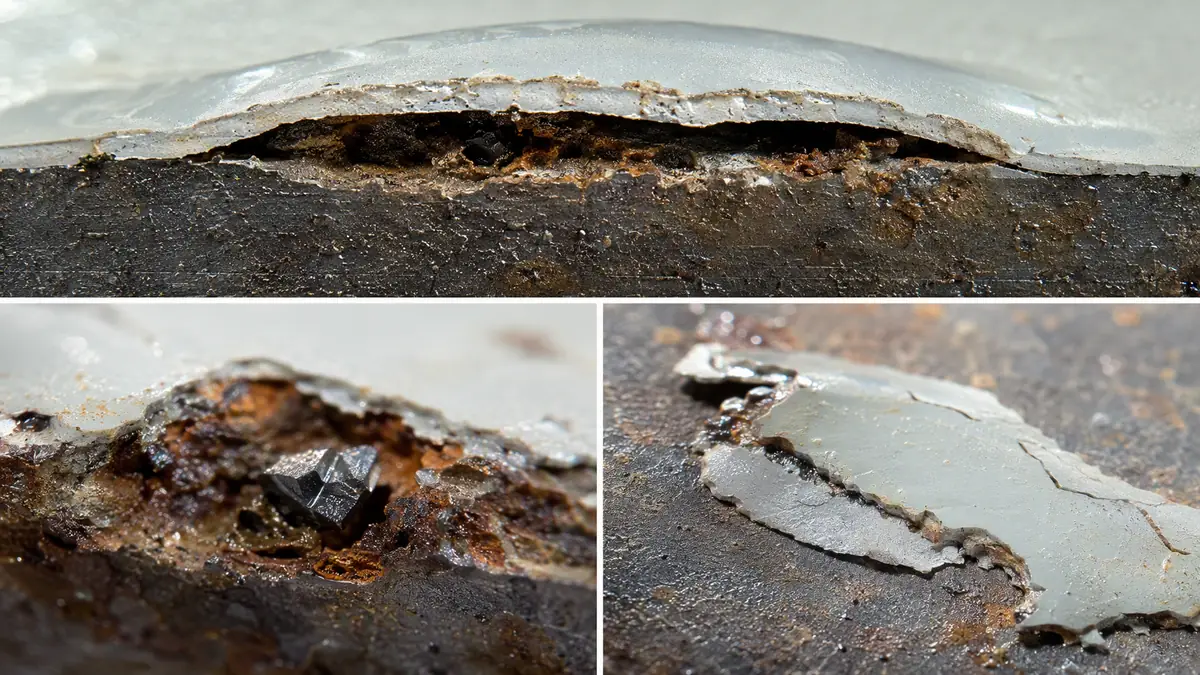
A cross-section view reveals how an embedded abrasive fragment in the steel profile initiates blistering, delamination, and underfilm corrosion in immersion ser

An extreme macro photograph showing a failed epoxy coating system on steel. The coating has blistered away, revealing active rust and a pit caused by an embedded black abrasive particle, demonstrating the critical need for low-embedment blast media in immersion environments.

Macro close-up of coating delamination and corrosion on steel caused by embedded abrasive fragment.

Immersion service differs fundamentally from atmospheric exposure. A coating submerged in seawater faces continuous electrochemical attack, cathodic disbondment risks, and osmotic blistering. Any surface preparation defect — residual salts, insufficient profile, embedded abrasive fragments — becomes a corrosion initiation point once the tank is in service.

The IMO PSPC addresses this by setting stringent requirements:

  • Surface cleanliness: Sa 2½ (near-white blast cleaning) per ISO 8501-1, with no visible oil, grease, dirt, mill scale, rust, or paint residues. Only slight traces of staining are permitted.
  • Surface profile: 30–75 µm for epoxy-based coatings, measured against the coating manufacturer's specification.
  • Salt contamination: Maximum 50 mg/m² of sodium chloride equivalent on the prepared surface.
  • Dust rating: Maximum rating of 2 per ISO 8502-3 for particle size classes 3, 4, and 5.

These parameters are not aspirational targets — classification societies survey against them. An abrasive that cannot consistently deliver this surface condition is unsuitable for ballast tank work, regardless of its cost or availability.

What the IMO PSPC Means for Abrasive Selection

Technician performing Bresle patch salt test and measuring surface profile on blasted steel.
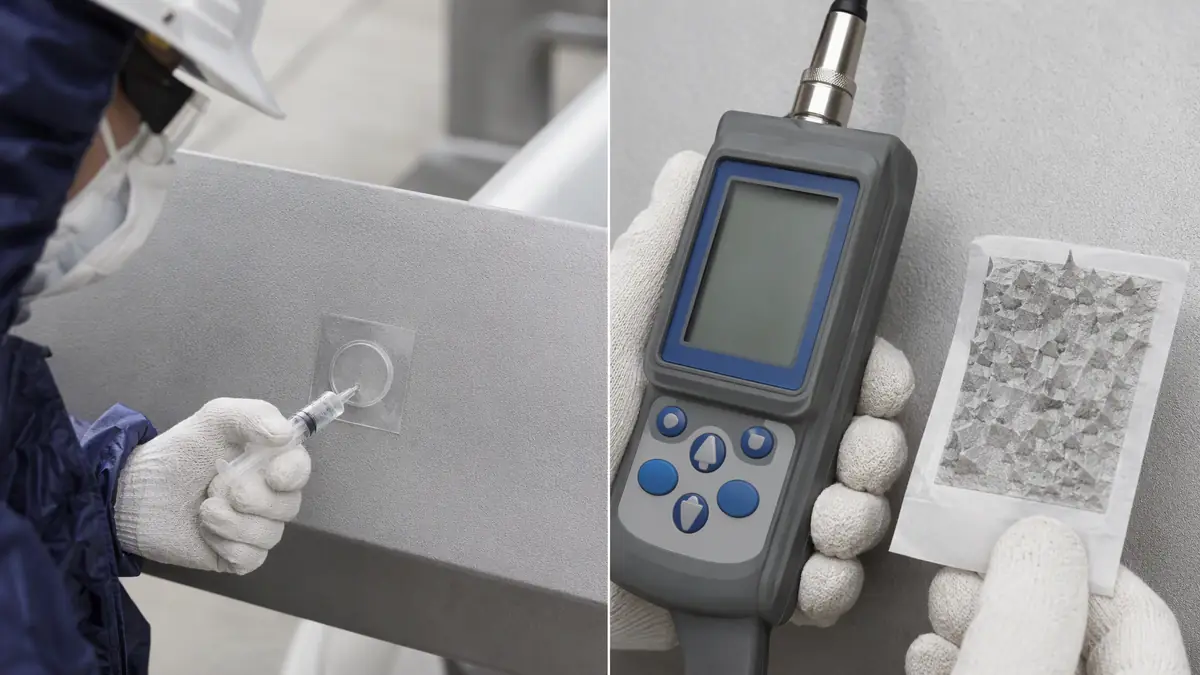
Verifying IMO PSPC compliance: a Bresle patch test for soluble salts and replica tape for anchor profile measurement are essential quality control steps after a

A split-view industrial image showing critical quality control for immersion coating prep. One side shows a technician conducting a Bresle patch test for salt contamination, while the other shows a conductivity meter and a replica tape imprint of a sharp, angular blast profile on near-white steel.

Technician performing Bresle patch salt test and measuring surface profile on blasted steel.

The PSPC does not name specific abrasive types, but its requirements effectively narrow the field. The standard demands a sharp, angular profile for mechanical adhesion, low embedment risk, and minimal contribution to surface contamination. This shifts preference toward certain media and away from others.

Critical Abrasive Properties for Immersion Service

PropertyWhy It MattersPSPC Implication
Shape and angularityDetermines profile depth and peak densityMust produce 30–75 µm profile with sharp peaks for epoxy adhesion
HardnessControls cutting speed and media breakdownHarder media cut faster but may embed if brittle; softer media may not achieve profile on hard steel
FriabilityTendency to fracture on impactLow friability preferred — fractured dust contaminates the surface and raises dust ratings
Chemical compositionPotential for corrosive residuesIron-based media can leave flash rust if not managed; mineral media must be free of soluble salts
Embedment tendencyFragments lodged in the substrateEmbedded particles create corrosion cells under the coating; PSPC expects near-zero embedment
RecyclabilityNumber of productive cyclesAffects cost per square metre and process consistency across large tank surfaces

Abrasive Media Options for Ballast Tank Blasting

Top-down comparison of garnet, aluminum oxide, and steel grit abrasive media.
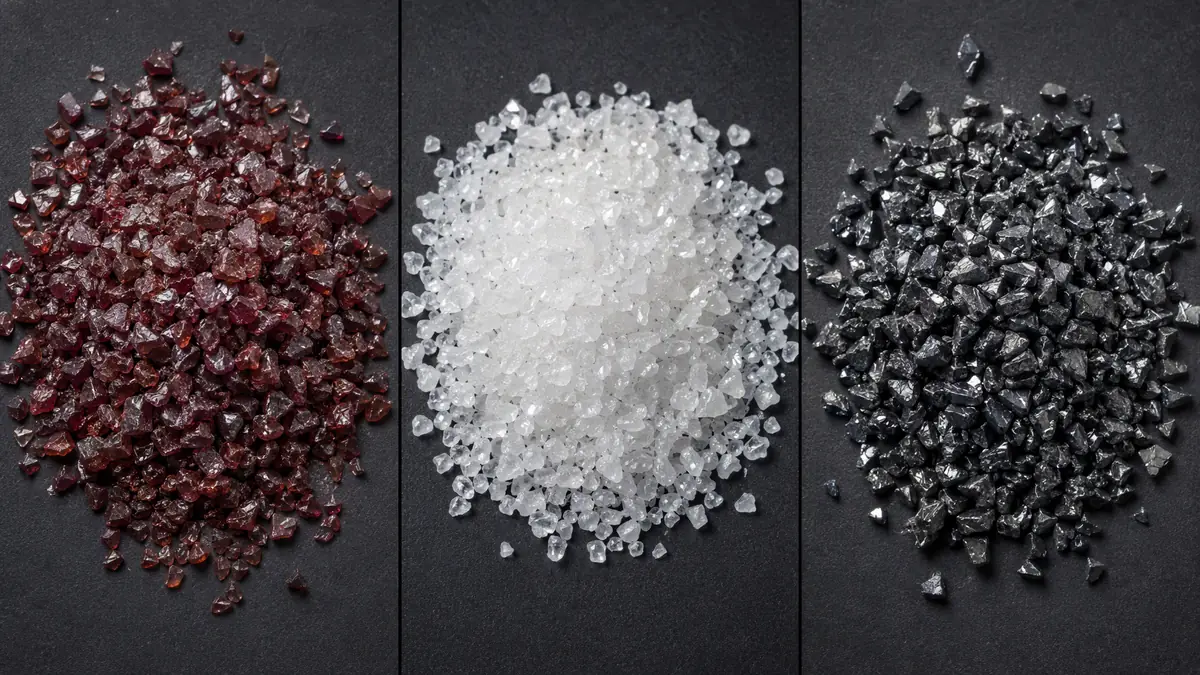
A direct visual comparison of three primary abrasive choices for ballast tank blasting: garnet, aluminum oxide, and steel grit, each offering different properti

A flat-lay industrial photograph comparing three distinct abrasive media types used in marine coating preparation. Sharp, angular grains of red garnet, white aluminum oxide, and dark metallic steel grit are displayed side-by-side, emphasizing their unique physical characteristics for optimal blast m

Top-down comparison of garnet, aluminum oxide, and steel grit abrasive media.

Garnet Abrasive

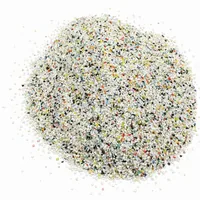
Garnet is widely considered the reference abrasive for marine immersion coating prep. Its combination of natural angularity, moderate hardness (7.5–8.0 Mohs), and low friability produces a consistent, sharp profile with minimal embedment.

Advantages for ballast tanks:
- Produces a clean, angular profile well within the 30–75 µm range
- Low dust generation compared to slag abrasives, helping meet PSPC dust ratings
- Chemically inert — no metallic contamination to promote corrosion
- Excellent salt removal when used with proper blast pressure and technique
- Available in graded sizes for profile control

Limitations:
- Higher initial cost per tonne than expendable slags
- Single-use in most shipyard applications (recycling requires closed-loop systems uncommon in tank blasting)
- Supply chain variability — garnet quality differs by source; confirm the specification before procurement

Aluminum Oxide

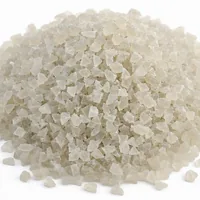
Aluminum oxide offers high hardness (9.0 Mohs) and exceptional cutting speed. It is typically reserved for specialized applications rather than general ballast tank blasting.

When it fits:
- When the substrate is particularly hard or heavily scaled
- When a coarser profile is specified (toward the upper end of 75 µm)
- In controlled shop environments where recycling systems capture the media

Caution for immersion service:
- High friability in lower-purity grades generates dust that complicates PSPC compliance
- Brown fused aluminum oxide can embed in softer steel grades; confirm substrate hardness compatibility
- Cost per square metre is significantly higher than garnet or slag — evaluate total project economics

Steel Grit

Steel grit is the dominant abrasive in automated and centrifugal wheel blasting for shipbuilding, particularly in panel shops and block-stage preparation. Its high density and recyclability make it economically attractive for high-volume work.

Advantages:
- Extremely durable — can be recycled hundreds of times in wheel-blast systems
- Produces a consistent angular profile
- Low dust generation in enclosed systems

Critical limitations for ballast tanks:
- Embedment risk: Steel grit particles lodged in the substrate corrode under the coating, creating pinpoint rust spots. This is a known failure mechanism in immersion service.
- Flash rust: Freshly blasted steel is highly reactive; steel grit residue accelerates oxidation, especially in humid shipyard conditions.
- PSPC compliance: Many coating manufacturers and classification surveyors discourage or prohibit steel grit for final blasting of ballast tank surfaces unless followed by rigorous inspection and removal of embedded particles.

Where steel grit is used in earlier fabrication stages, a final sweep blast with garnet or a comparable non-metallic abrasive is common practice to remove embedded particles and establish the final profile.

Copper Slag and Coal Slag

Expendable slags are widely available and low in cost, making them common in open-nozzle blasting operations.

Advantages:
- Low purchase price per tonne
- High productivity on rust and mill scale
- Readily available in major shipbuilding regions

Significant concerns for immersion service:
- Soluble salt content: Slag abrasives can contain residual salts from the smelting process. Blasting with salt-contaminated media deposits chlorides directly onto the prepared surface — the very contamination PSPC seeks to eliminate. Always verify the manufacturer's salt certification and conduct on-site conductivity testing.
- High friability: Slags break down rapidly, generating fine dust that raises dust ratings and may exceed PSPC limits.
- Inconsistent profile: Rapid breakdown means the working mix changes continuously, making profile control difficult across large tank surfaces.

Copper slag can be acceptable for ballast tank prep only when sourced from a certified low-salt producer and when dust management systems are robust. Even then, many shipyards prefer garnet for the final blast to eliminate salt risk.
Salt Contamination: The Hidden Failure Mechanism

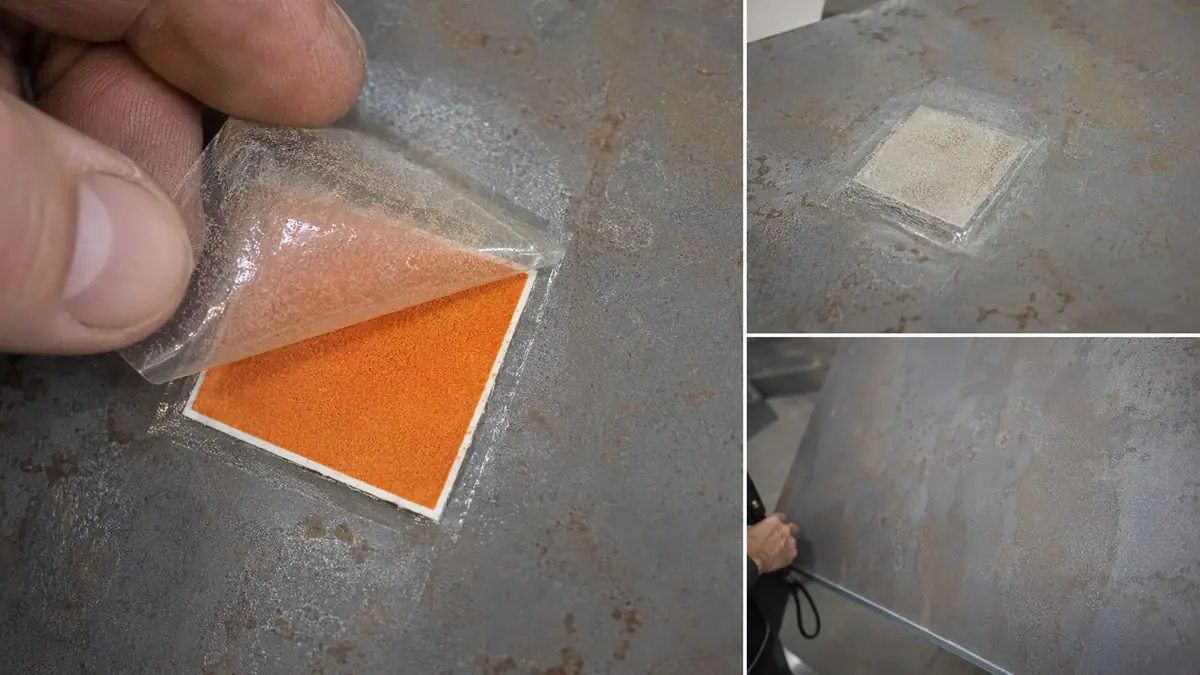
Bresle patch test revealing high salt contamination indicated by orange color change on test paper.
A positive Bresle patch test, shown by the orange discoloration of the test paper, reveals high levels of soluble salt contamination that will cause osmotic bli

A detailed close-up of a Bresle patch salt test in progress. A technician's gloved hand peels back the adhesive patch to reveal a test paper that has turned bright orange, signaling a critical level of chloride contamination on the steel surface that must be addressed before coating.

Bresle patch test revealing high salt contamination indicated by orange color change on test paper.

Salt is the most common root cause of immersion coating failure that traces back to abrasive selection. The IMO PSPC limit of 50 mg/m² is stringent — a level that cannot be achieved if the abrasive itself introduces chlorides.

Practical steps for controlling salt during blasting:

  1. Specify abrasive salt limits at procurement: Request certificates of analysis showing water-soluble chloride content. For immersion service, aim for abrasives with less than 100 ppm water-soluble salts.
  2. Conduct on-site checks: Use the Bresle patch method (ISO 8502-6) or equivalent conductivity testing on the blasted surface before coating. Do not rely solely on abrasive certification.
  3. Monitor blast air quality: Contaminated compressed air introduces oil and water that trap salts. Check air quality at the nozzle, not just at the compressor.
  4. Control the environment: High humidity during blasting accelerates salt deposition. Schedule blasting when relative humidity and dew point conditions are favourable.

Profile Control: Matching Abrasive Grade to Coating Specification

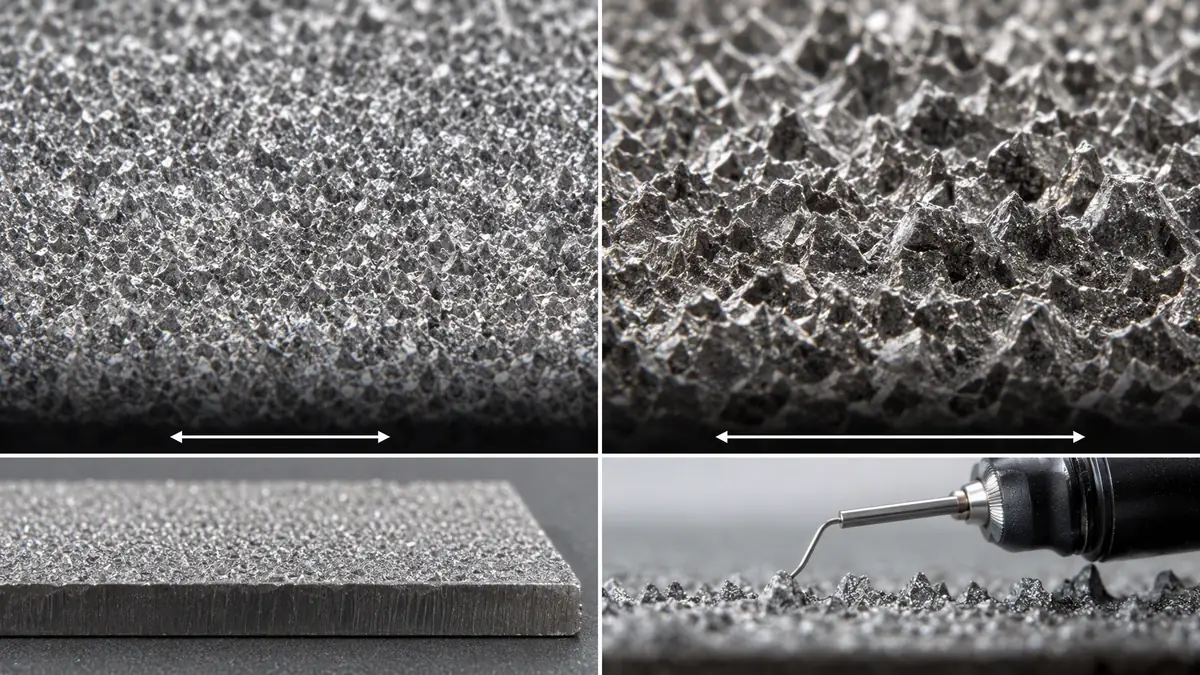
Macro comparison of fine 30-50 micron and coarse 50-75 micron anchor profiles on blasted steel.
A macro comparison showing a fine anchor profile (30-50 µm) versus a coarser profile (50-75 µm), demonstrating the need to match abrasive grade to the specific

A high-magnification split-view image comparing two different surface profiles on blasted steel. The left shows a fine, dense peak pattern suitable for thin-film epoxies, while the right shows a deeper, more aggressive profile. A profilometer stylus is shown measuring the peak-to-valley depth, highl

Macro comparison of fine 30-50 micron and coarse 50-75 micron anchor profiles on blasted steel.

The IMO PSPC profile range of 30–75 µm is broad, but individual coating systems specify a narrower window. Epoxy coatings typically require 30–50 µm for optimal adhesion without risk of peak penetration through the coating film.

Abrasive grade selection guide (typical ranges — confirm against your coating specification):

Desired Profile (µm)Garnet Mesh Size (typical)Aluminum Oxide Grit Size (typical)
30–5030/60 or 80 mesh36–54 grit
50–7520/40 or 30/60 mesh24–36 grit
75+ (check coating limits)12/24 or 20/40 mesh16–24 grit

These are approximate starting points. Profile achieved depends on blast pressure, nozzle distance, angle of attack, and substrate hardness. Always run a test patch on the actual substrate and measure the profile with replica tape (ISO 8503-5) or a surface profile gauge before committing to full-scale blasting.

Common Mistakes in Ballast Tank Abrasive Selection

1. Choosing Abrasive on Price Alone

Expendable slag may appear cheaper per tonne, but higher consumption rates, dust-related rework, and salt-induced coating failures erase any initial savings. Evaluate total cost per square metre of acceptably prepared surface, not cost per tonne of abrasive.

2. Ignoring Embedment in Immersion Service

Abrasive embedment that would be cosmetic on a topside structure becomes a corrosion initiation point underwater. Non-metallic abrasives (garnet, aluminum oxide) are strongly preferred for final blasting of immersion surfaces.

3. Mixing Abrasive Types Without Testing

Some operations mix garnet with slag to reduce cost. This changes the working mix properties — profile, dust level, and salt content all shift. If mixing is considered, test the exact blend ratio on a representative substrate and verify all PSPC parameters before production blasting.

4. Skipping Surface Salt Testing

Assuming that a certified low-salt abrasive guarantees a compliant surface is a dangerous shortcut. Ambient conditions, blast air quality, and handling practices all influence final surface salt levels. Test every prepared surface before coating.

5. Using Worn or Contaminated Recycled Media

In operations where abrasive is recycled, the working mix degrades over cycles. Fines accumulate, cutting performance drops, and contaminants concentrate. Establish a replenishment rate and discard schedule based on sieve analysis and salt testing, not visual appearance alone.

Practical Selection Framework for Shipyards

When evaluating abrasive for immersion coating prep, work through these decision points in sequence:

  1. Confirm the coating specification: What profile range does the coating manufacturer require? This sets the abrasive grade.
  2. Verify PSPC compliance requirements: Is the vessel subject to IMO PSPC? If yes, salt limits and dust ratings are non-negotiable.
  3. Assess the blasting method: Open-nozzle air blasting favours garnet or certified low-salt slag. Wheel blasting in fabrication may use steel grit, but plan for a final sweep blast with non-metallic media.
  4. Evaluate environmental conditions: High-humidity yards need abrasives with low post-blast reactivity. Garnet and aluminum oxide outperform steel grit on this criterion.
  5. Calculate total cost: Include consumption rate, disposal costs, rework risk, and coating warranty implications — not just the purchase price.
  6. Test before committing: Run a trial area, measure profile, test for salts, and inspect for embedment. Confirm results meet the specification before ordering bulk quantities.

Conclusion

The abrasive chosen for ballast tank surface preparation is not a commodity decision — it is an engineering choice that directly determines whether a marine coating system reaches its design life. For IMO PSPC compliance and long-term immersion service, non-metallic angular abrasives — particularly high-quality garnet — offer the most reliable path to achieving the required cleanliness, profile, and salt limits without introducing embedment risks.

Steel grit and slag abrasives have their place in shipyard operations, but their limitations in immersion service must be understood and managed. Where they are used in earlier production stages, a final garnet sweep blast is a prudent insurance policy against premature coating failure.

The cost of the wrong abrasive is measured not in rupees per tonne, but in the cost of re-blasting, coating repair, and potential class survey rejections — expenses that far exceed any savings on blast media.

Frequently Asked Questions

What abrasive is best for IMO PSPC ballast tank coating prep?

Garnet is widely considered the reference abrasive for ballast tank immersion service. Its natural angularity, moderate hardness, and low friability produce a consistent, sharp profile within the required 30–75 µm range while minimizing dust and embedment. It is also chemically inert, so it does not introduce metallic contamination that can cause corrosion under the coating.

Can I use steel grit to blast ballast tanks?

Steel grit is generally discouraged for final ballast tank blasting due to the high risk of particle embedment. Embedded steel grit particles can corrode under the coating, creating pinpoint rust spots and premature failure in immersion service. If used in earlier fabrication stages, a final sweep blast with a non-metallic abrasive like garnet is common practice to remove embedded particles.

Why is salt contamination a major concern when choosing a blast media?

Salt contamination is a primary cause of immersion coating failure. If the abrasive itself contains soluble salts, it deposits chlorides directly onto the steel surface during blasting. These salts then cause osmotic blistering and corrosion under the coating, making it impossible to meet the IMO PSPC limit of 50 mg/m² of sodium chloride.

Is copper slag a safe choice for immersion coating preparation?

Copper slag can be acceptable only when sourced from a certified low-salt producer and used with robust dust management. Its main risks for immersion service are potential soluble salt content and high friability, which generates dust that can exceed PSPC limits. Many shipyards prefer garnet for the final blast to completely eliminate salt risk.
What surface profile does the IMO PSPC standard require?

The IMO PSPC mandates a surface profile of 30–75 µm for epoxy-based coatings. However, individual coating manufacturers often specify a narrower window within this range, typically 30–50 µm, to ensure optimal adhesion without the risk of sharp peaks penetrating the coating film.

How do I select the correct abrasive grade for my required profile?

Abrasive grade selection depends on your target profile. As a starting point, a 30/60 or 80 mesh garnet is typical for a 30–50 µm profile, while a 20/40 or 30/60 mesh is used for a 50–75 µm profile. Always confirm against your specific coating specification and run a test patch on the actual substrate to verify the achieved profile.

What are the key abrasive properties to check for immersion service?

The critical properties are angularity to create a sharp profile, low friability to minimize dust, chemical inertness to prevent contamination, and a low tendency for embedment. The abrasive must be able to consistently deliver a Sa 2½ cleanliness with a sharp, angular profile while not introducing soluble salts or corrosive residues onto the prepared surface.

What is the next step after selecting an abrasive for our ballast tank project?

Once you have identified a suitable abrasive type and grade, the next step is to verify its specification with suppliers. Request certificates of analysis for water-soluble chloride content and compare available products. You can then compare relevant abrasives and enquire for availability and pricing to secure the right media for your project.

Solution

Selecting the right abrasive for marine immersion coating prep requires matching media specifications to your project's coating system, PSPC obligations, and operational setup. Compare garnet, aluminum oxide, and other abrasive options available on SPA2Z to evaluate grades, specifications, and compatibility with your surface preparation requirements. For technical guidance on abrasive selection or to enquire about bulk availability and pricing, contact the SPA2Z sales team with your project parameters.

Get a quote

Get a quote

Tell us what you need. We reply within one business day.

Sending…
Need a price? Ask us here.